

The drone industry loves a headline. From announcements about new aircraft and fresh funding rounds to autonomy breakthroughs and beyond visual line of sight (BVLOS) approvals, the announcements flood industry in boxes. But the work that actually turns those ideas into functioning aviation programs tends to happen in the background, on a much smaller scale. Sentinel Robotic Solutions, known as SRS, operates in that space.
National Missions From a Rural Home Base

This small, woman-owned company sits on Virginia’s Eastern Shore near Wallops Island. Since its founding in 2012, it has grown from a niche unmanned systems shop into a national UAS resource. SRS now supports first responders, electric cooperatives, utilities, private companies, schools and government agencies across the country. Its work spans critical infrastructure inspection, training and program development, emergency response, agricultural operations, FAA regulatory support, aircraft testing and the design of American-made unmanned aircraft.
Despite such a wide portfolio for a company its size, SRS did not set out to collect services. It built each capability by chasing a customer’s problem, for example, when a utility wanted a safer way to inspect power lines or a cooperative wanted to stand up its own drone program instead of relying on contractors. SRS treated these as connected problems all pointing toward the common goal of making unmanned aircraft useful in the field.
That goal keeps SRS’ portfolio diversified and its crews on the road. SRS may be headquartered in a rural corner of Virginia, but its team rarely stays there. Personnel travel constantly, embedding with utility linemen learning to fly around energized infrastructure one week, helping a fire department launch its first drone program the next, then heading out for an inspection job, an agricultural mission, aircraft testing or an emergency deployment thousands of miles from home.
A small core team, backed by contract and on-call pilots, lets SRS scale up fast when a project or emergency demands more hands. That structure creates a real advantage. The people writing training programs are often the same people flying missions. A lesson learned during an inspection, for example, can show up in next month’s training curriculum and feedback from a utility client can change how a crew collects data. In a company of SRS’ size, there is barely any distance between spotting a problem and fixing it.
Buying a Drone Is the Easy Part
SRS has learned, again and again, that buying a drone does not create a UAS program. In fact, the aircraft purchase is usually the simplest step. A real program needs trained pilots, standard operating procedures, maintenance routines, battery management, flight records, recurrent training, risk management and often FAA waivers or exemptions layered on top.
All of this drives how SRS opens client conversations. Instead of asking which drone a customer wants, the company asks what the customer is trying to accomplish. For a fire department, it might mean better situational awareness or thermal intelligence for an incident commander. For a farmer, it might mean more efficient crop treatment. Once SRS understands the mission, the aircraft becomes just one piece of a larger system, not the whole answer.
That mindset has pushed SRS deeper into program development and further from simple drone services. When SRS shows up to help an organization, it aims to build a customer capability/program that can eventually run independently.
Training Built Around the Mission, Not the License
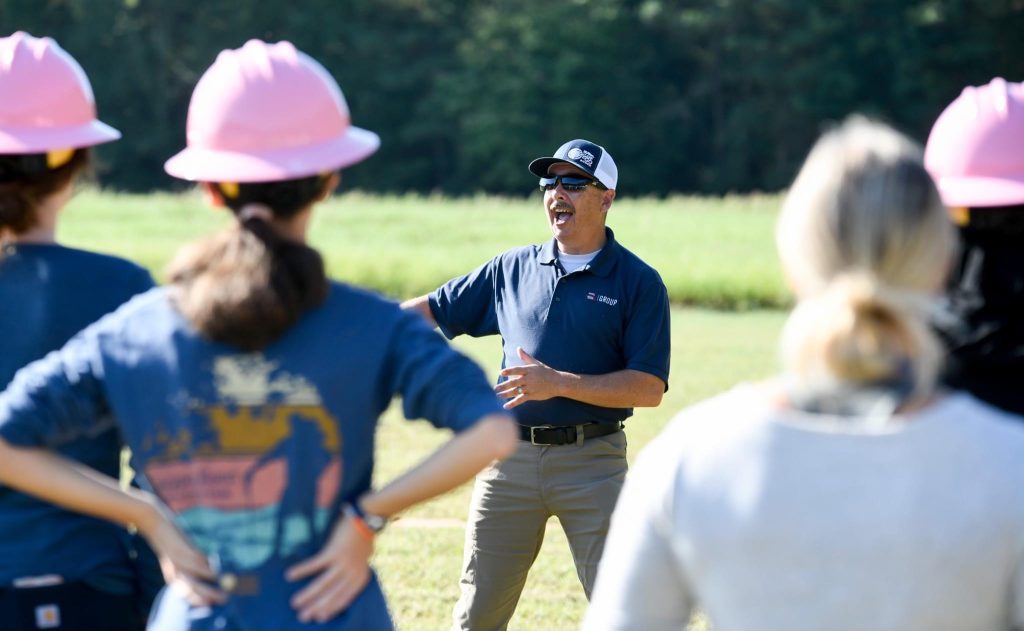
Training has become central to SRS’ work. Since 2017, the company has trained more than 2,000 people, including over 300 utility linemen alongside first responders, government staff, commercial operators and students. The nature of that training has shifted considerably. FAA Part 107 certification still ranks high, but professional UAS work increasingly demands mission-specific skills that go far beyond a basic license.
A pilot inspecting a live transmission line needs different training than one supporting a fire scene, just as a BVLOS infrastructure pilot faces risks that a short line-of-sight flight never will. They may share the same regulatory starting point, but the mission requirements are very different.
For these reasons, SRS has responded by expanding into advanced, mission-specific training. This includes utility inspection, public safety operations, large UAS handling and standardized flight-skills assessment using NIST-developed aerial drone test methods, including Level 1 through Level 3 proficiency evaluations. The goal is for the student to actually perform under real conditions, not just pass a test on paper. As drones take on more safety-critical roles, that kind of experiential competency will matter even more.
Turning Flight Data Into Decisions
Critical infrastructure work shows just how far the technology and the mission have evolved. SRS has run inspection programs using visual, thermal and LiDAR sensors, on jobs ranging from single structures to thousands of utility assets spanning miles of infrastructure. But the company doesn’t measure success by flight hours or photo counts. It measures success by whether the information provides useful and actionable information to asset owners.
A LiDAR scan that generates a massive point cloud without actionable insight hasn’t solved the client’s problem either. That’s why SRS blends aviation training with infrastructure knowledge. A skilled pilot who doesn’t understand the asset can miss exactly the detail that matters. Conversely, an experienced lineman needs aviation skills to collect that information safely. The strongest programs need both.
That maturity carried SRS into BVLOS operations. The company holds FAA authorization for shielded BVLOS work to support linear critical infrastructure. It enables trained crews to cover more ground efficiently. But BVLOS isn’t just about flying farther. It changes the entire risk picture, demanding new approaches to communications, airspace awareness, crew coordination and aircraft reliability. (See prior AG coverage of training for autonomous missions).
The gap between what aircraft can technically do and what organizations are legally or operationally ready to do is one SRS has learned to navigate, whether through Part 107 waivers, operations involving aircraft over 55 pounds, agricultural exemptions or other advanced FAA approvals.
Agriculture, Emergencies and Extreme Altitude
Agriculture has pulled SRS into another fast-changing corner of unmanned aviation. Today’s agricultural drones bear little resemblance to the small quadcopters most people picture. These aircraft can weigh hundreds of pounds fully loaded and carry significant liquid or granular payloads. Operating under FAA Part 137 and related exemptions requires pilots who understand aircraft performance and application rates, calibration, weather and product handling all at once. It’s one more reason the industry is moving past the idea of a single, generic drone pilot. Public safety, agriculture, utility inspection, mapping and BVLOS infrastructure work are becoming distinct professional specialties.
Emergency response highlights a different SRS strength, speed. When wildfire mitigation crews in Utah needed emergency thermal inspection support, SRS mobilized personnel and equipment across the country within about 24 hours. Rapid deployment means coordinating pilots, sensors, batteries, transportation, airspace clearance and data delivery all at once. The urgency never lowers the bar. The Utah team ultimately delivered its findings through GIS-based reporting to support decisions on the ground. That mission reinforced something SRS now treats as a core principle. The value of a drone isn’t the flight itself. It’s what happens with the data after the aircraft lands.
SRS has also tested aircraft ranging from small Group 1 platforms to systems approaching 1,200 pounds, including high-altitude trials near Leadville and Hagerman Pass, Colorado, at elevations nearing 10,000 to 12,000 feet. At that altitude, density altitude and shifting mountain weather stop quickly become immediate operational hazards.
Building an Aircraft, and a Workforce

That breadth of field experience eventually moved SRS from operating aircraft to helping design one. MAGPIE, the company’s American-made modular UAS platform, grew directly out of lessons learned in the field. (See prior AG coverage of the MAGPIE). Building an aircraft raises entirely different questions derived from flying one. Can it be repaired on-site? Can payloads swap easily? Does a feature that looks great in engineering actually make sense to someone standing in a field holding it? SRS’s operational history shapes those answers because the people building the aircraft are the same ones who have spent thousands of hours flying and training others.
At the same time, SRS invests heavily in people who have never flown a drone. Through partnerships with schools and workforce development programs, the company introduces students to UAS and aerospace through hands-on flight paired with classroom instruction. Drones tend to hook students first, then open doors to bigger subjects. Airspace leads to aviation, mapping leads to GIS, autonomous flight leads to programming and thermal sensors lead to physics. As unmanned aviation expands into infrastructure, public safety, agriculture and logistics, that pipeline of trained operators will matter as much as the technology itself.
Small Company, Outsized Role
There’s a common assumption in emerging tech that capability scales with company size. SRS’s track record defies that assumption. A small outfit from Virginia’s Eastern Shore trains thousands of people, helps utilities and fire departments launch programs, inspects infrastructure nationwide, runs BVLOS missions, flies agricultural aircraft weighing hundreds of pounds, responds to wildfires across the country and helps build new aircraft, all without the scale of a major defense contractor.
None of that happened overnight. It grew one customer, one flight and sometimes one problem at a time. Understanding the needs of different mission sets has shaped everything about how SRS grew. The company refused to build its future around a single aircraft or application and instead stayed focused on the mission at hand.
The next decade of unmanned aviation will bring more autonomy, more artificial intelligence, wider BVLOS operations and aircraft that will do things hard to imagine today. Technology alone won’t determine how fast those capabilities become useful. Success will depend on experienced people who understand the mission and willing to bring the aircraft, the regulations, the training and the data together.
SRS may be small, but it is surely mighty. With more than a decade of building, flying, teaching and problem-solving under its belt, SRS epitomizes the idea that size does not define what a company can accomplish. There are still programs to build, pilots to train, aircraft to test and problems waiting to be solved. That is exactly where a small company like SRS can continue to make an outsized difference.