

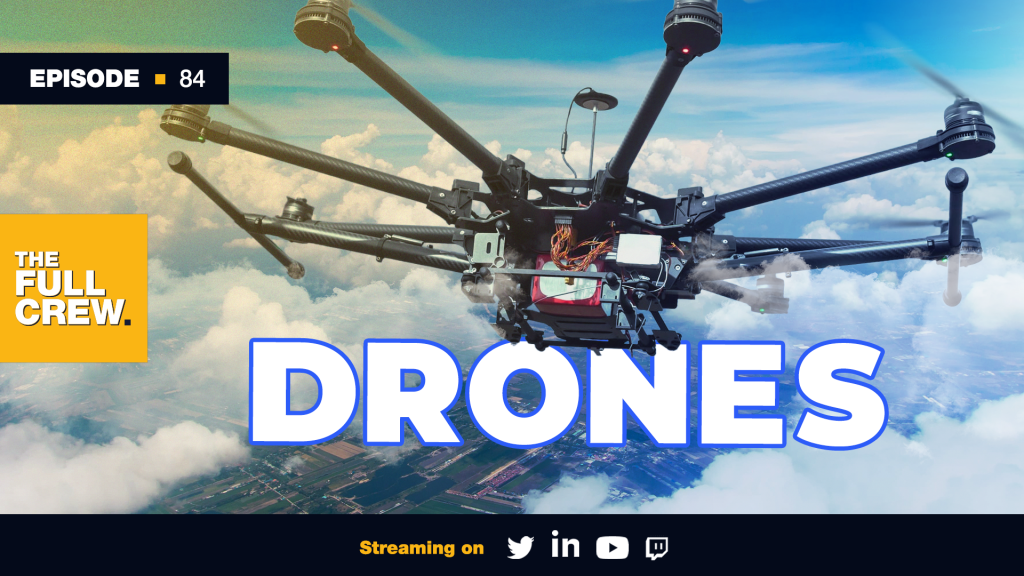
Autonomy Global Network’s Full Crew podcast gathered three drone industry leaders for Episode 84 in a conversation that moved from offshore helicopter conversions to battlefield swarm warfare and heavy lift drones. Host Dan Juhlin, principal of Juhlin Aerospace Consulting and Autonomy Global’s Ambassador for Canada, introduced the three guests: Peter H. Schmidt, CEO of Ironaxe; Robert Cheek, Chief Operating Officer of UVIFY; and Sean D. Pond, co-founder and CEO of DroneLFT. While each brought a different article to the table, together they painted a picture of an industry stretching toward bigger payloads, more autonomous coordination and a defense posture that seems dangerously behind schedule. Here’s what they had to say about where uncrewed aviation is heading and who stands to win the race.
Robinson’s Uncrewed Helicopter Lands on Offshore Platforms
Schmidt opened the discussion with an article about a demonstration that moved rotorcraft conversion from theory into open water. Robinson Unmanned flew its uncrewed R44 Airtruck through a series of offshore cargo tests at Acadiana Regional Airport in New Iberia, Louisiana, on September 2 and 3, where it made repeated approaches to a platform rigged to simulate an offshore deck.
The R44 is the most popular general aviation airframe of the century, with more than 10,000 units sold. In this case, Robinson partnered with New Hampshire’s Rotor.ai to convert the piloted airframe into an uncrewed cargo hauler that can carry a 1,000-pound useful load. For viewers who default to picturing small consumer drones, Schmidt noted, “The world is bigger than that.” The aircraft already flies commercial missions in Brazil, even though it remains in the experimental category in the United States. He called the Louisiana flights “a significant step forward in demonstrating the viability” of autonomous helicopters.
Pond connected the demo to a wider shift among helicopter manufacturers. “There’s just more and more helicopter companies that are going towards this autonomous look,” he said, pointing to Airbus’s uncrewed logistics contract with the Marine Corps. But he also flagged the aircraft’s structural limits. “Helicopters lack volume. They lack space,” he said. Pond also noted that sling-loading cargo out to offshore platforms makes the mission even more dangerous, a problem DroneLFT examined when it explored offshore energy re-supply roughly eighteen months earlier. DroneLFT, now in its design phase, is developing a heavy lift autonomous cargo drone platform targeting payloads of 2,500 to 5,000 pounds, also targeting the offshore re-supply market. Schmidt pushed back on the assumption that electric multirotors will replace helicopters outright.
Cheek offered a counterpoint rooted in his own family history in aviation. “I do come from a family of traditional helicopter pilots,” he said, pulling the conversation more towards the shift toward autonomy versus rotor design. He mentioned his company’s swarm technology focus on the two pillars of autonomy and coordinated numbers, rather than any single airframe’s mechanical advantage.
The exchange ended without resolution, which Schmidt seemed to welcome, and Cheek agreed, saying “We can agree to disagree, which is a great thing about industry and democracy.”
The West Is Losing the Swarm Race

During the second segment, Cheek presented an article on Western unpreparedness for autonomous drone swarms, a topic he said his company can address with unusual authority.
UVIFY, he explained, enabled DARPA’s OFFSET program seven years ago, well before swarm technology became a defense buzzword. “I can’t name one company in the West that is capable or has the experience at building massive and deploying massive swarms,” Cheek said. He added that adversarial nations already hold that capability.
Cheek explained the scale UVIFY has already proven in commercial settings, which now translates to defense. The company effectively created the drone light show industry after adapting technology first invented by Austria’s Ars Electronica. He noted the company holds the Guinness World Record for drone sorties flown in a single week, more than 66,000. This is more than Ukraine and Iran put together,” he said. “Everyone talks. I like to say, ‘big talk, small tech.’”
Pond, drawing on his background as a retired U.S. Army transportation and logistics officer, called the swarm threat “a scary thought” and pointed to the ongoing Ukraine-Russia conflict as proof the danger is not theoretical.
Cheek said lessons from Ukraine’s battlefield, rather than his company’s proprietary position, answer technical questions about swarm communication architecture, specifically whether coordinated drones exchanging signals with each other create an exploitable RF signature for counter-drone systems, versus autonomous platforms that operate without any link back to a ground station. Schmidt responded, “The answer to most of these questions is Ukraine is already doing this.” Mother ship drones coordinate with children drones for target designation without any communications link that a defender could intercept.
Schmidt, whose own company builds drones as counter-UAS interceptors, added that his team has already prototyped inexpensive, scalable countermeasures against multicopter swarms, though high-speed threats remain a tougher problem.
In the end, all panelists agreed that funding must flow for a much larger U.S. defense drone and counter-drone posture. When asked by a viewer where that money will come from, Schmidt quipped, “The Navy will hate me but we need to stop building capital ships.”
DARPA’s Heavy Lift Challenge Redraws the Payload Curve

Pond closed with an article focused on DARPA’s heavy lift competition, held roughly a month before the show in Dayton, Ohio. He explained that most helicopters achieve a lift ratio close to one to one, with the Kaman K-MAX reaching about two to one at best.
DARPA’s challenge asked teams to reach four times a drone’s own weight, an aggressive target intended to signal where the technology needs to go. The winning team, AVIDrone, landed just short at roughly 3.84 to 1. Schmidt and Pond concurred that success was due partly to relaxed requirements rather than a breakthrough engineering feat. They noted the competition only required picking up a payload and flying a short course, without the crashworthiness or repeated-use standards a certified aircraft must meet.
Schmidt, who has spent a decade designing aircraft, sounded a note of caution. “I am very skeptical that you can scale 4x to payloads on the thousand pound class that the R44 is pulling,” he said. He noted one DARPA competitor’s aircraft was built so light it snapped a rotor blade under load, a reminder that stripping weight to hit a ratio carries real engineering trade-offs.
Cheek viewed the result differently. He argued the real story is that small drones are shedding their reputation for small capability. “That assumption is now becoming obsolete,” he said. “Drone performance isn’t just about how big the aircraft is anymore. It’s really about payload efficiency, autonomy, range, communications, and ultimately how many of these systems can we deploy and coordinate at scale.”
Juhlin asked whether the shift toward attritable, mass-produced aircraft demands a rethink of traditional aviation safety standards built around certification and tens of thousands of flight hours. In response, Schmidt described Ironaxe’s own manufacturing approach. “The aircraft we’re flying are 3D printed and the tolerances are much lower than traditional aerospace tolerances, because our software is smart enough to make up the difference,” he said. He added that Ukraine is increasingly 3D printing drones directly on the battlefield.
Schmidt tied the point back to his Airtruck comparison, noting that five AVIDrone-style aircraft could plausibly carry a similar payload to one Airtruck at a fraction of the cost, even if each one is discarded after a single mission.
The show closed with audience questions on weather resilience and swarm funding, where Schmidt suggested forward-deploying small aircraft as expeditionary weather sensors, and argued that acoustic detection remains one of the most weather-resistant methods available against current drone threats.
Each guest left listeners with their bottom lines: Schmidt urged rapid adaptation on both civil and military sides, Cheek pointed audiences to UVIFY and the Drone Code Foundation and Pond closed with “Innovate, pivot, and double time,” urging the industry to move faster and partner rather than work in silos.
Watch Episode 84 of the Full Crew, Drones.
Check out the articles discussed in this show:
- Robinson Unmanned R44 Airtruck Flies Offshore Cargo — AIN Online
- West Lacks Adequate Defence Against Drone Swarms — UK Defence Journal
- DARPA Came Close to Finding a Drone That Can Lift Four Times Its Own Weight — Defense News