

Campus Guardian Angel took the stage and the outdoor demo area by storm at Carahsoft’s inaugural Drones in Public Sector Summit in Reston, Virginia last month. The Texas-based company builds a less-lethal drone response system designed to intercept an active shooter inside a school before officers can reach the scene. Speed, not firepower, drives everything the company builds.
A Mission Born From Tragedy Data

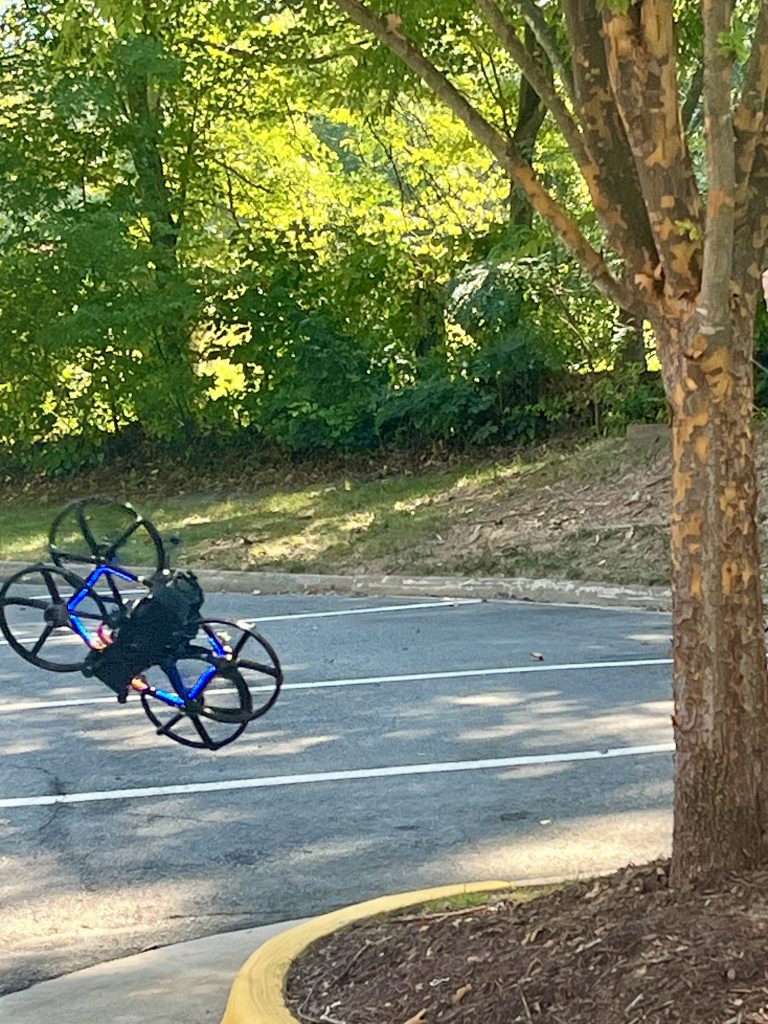
Campus Guardian Angel CEO and founder Justin Marston explained that Campus Guardian Angel installs fleets of less-lethal drones inside ceiling-mounted boxes stationed across a school campus, positioned much like fire sprinkler heads throughout a building. When a threat is confirmed, the drones launch and fly directly toward the danger, carrying pepper spray payloads and utilizing a reinforced nose built to break through windows and physically engage an active shooter. Remote FPV pilots based at the company’s operations center in Austin fly every aircraft, often from a thousand miles away from the campus itself.
Marston said the mission exists because school shootings resolve far too quickly for traditional response times to keep up. He built the entire company around closing that gap. “We think every kid deserves an education free from the fear of mass gun violence,” he said. He added that achieving that goal comes down entirely to response speed.
To explain why this idea took so long to come to fruition, Marston compared it to one of the most familiar pieces of building safety equipment in existence. “It took some guy who had a piano store, worried about his insurance premiums, to invent sprinkler systems,” Marston said. He views his company’s approach as an equally overdue fix that has been hiding in plain sight.
Marsten built the company with chief drone pilot Christian Amari Van Sloon and co-founder Bill King, a former Navy SEAL with 32 years of service. Their design process started with grim research, rather than engineering specs. Marston explained how the group studied the K-12 School Shooting Database, which recorded more than 2,000 school shootings over the past decade, including 352 in 2023 alone, the highest total on record.
He said the team also interviewed parents, police officers and school administrators connected to some of the deadliest shootings in recent American history, including Parkland and Uvalde. One detail from Uvalde shaped the company’s entire design philosophy. “The shooter was outside for two and a half minutes, which is an incredibly long time before we went into the building,” Marston said. “But in most of these mass shootings, the shooting starts and is over in 120 seconds.”
Once he and his co-founders realized speed was the answer, they assembled a team built specifically around elite piloting talent, rather than automation.
How the Drone Response System Works
Campus Guardian Angel’s drones live inside ceiling-mounted boxes stationed throughout a campus, similar in placement to fire sprinkler heads. They stay dormant until a teacher or staff member confirms an active threat, then launch and fly to the danger zone under the control of remote pilots.
The company’s benchmarks reflect the utmost precision: respond within five seconds, reach the shooter within 15 seconds and neutralize the threat within 60 seconds, in any school in the country, from the Austin command center. “It’s really about the timing,” he said. “The timing is so critical.”
Inside a building, the drones travel 30 to 40 miles per hour and can strike at 50 to 60 miles per hour. Outdoors, they can reach speeds up to 99 miles per hour under current FAA limits. The aircraft carry pepper spray payloads and a reinforced nose designed to break through windows and physically engage a shooter. Each unit costs schools an estimated $60,000 to $70,000 dollars to deploy.
Situational Awareness Beyond the Drone Itself

Marston described the system’s operations center as delivering what he called a “mission impossible view” of a live incident. The company builds a digital twin of each school campus and fuses every security camera feed into that model. This gives remote operators real-time visibility across the building. From there, the team coordinates directly with 911 dispatch and with school resource officers through a mobile app, while the drones themselves carry built-in speakerphones so pilots can communicate directly with people on the ground.
Each deployment involves an 11-person response team with defined roles. One person liaises with the school resource officer, another feeds situational awareness to the 911 center, and additional staff track threats and manage camera angles. A tactical medic on the team also helps locate injured students once a shooting phase ends, transitioning the drones into a search role to identify arterial bleeding and route emergency medical services to where they are needed most, including helping with reunification logistics afterward.
Scaling Across States and Campuses
Campus Guardian Angel has already installed systems in schools across Florida, Georgia and Colorado, with Texas and Arkansas next on the rollout list. Marston said the company has run joint exercises with the FBI in Texas school districts, including BoerneISD, and is preparing deployments in Houston’s Spring Branch district and in Westlake through Eanes Independent School District.
The company has also briefed the Republican caucus in the Texas Senate. Marston pointed to Texas House Bill 462 from the last legislative session as an example of how school safety policy and drone deployment strategy increasingly move together. Filed by State Representative Ryan Guillen, HB 462 would have let a “remote-human-operated aerial device” providing less-lethal air-based irritant delivery count toward the armed-officer staffing ratio that Texas law requires at every campus, one unit for every 200 students, in place of a human guard. The bill would also have raised the per-student school safety allotment from $10 dollars to $100 dollars and the base campus allotment from $15,000 dollars to $100,000 dollars. The bill never received a committee hearing and died without a floor vote, but it signals how directly Campus Guardian Angel’s growth strategy is tied to statehouse action, not just district-level purchasing decisions.
Because every drone is manufactured domestically through U.S. contract manufacturers, Marston said the company could scale production to 100,000 units per month by early next year if demand from states and districts continues to build. He does not view the mission as stopping at K-12 campuses since higher education campuses face many of the same threat scenarios. Arkansas State University is close to signing on, and other university demonstrations have already taken place.
Marston also situated the company within a broader shift he expects across the American drone market. Currently, the domestic industry currently leans on a small number of expensive, high-end vendors, while autonomy and sheer production volume, the kind seen extensively in Ukraine’s drone operations, remain underdeveloped in the United States. “Those are two things that I expect we’ll see will change in the next three to five years,” he noted.
For a Summit built around exploring where uncrewed systems fit into public sector missions, Campus Guardian Angel’s session offered one of the clearest, and most urgent, answers: seconds saved by a drone pilot a thousand miles away could someday mean the difference between a contained incident and a tragedy.