

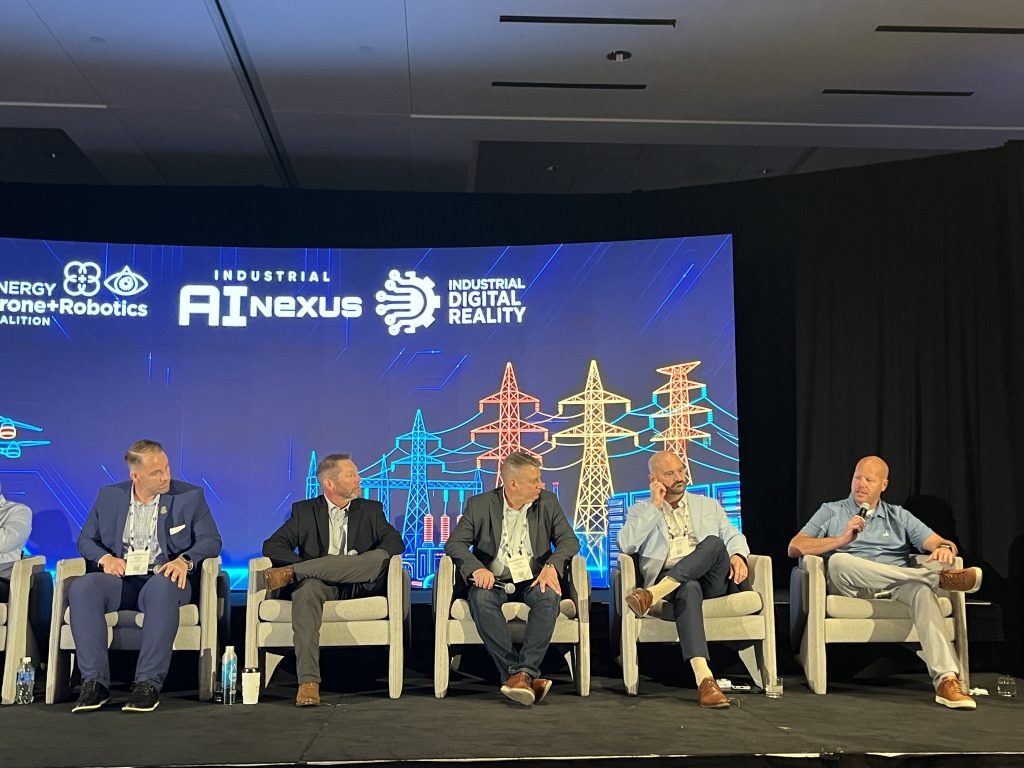
The pathway to routine beyond visual line of sight (BVLOS) drone operations in the energy sector is no longer a question of whether, but of how. The gap between where operators stand today and where Part 108 will take them requires deliberate preparation starting now. That was the consensus from the panel at the 10th Annual Energy Drone & Robotics Summit in Houston, where asset owners from Devon Energy, TC Energy, and Pacific Gas and Electric sat alongside regulators, consultants and technology providers to talk through the practical realities of BVLOS operations and what operators can actually do today, as they prepare for tomorrow.
Where Operations Stand Today
Every major energy operator on the panel is already conducting some form of BVLOS drone operations. In every case a Part 107 waiver provides the mechanism. That process is neither fast nor straightforward. Jared Markes of Devon Energy described spending a week assembling Devon’s first waiver application by pulling documentation from equipment manufacturers, only to receive a call from the FAA asking why he had submitted six separate waivers for different operating areas across the company’s footprint from North Dakota to the Gulf of America.
Devon has since built a library of approved waivers and is currently pursuing a multi-aircraft, single-pilot waiver, a capability that would let one operator run several drones simultaneously. Markes said the 90-day FAA turnaround they’ve been seeing recently is reasonable for a federal agency, and noted that AI tools have meaningfully improved the quality of their waiver submissions by pulling in prior approved language and documented operational history.
TC Energy takes a hybrid approach. Reno Mathews, who manages drone programs across Canada, the US, and Mexico, said TC Energy engaged expert consultants to assemble their initial SFOC and waiver packages while using third-party service providers to execute the missions themselves under company oversight. The long-term plan is to bring those operations in-house.
Kellen Kirk of Pacific Gas and Electric described a more mature program. PG&E has 10 BVLOS dock sites currently active, with drones flying up to three miles from their stations. The company operates roughly 100 drones alongside 35 to 40 helicopters across California, all sharing the same low-altitude airspace. PG&E handles 100% of its own BVLOS operations internally and uses a centralized dispatch system to deconflict its uncrewed and crewed flights.

The AI Factor in Waiver Applications
One dynamic that emerged throughout the discussion is that both applicants and the FAA are now using AI to process waiver applications. Charlton Evans of End State Solutions, who advises companies on FAA certification, described a situation where applications that do not immediately surface the discrete information the FAA’s AI system looks for risk getting deprioritized in the review queue. (See Evan’s prior AG feature on AI in FAA processes).
Evans was direct about the limits of AI for this work. Claude and similar tools can accelerate document assembly and improve consistency, but they cannot replace aerospace expertise when building a full system-level submission. An application that reads as technically coherent to an AI but lacks aviation context will not hold up under review. The FAA’s own AI systems also may carry biases that could affect how applications are scored. Human verification remains essential across the board.
Navigating Beyond Part 107
For operators considering drones above 55 pounds, the regulatory picture gets significantly more complex. Nate Ernst of The Tactien Group walked the room through Section 44807, the existing authority for operating heavier UAS outside of Part 107. Getting a 44807 designation requires a full top-down program examination by the FAA covering standards, procedures and demonstrated aircraft performance specific to the intended operation. Paired with Part 91.13 for detect-and-avoid, it represents the current pathway for BVLOS with larger platforms, but it is administratively intensive and requires operators to prove their concept of operations physically or on paper before receiving approval. (See Ernst’s prior AG feature on 44807).
Part 108, the long-anticipated BVLOS rulemaking, will normalize many of these operations once finalized. The draft NPRM exceeds 400 pages. A companion rule, Part 146, establishes a framework for the digital infrastructure needed to support those operations through a new category of organizations called Automated Data Service Providers (ADSPs), which handle functions like strategic deconfliction, sensor fusion and weather services. Nathan Ruff of AirWise Solutions emphasized that Parts 108 and 146 must be understood together because the aircraft and operator rules in 108 are only functional when the supporting digital infrastructure described in 146 is in place.
Building the Airspace Picture
The technology side of BVLOS comes down to the key problem of knowing where everything is. Thomas Jimenez of uAvionix framed this as electronic conspicuity (EC), a concept where every participant in the airspace voluntarily broadcasts their location so other aircraft and systems can act on that information. He pointed to two recent incidents, the DCA midair collision and a LaGuardia incident as contributing to accelerated regulatory action to require location broadcasting from aircraft and ground vehicles. The FAA is now equipping its first 2,000 ground vehicles to broadcast their positions on 978 MHz UAT.
Jimenez held up a device called the Sky Echo 2, currently approved in Australia and the United Kingdom but not yet the U.S., as a preview of where the technology is heading. This sub-$650, battery-powered, user-friendly transponder requires no aircraft modification and broadcasts anonymized location data. A U.S.-compliant version would be built at uAvionix’s Montana facility once Part 108 and 146 requirements are finalized, Jimenez said.
AirWise’s Ruff added that the goal is not just to see a blip on a map but to see a trusted, FAA-validated blip. AirWise provides the unified operating picture that integrates data from sensors like uAvionix hardware, flight plan deconfliction, weather services and airspace authorizations into a single interface. Ruff reported that as of May 31, 2026, UAS Traffic Management (UTM) systems across active key sites in the US had executed 910,000 strategic deconflictions in the first five months of the year, and that the program had likely crossed the one million threshold by the time of the summit.
TC Energy’s Mathews flagged a persistent gap on the hardware side for large-scale pipeline operators. With over 90,000 kilometers of pipeline and a crewed fleet that shares airspace below 400 feet with drones at a near-100% overlap rate, cost and connectivity constraints on detect-and-avoid sensors remain real barriers. LTE-dependent systems fall short in remote corridors where coverage is inconsistent, and Bluetooth or Wi-Fi broadcast solutions face range limitations.
Preparing for Part 108 Now

Every operator on the panel offered the same message about preparation. Do not wait for the final rule before building the organizational infrastructure it will require.
Mathews described TC Energy’s approach of integrating drones into the company’s existing aviation Safety Management System (SMS) now, even though Part 107 does not require it. The intent is to avoid a cultural and operational shock when Part 108 shifts accountability from the individual pilot to the organization. Evans reinforced this by noting that Part 108 raises the bar significantly with airworthiness and operations elements that do not exist at all under the current framework.
Kirk at PG&E is building a three-to-five year technology roadmap and already applying aviation-grade SMS standards to both internal and third-party operators on its system. Devon Energy’s Markes agreed, while also making the case to keep programs operationally simple. Ground every decision in safety, and use AI as a documentation and tracking tool rather than a substitute for aviation judgment.
Ernst closed the forward-looking discussion with a clear challenge for energy sector operators: the future of BVLOS at scale is not built around a few skilled pilots flying with a stick and a controller. Organizations that are still dependent on a small number of expert operators when Part 108 drops will not be positioned to scale. The infrastructure, the governance and the safety culture need to be in place before the regulation, not after.