
By Philip Hicks, Autonomy Global Ambassador, U.K. & Middle East
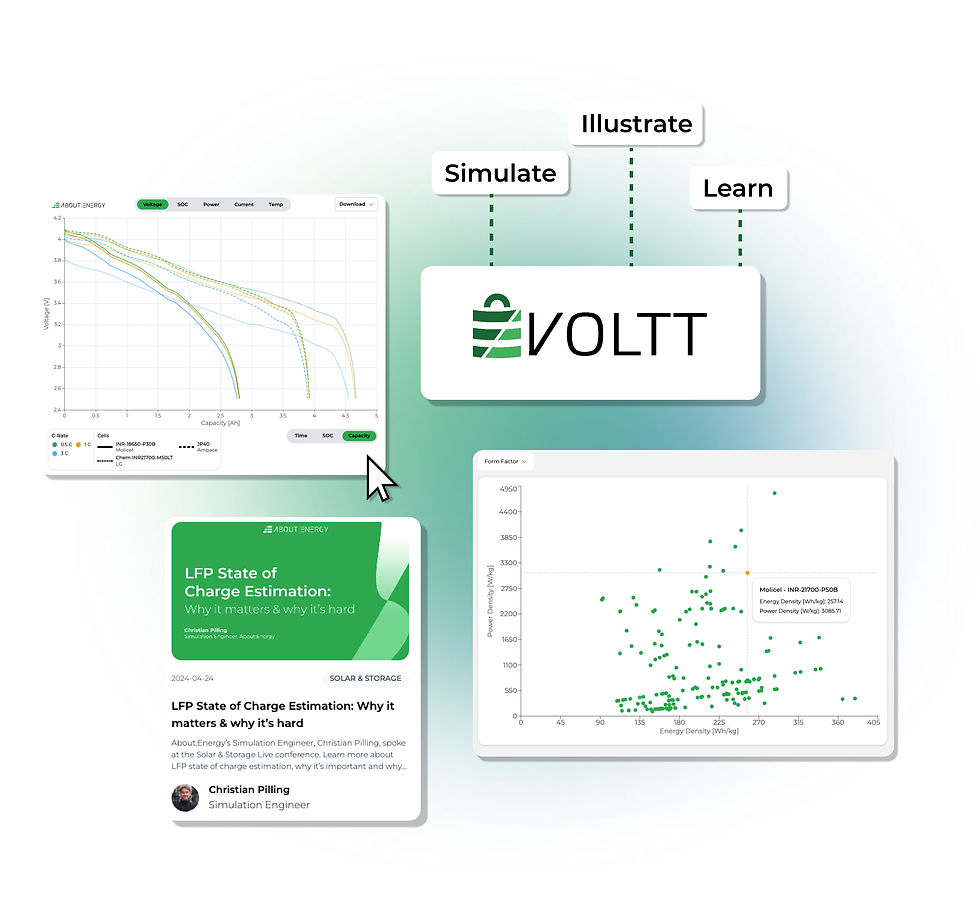
Battery development has traditionally been the single biggest bottleneck in drone innovation. Sparse manufacturer data, opaque models and testing cycles that drag on for months have slowed progress and driven up costs. On the sidelines of DroneX 2025, I sat down with Dr Gavin White, co-founder and CEO of About:Energy, a company revolutionising battery development by replacing slow, expensive physical testing with highly accurate software modelling. We discussed the company’s new approach that has already shaken up the sector: white-box battery models that finally give engineers transparency, control and speed. That vision has now become a reality with The Voltt, the company’s new cloud platform dedicated to cell selection.
The Brains That Energized the Voltt

Dr. White’s journey began during his PhD at Imperial College London, where he focused on the thermal properties of lithium-ion batteries. In the course of his research, he invented a novel method for measuring how batteries generate and dissipate heat, a critical factor in performance and safety that was historically difficult to model accurately.
Recognising that this “black box” of missing data was a universal bottleneck for engineers, White used his thesis as the foundation for a commercial enterprise. He co-founded About:Energy to scale this technology, moving from bespoke lab measurements to a cloud-based software platform (“The Voltt”). This platform provides transparent, “white-box” models that allow companies to virtually prototype and select battery cells, cutting development timelines by up to 70% and eliminating months of trial-and-error testing.
Breaking the Black Box
For years, engineers have been forced to rely on limited data sheets from manufacturers and redundant in-house testing to evaluate cells. The internal workings of these models were effectively hidden in a “black box,” making it nearly impossible to understand exactly how inputs were processed or how results were generated. The result was almost always the same: slow, risky and expensive programmes. The Voltt flips the script on this outdated process.
Built on About:Energy’s validated model library and data derived from thousands of batteries, the platform allows engineers to virtually test and compare cells under real-world duty cycles. By using Equivalent Circuit Models that replicate voltage response and heat generation with high precision, teams can now interrogate parameter sets, explore different architectures, and design virtually. According to Dr White, this shift can cut development time by up to 70%.
Strategic Capability Proven in the Field

The platform’s impact is already visible in the field. In a recent collaboration with EFT Mobility (part of the Quantum Systems Group), About:Energy demonstrated exactly how simulation accelerates drone battery design.
Quantum Systems, a key developer of advanced UAVs for defence and commercial use, validated The Voltt during a recent project. The results were significant. EFT Mobility was able to reduce the cell shortlisting phase by six months and speed up overall pack development by three months. Perhaps most critically for safety and reliability, they improved their thermal issue detection by 20%.
The Voltt represents the next phase for About:Energy as they move from bespoke modelling services into scalable software tools. The platform offers access to over 30 high-performance chemistries, including those from major players like Amprius, Molicel and Enpower Greentech. This variety allows engineers to make “first-time-right” choices that directly improve range, lifetime and charging performance.
“By giving leaders the evidence to choose the right cell at the outset,” Dr White explained, “we’re empowering them to unlock performance and commercial advantage without costly trial-and-error.”
Charging Ahead
The context for this technology is urgent. In an industry where endurance and reliability are the defining metrics for ROI, these time savings and performance gains are transformative. The drone industry is projected to grow at 8–10% annually, reaching a value of $60 billion by 2030. Battery demand will scale even faster as the logistics, agriculture and defence sectors push for longer endurance and higher reliability.
About:Energy is positioning The Voltt at the centre of this growth. By offering validated data and simulation, they are looking to de-risk critical design decisions not just for drones, but across aviation, space and motorsport.
From the concepts introduced at DroneX to the validation by Quantum Systems, it is clear that transparency and evidence are finally replacing guesswork. For the drone sector, the message is simple: battery development doesn’t have to be the bottleneck anymore.
Key Gains with The Voltt
| Metric | Impact Achieved |
| Cell shortlisting | Reduced by 6 months |
| Pack development | Accelerated by 3 months |
| Thermal issue detection | Improved by 20% |
| Development time overall | Cut by up to 70% |
| Cell library access | 30+ high-performance chemistries |
| Validation | Proven in Quantum Systems UAV programmes |
| Market growth context | Drone industry projected to reach $60B by 2030 |