
By Abigail Smith, AG Ambassador – Airspace Awareness
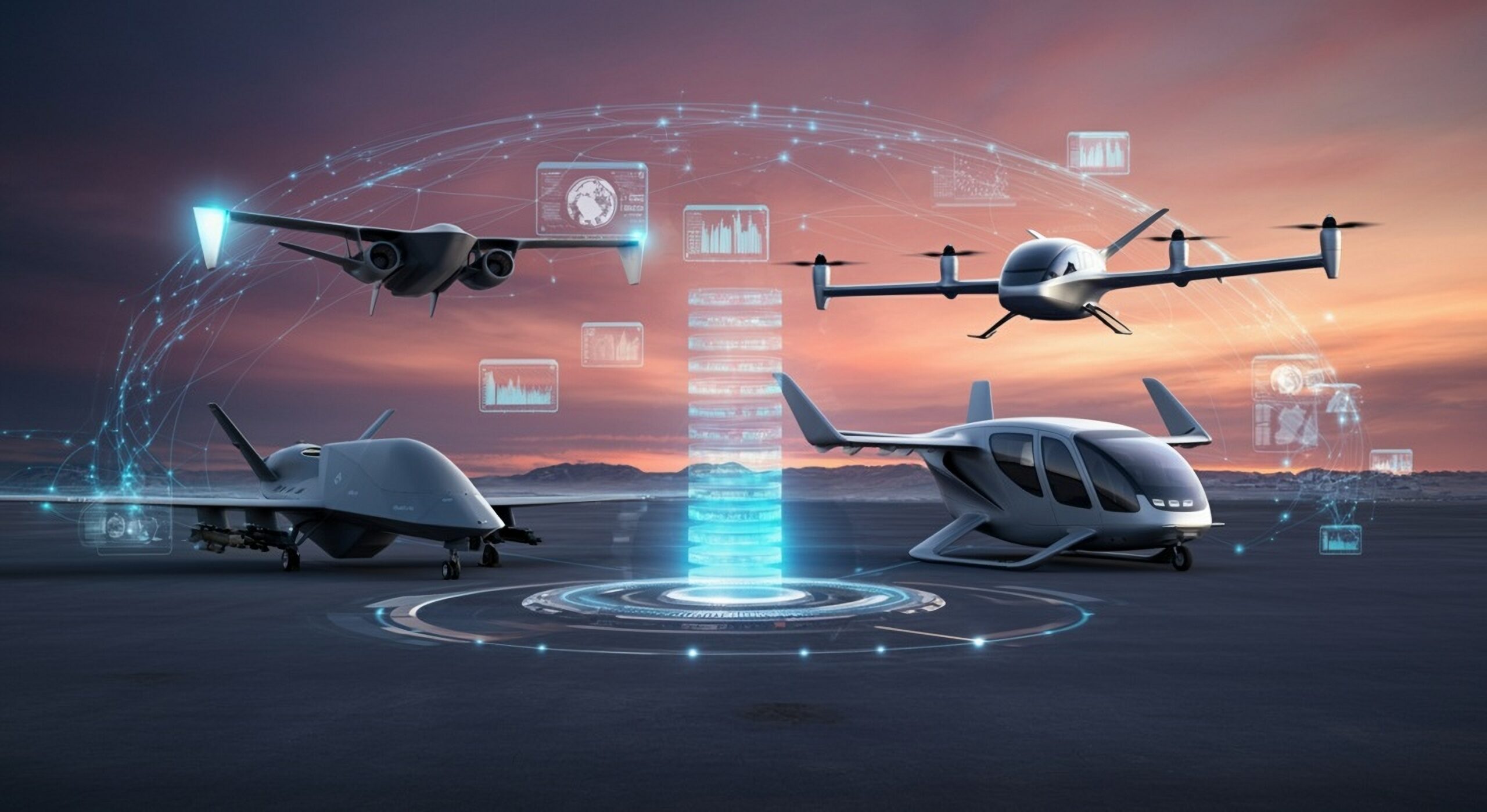
The future of airspace is actually unfolding now, thousands of feet above cities, farmland, forests, coastlines and conflict zones globally. Autonomous aircraft inspect power lines, deliver medical supplies, support disaster response, map terrain and have reshaped logistics and security operations. Despite this rapid progress, one towering challenge remains unresolved: how do we create a truly interoperable global airspace where autonomous and traditionally piloted aircraft operate safely, efficiently and equitably together?
“This is no longer primarily an engineering challenge. It is a governance and coordination challenge,” said Juan Carlos Salazar, Secretary General of the International Civil Aviation Organization (ICAO), in recent remarks on global airspace modernization. “Technology is advancing faster than international alignment.” At Global UTM Association’s Harmonized Skies 2025, Peter Sachs, UTM Policy Expert at Zipline, squarely addressed that gap.
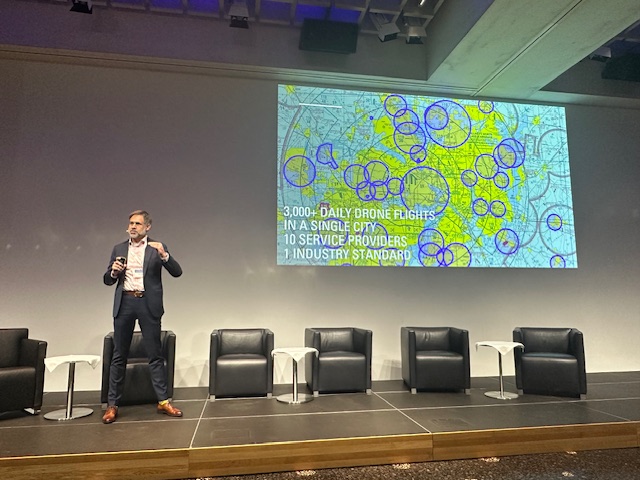
Speaking to regulators, air navigation service providers (ANSPs), manufacturers, defense agencies and commercial operators, Sachs argued that a truly interoperable global airspace will not emerge organically from market forces alone. Instead, he posited, the future of safe, scalable and inclusive aviation depends on alignment around four foundational system pillars:
- Universal Digital Conspicuity
- Operational Interoperability Standards
- Codified Rules of Right-of-Way and Priority
- System-Level Metrics for Continuous Optimization
The industry must view these pillars as enforceable, measurable requirements, not merely as aspirational goals. Because with these pillars and such a serious approach to them, autonomy will scale unevenly, region by region, constrained by incompatible architectures and fractured governance. With them, Sachs believes, aviation will truly enter its next great phase. ICAO, EASA, FAA and global ANSP communities agree.
Conspicuity Is Foundational: If You Can’t Be Seen, You Can’t Belong
In every shared environment (think: roads and waterways), visibility has been the price of entry. In airspace, where closing speeds routinely exceed 400 knots, the same must hold true. Invisibility could be existentially dangerous.
In a future populated by crewed aircraft, uncrewed systems, electric vertical takeoff and landing (eVTOL) “air taxis,” automated cargo vehicles, emergency response drones and national-security platforms, digital conspicuity must be universal and non-negotiable. Every participant must be electronically visible, in real time, to relevant airspace authorities, autonomous systems and human pilots. No exceptions. No dark operators. No privileged invisibility.
“You cannot safely integrate what you cannot reliably detect and identify,” said Margaret Jenny, former President and CEO of RTCA. “Universal electronic visibility is the foundation of scalable autonomy. Without it, interoperability and safety both break down.”
For autonomous systems, the industry cannot view conspicuity as merely a compliance checkbox. It forms the basis of machine trust. Algorithms construct their operational reality from streams of identity, position, velocity and intent. A single non-conspicuous participant degrades the safety envelope. This holds true not just locally, but system-wide. Invisibility injects uncertainty into every nearby trajectory prediction and conflict-resolution routine.
Critically, modern architectures have proven that visibility and security are no longer mutually exclusive. Today’s digital airspace can support:
- Encrypted broadcast identities
- Tiered and role-based access to surveillance data
- Law-enforcement-only decryption authorities
- National-security protections with audit and accountability
“Security and transparency are no longer opposites,” said Dr. Parimal Kopardekar, founding Director of NASA’s Air Traffic Management-Exploration (ATM-X) Program. “We can achieve full situational awareness without compromising sensitive operations.”
A so-called “digitized” airspace that allows non-conspicuous participants is actually not digitized at all. It is automated risk masquerading as innovation.
Interoperability Is the Social Contract of the Sky
Many misunderstand interoperability as forced technology sharing. In reality, interoperability protects innovation by making large-scale coexistence possible. A global autonomous airspace cannot function as a patchwork of vendor-locked ecosystems or incompatible national architectures.

Operators do not need to surrender intellectual property (IP). They must agree to shared operating behavior at system boundaries, including how:
- Identity and authentication are exchanged
- Intent and trajectory are declared
- Strategic deconfliction is coordinated
- Conformance to plans is monitored
- Failures and loss-of-link events are handled
- And when humans intervene
“Interoperability is the price of scalability,” said Terry McVenes, former Chairman of RTCA’s Aviation Advisory Committee. “You innovate freely inside your system, but at the boundary with others, your behavior must be predictable and certifiable.”
Legacy aviation already demonstrates this principle. Aircraft designed on different continents by competing manufacturers operate safely worldwide not because they share designs, but because they obey harmonized operational standards. Autonomy must now inherit, and significantly extend, that model at digital speed.
System predictability remains at stake. Without interoperability, airspace becomes competitive territory. With it, airspace becomes a neutral, trusted, and scalable shared global infrastructure.
Right-of-Way and Priority: The Moral Grammar of Airspace

Every shared environment requires not just technical rules, but a moral and operational grammar. This means we must have a universally accepted logic that determines who yields, who proceeds and who is protected when interests collide. In a global autonomous airspace, these rules can be life-critical. Priority must be absolute, explicit, and machine-executable for:
- Medical and life-saving missions
- Disaster response and humanitarian relief
- Public-safety operations
- Verified, imminent national-security threats
Equally important, everyday non-emergency traffic must operate under equally clear right-of-way logic. This will prevent congestion, unstable densities and inequitable access to shared airspace capacity.
“Machines cannot interpret ambiguity the way humans do,” said Florian Guillermet, Executive Director of the European Union Aviation Safety Agency (EASA). “Priority rules must be digitally explicit and globally harmonized.”
Key policy questions now confronting regulators worldwide include:
- Does verified medical traffic always outrank commercial cargo?
- How do sovereign security overrides propagate across civil systems?
- Who arbitrates competing emergency claims in shared corridors?
- What happens when a human pilot and an autonomous system interpret priority differently?
“Inconsistent priority logic across borders is one of the greatest hidden risks of distributed autonomy,” warned Jeff Poole, former Director General of the Civil Air Navigation Services Organisation (CANSO).
For a machine-managed sky, ambiguity is not just inefficient. It is unsafe. Rules of priority must be explicit, internationally harmonized, digitally enforceable and backed by real legal authority.
You Cannot Optimize What You Do Not Measure
Autonomous aviation today is measured largely by vehicle performance. But the future will be won, or lost, on system performance.
“We are very good at certifying aircraft,” said Dr. Raja Sengupta, transportation systems researcher at UC Berkeley. “We are still learning how to certify airspace as a living, digital system.”
To optimize a truly interoperable global airspace, the industry must agree on, and continually refine, a shared set of key performance metrics, that includes:
Safety & Risk
- Loss-of-separation rates
- Conflict-resolution success
- Emergency response time
- Near-miss frequency across vehicle classes
Efficiency
- Airspace throughput
- Transaction latency between systems
- Routing and energy efficiency
- Mission-completion reliability
Resilience & Security
- Communications and surveillance uptime
- Cyber intrusion detection and containment
- System recovery time after disruption
- Fail-safe and graceful-degradation performance
Equity & Access
- Corridor saturation by operator size
- Emergency access availability
- Rural versus urban service parity
“These metrics must continually feed back into policy, certification thresholds, and operational constraints,” said Lynn Lunsford, former senior FAA NextGen executive and program leader. “Otherwise, we risk optimizing vehicles while destabilizing the system.”
Optimization is not a destination. It is a permanent discipline.
Interoperable Airspace Is Infrastructure, Not a Product
One of the autonomy sector’s greatest structural risks is the temptation to treat airspace integration as a proprietary business advantage, rather than a shared infrastructure obligation. Digital airspace is not an app. It is not a commercial platform. It is a global public utility, on par with GPS and spectrum. Like all critical infrastructure, interoperable digital airspace must be:
- Vendor-agnostic
- Politically neutral
- Technically harmonized
- Legally enforceable
- Operationally resilient
“Airspace works only when no single actor controls the operational rules,” said Roberto Kobeh González, former President of the ICAO Council. “Fragmentation is the enemy of safety.”
Private innovation will always move faster than public rulemaking. But only governments, acting collectively, can create the binding compacts that transform fragmented innovation into safe global systems.
A Choice Point for Global Aviation
Aviation now stands at one of the most consequential inflection points since the advent of radar and jet propulsion. Autonomy of the skies is about more than just new classes of aircraft. It must be about a new operational regime for how we manage the sky itself.
“The technology race is already underway,” said Michael Huerta, former Administrator of the Federal Aviation Administration (FAA). “The governance race is what will determine whether autonomy transforms aviation, or destabilizes it.”
The airspace of the future will not be owned by any single country, company or platform. It will be shaped by the agreements made today that embrace the four pillars of interoperable airspace. We must agree globally on how we see each other, how we cooperate, how we yield when lives are at stake and how rigorously we measure success. The real work of building a truly interoperable global airspace has already begun…and must fully come to fruition so autonomous and piloted aircraft can finally safely fly together.