
By: Dawn Zoldi
Jesse Hamel, founder and CEO of VICTUS Technologies, has spent his entire career preparing for a world where GPS can no longer be trusted. In anticipation of that future, he started VICTUS and created the technology to ensure reliable autonomy that can navigate from orbit to seabed. He calls it “synthetic GPS,” an edge-native mission software that keeps drones and robots on course, even when traditional signals fail. Now, fresh out of stealth mode, Hamel and his team stand ready to put that capability into the hands of operators who need it most.
From Contested Skies to Contested Spectrum
Hamel’s path to founding VICTUS began in the cockpit and command posts of the U.S. Air Force. He retired as a lieutenant colonel after a stellar career shaped by contested airspace, electronic warfare and the uneasy realization that most autonomous systems still assume clean, reliable signals. In those environments, GPS was often the first thing to fail. Even so, it still remained the backbone of navigation for aircraft, drones and robots across every domain.
That disconnect became the seed of VICTUS. Hamel saw operators forced to choose between underutilizing unmanned systems or accepting brittle autonomy that could be blinded by a single jammer or spoofed signal. And Jesse was determined to solve this problem. After turning down a slot at the Air War College and retiring from the US Air Force, Jesse went to MIT for a machine learning fellowship and an Executive MBA. VICTUS was born out of MIT. His experience there allowed him to hone his knowledge of machine learning, develop the business model and connect with world-class engineering talent from MIT.

Hamel now describes that period at MIT and his work on GPS-denied autonomous systems as the bridge between combat aviation and entrepreneurship. That experience crystallized his decision to “spin out” a company dedicated to solving the autonomy problem he had seen firsthand in contested environments.
And so, Victus was born.
“If your autonomy stack collapses the moment the spectrum gets dirty, it’s not combat-ready,” Hamel explained. “For this reason, I framed Victus’ mission as closing the gap between lab-grade autonomy and operational reality.”
The Autonomy Problem VICTUS Was Built to Solve
Hamel defines the core autonomy challenge in stark, operator-centric terms. Without new approaches, one human can realistically supervise only a handful of platforms, and those platforms remain fragile whenever GPS degrades. He summarized it as the “2–10 humans for one platform” problem, meaning too many people, too little resilience and no way to scale autonomy to the fleets that modern missions demand.
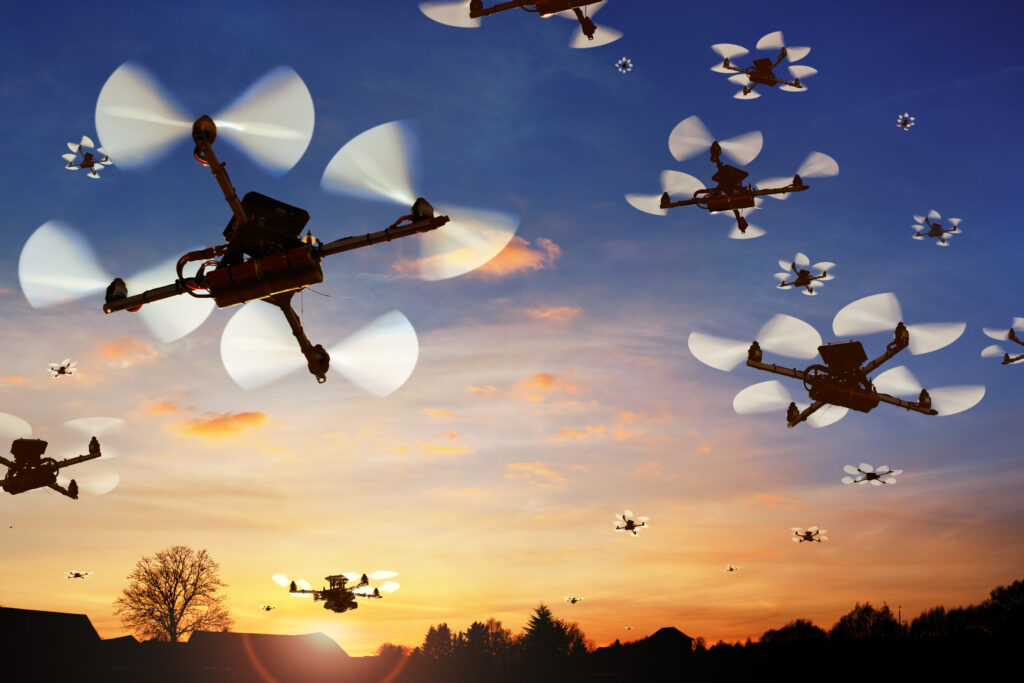
The company is flipping that ratio. With VICTUS software on board, a single human can direct up to 100 platforms, with each capable of holding its mission even when GPS is jammed, spoofed or denied. In a recent DevCon presentation, Hamel described the goal as “hyperscaling autonomy from orbit down to the seabed.” Victus built its navigation backbone, PhantomNAV, to work across uncrewed aircraft systems (UAS), land robotics, maritime surface craft, and space-adjacent platforms.
Inside Phantom Nav: Synthetic GPS at the Edge
PhantomNAV is the mission autonomy and navigation layer designed to turn any vehicle into a GPS-independent teammate. Rather than relying on a single sensor or vulnerable GNSS pipeline, PhantomNAV fuses multiple signals into what Hamel refers to as a “synthetic GPS” to generate a robust state estimate the platform can trust, even when traditional navigation is degraded.
VICTUS engineers built the system around a patent-pending machine learning (ML) state estimator. They pre-trained it in high-fidelity simulation on both synthetic and real-world data, then quantized that down to run on edge compute as small as a Raspberry Pi 4.
In jammed environments, VICTUS has demonstrated up to 20x reduction in navigation drift and sustained 5–10 meter precision over an hour-long mission. They have validated this level of performance through maritime Group 1 UAS flights and TRL-7 testing in operationally relevant scenarios. Hamel framed the payoff succinctly in a recent Palantir talk, “Dynamic simulations can enhance drone resilience, with no GPS needed.”
Built With Operators, For Operators (WOFO)
VICTUS’ designed its software architecture to match how real teams plan, test and deploy autonomy, with and for operators. Mission designers simulated vehicle dynamics and environments in the Palantir Foundry, generated synthetic GPS data,and trained PhantomNAV before pushing it to the edge for live operations. That loop of “simulate, train, deploy, execute,” lets customers pressure-test autonomy stacks against jamming, spoofing and harsh terrain before ever risking a live asset.
To be clear, the company’s “hardware-agnostic, all-domain” stance is not marketing shorthand. Hamel often says “we are eternally hostile to vendor lock.” The team engineered PhantomNAV specifically for denied, austere, maritime and space-adjacent environments to span “orbit to seabed” while plugging into a wide range of platforms and radios.
Hamel often describes the VICTUS’ philosophy in human terms. Autonomy should not replace operators, but give them more, and more reliable, teammates. “Our job is to make every robot, aircraft and device a teammate you can trust when everything else goes sideways,” he said.
The Journey Out of Stealth
VICTUS’ emergence from stealth began in late 2025, after more than a year of building with, and inside, some of the most demanding ecosystems in defense and dual-use technology. Hamel and his core team, which includes expertise from Massachusetts Institute of Technology’s Computer Science and Artificial Intelligence Laboratory (MIT CSAIL), U.S. Cyber Command and leading commercial technology firms, deliberately validated PhantomNAV in real missions before seeking broader visibility.
That approach has resonated with partners. The company already counts more than a dozen memoranda of understanding (MOU), nine accelerator or innovation programs and engagements with manufacturers, operators and integrators across land, sea and air domains. Most recently, Palantir’s DevCon Startup Fellowship showcased VICTUS as part of a select cohort of companies building on the company’s Foundry. At that pitch, Hamel closed his demo on a clear thesis for this new partnership. “VICTUS plus Palantir is how we dominate in the robotics age,” he proclaimed.
NATO DIANA, Dual-Use and Next Steps
VICTUS’ momentum continued through the year’s end with its selection for NATO DIANA’s 2026 Challenge Programme, the Alliance’s flagship accelerator for dual-use deep tech. DIANA chose 150 companies from a record 3,680 submissions across 24 NATO nations. It connects each with accelerator sites, test centers, mentors and military end users focused on ten critical challenge areas, including autonomy and unmanned systems, contested electromagnetic environments and resilient space operations.
Starting in January 2026, cohort companies will receive contractual funding and access to DIANA’s network of 16 accelerator sites and more than 200 test centers across 32 nations. This platform is designed to move promising capabilities from prototypes to fielded systems. For VICTUS, the fit is explicit. PhantomNAV sits at the intersection of autonomy, contested spectrum and resilient navigation, which exactly addresses the operational pain points DIANA seeks to address for NATO as it prepares for more congested and contested theaters.
Although VICTUS’ earliest traction has been in the defense and national security markets, the company’s model is unapologetically dual-use. Any sector that depends on fleets of robots and vehicles in complex environments, such as offshore energy, logistics, inspection, disaster response, all face the same core problem of fragile, GPS-centric autonomy.
Autonomy that Actually Scales
VICTUS enters 2026 with real-world performance data, an operator-driven product, engagement with Palantir and more than 20 other organizations, and having been selected to participate in the NATO DIANA programme – alongside growing traction across defense and dual-use markets. It projects robust growth across the autonomy decade from 2025–2035, targeting an obtainable market of roughly 180 million dollars over its first 36 months and positioning PhantomNAV as the navigation backbone for millions of manned and unmanned platforms. As Hamel puts it, “Synthetic GPS is our way of giving autonomy a backbone that doesn’t disappear when the map gets noisy.” PhantomNAV provides robotic systems with an inner ear – one that provides localization and orientation without reliance on other sensors.
The company’s business model echoes that of successful software-first defense companies. It uses a licensing, deployment and sustainment stack that can start with a single program and expand across fleets, platforms and partners.
The company also plans to advance its current seed fundraising round to scale PhantomNAV and expand deployments with early customers. That capital will support continued R&D on GPS-denied autonomy, hiring across engineering and go-to-market roles and deeper integration with operators and platforms that need resilient navigation in the most contested environments
In the meantime, for Hamel, his mission remains simple. Build autonomy that does not break when it matters most. Keep an eye on VICTUS, as it intends to “empower every robot, aircraft and device with navigation it can trust, so humans can focus on the decisions only they can make.”
Learn more about Victus here.
Stay turned for Jesse Hamel and VICTUS on the February 4th Dawn of Autonomy for “AI and Data” Month.