

By: Michelle Duquette, Autonomy Global Ambassador – Operations
Within the first 15 days of April, I had the privilege of participating in three very different events. Each had its own tone and geography, but all orbited the same central question: What does it actually take to make Advanced Air Mobility (AAM) real?
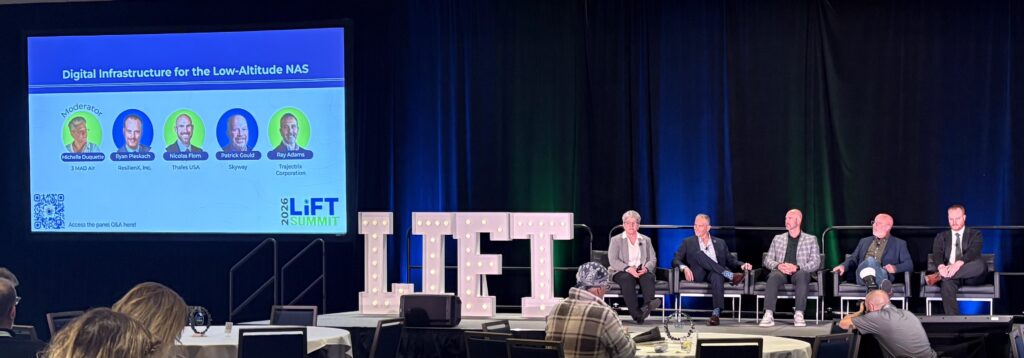
From a clean-energy aviation summit on California’s Monterey Bay coast, to an FAA-sponsored technology plenary in Dallas, to a closed-door strategic workshop in Montreal, the pain points repeated themselves through the various speakers. The system that allows aircraft to operate safely, repeatedly and predictably matters just as much as aircraft certification. AAM at scale depends on infrastructure, governance and interoperability. Right now, all three remain works in progress.
I tend to filter these conversations through three questions: What has to be true for operations to work tomorrow? What has to be true for operations to scale next? And what has to be true for the National Airspace System (NAS) to remain one coordinated NAS as new entrants come online? Across Montreal, Dallas and Monterey, I heard enough to begin answering each one of these questions.
Infrastructure Lead Time Is Strategy
At the LIFT conference in Monterey Bay, the conversation about power moved well beyond the theoretical and into the pragmatics of operations. Utilities, airports, and developers operate on multi-year timelines. This means charging capacity is an engineering question that must also be a strategy decision made years before the first aircraft arrives.
In the real world, if an operator wants a specific turnaround time, the power profile of the charging system has to support it. If the power profile changes, the site design changes. If the site design changes, permitting and construction timelines shift. If those timelines shift, the business model shifts with them. Operational efficiencies depend on making the right strategic decisions in advance.
Airports and communities need an early demand signal. Utilities need an early energy signal. Operators need a planning horizon to which they can commit. Together, these form what I’d call the operational truth of AAM infrastructure. That truth makes public-private partnerships foundational.
Digital Coordination as Airspace Infrastructure
In Dallas, the FAA’s Center for Advanced Aviation Technology (CAAT) plenary, organized by Texas A&M, convened an airspace working group that did what seasoned aviation professionals reliably do. It moved directly toward the questions of interoperability, predictability, and fair access in shared airspace.

That instinct is correct. AAM will not operate in a clean or controlled environment. The low-altitude environment already hosts public safety operations, commercial drones, general aviation VFR traffic, airports, and special use corridors. Keeping the NAS functioning as one coordinated, predictable system, with all of those participants sharing the same sky, requires shared intent, shared awareness, and shared decision-making.
Digital coordination is the layer that makes that possible at operational tempo. It ties together the who, what, where, and when across multiple participants so that even when normal operations break down, there is a common baseline for how every operator in that airspace is expected to perform. Predictability is a core tenet of safe aviation.
Governance of that digital infrastructure continues to actively evolve. NASA’s digital flight rules concept and industry’s learn-by-doing service practices in locations like Tulsa, Syracuse, and Battle Creek, Michigan are laying early groundwork. But the tools alone aren’t enough. People have to agree on rules of engagement, data expectations, and responsibilities. Technology moves faster than the governance frameworks in this space. That gap needs to close.
Weather As a Business Model Problem
Both the LIFT and CAAT conversations treated weather as a business-model constraint rather than solely a technical one. Low-altitude weather intelligence cannot remain a research topic for another five years. (See prior AG coverage of the weather panel at LIFT).
Legacy weather dispatch tools built for airport-based flight planning don’t translate cleanly to the low-altitude environment. Airport AWOS and ASOS sensors provide reasonable coverage at and around the airport surface, but that coverage creates gaps the moment an operation moves beyond the immediate vicinity. The consequences compound quickly. Unanticipated microclimates generate cancellations. Cancellations erode customer trust. Eroded customer trust collapses demand. Operations require decision-quality weather data, at the altitudes and locations where these vehicles actually fly.
Regulatory Velocity Follows Structured Learning
In Montreal, I participated in an Advanced Air Mobility Strategic Workshop orchestrated by Innovitech in partnership with Espace Aero, the Centre of Excellence on Drones, ADM Aeroports de Montreal, the City of Mirabel,and GuaMobility. The event focused on Quebec’s future mobility needs through collaboration and structured partnership. One message came up consistently: regulators move faster when they can learn from repeatable operations and codify what becomes common practice.
That observation assigns a clear shared responsibility. Regulators need usable evidence. Industry needs to generate usable evidence. And both sides need to agree, in advance, on what “usable” means in the near term.
Regulators cannot build a bespoke rule for every experimental idea, and the pace of change in this industry makes that approach impractical anyway. What moves things forward is operators and communities defining viable use cases, clarifying what must be standardized first, and delivering structured, meaningful intelligence to the government decision-makers who shape the next round of rulemaking. I heard that point most clearly in Montreal, but the underlying need ran through all three events.
Workforce Capability Must Match System Complexity
The jobs and training discussion in Montreal reinforced something I observe consistently across both domestic and international contexts. The work is shifting toward cross-pollinated skill sets. The training pipeline has to match that shift before the demand overwhelms it.
Automation changes the human role. It does not eliminate it. Tribal knowledge and domain expertise remain critically valuable during this transition. The instinct to preserve that expertise as a formal requirement is exactly right. Pilots and operators increasingly function as systems managers, overseeing complex, highly automated operations while remaining accountable for safety and mission efficacy. Cybersecurity, data assurance, and technical literacy have become operational safety competencies in addition to IT considerations. Simulation and digital twin capabilities are proving to be practical enablers, supporting academic and vocational alignment, advancing training program development, and generating the kind of structured evidence regulators need to move forward with confidence.
What Comes First, Second, and Third
Big AAM headlines tend to cluster around new aircraft and certification milestones. But real AAM at scale depends on less visible infrastructure being built and operated well. This includes power and facilities, shared rules and oversight, and coordination systems that allow every participant to operate safely and securely within a shared environment.

For operations to work tomorrow, the operation has to be executable inside today’s system. That means clear responsibilities, clear procedures, and a realistic view of what current constraints actually allow.
Minimum enabling infrastructure must already exist where the aircraft will fly. Power, low-altitude weather sensing, and communications that support the operation are day-one requirements, not phase-two considerations.
For operations to scale, lead times have to be treated as strategic constraints. Multi-year budget planning, utility engagement, and permitting timelines mean infrastructure planning can’t wait for finalized route structures or perfect demand forecasts. Coordination must migrate from people to systems as traffic volume and complexity increase. And the workforce capability to manage that complexity is slightly different and must be deliberately built.
For the NAS to stay one NAS, interoperability has to be a hard requirement. The low-altitude environment is mixed and will remain mixed. Fair access and predictable rules of engagement have to be defined. And the shared infrastructure layers, including weather, data assurance, surveillance, security, and coordination, have to be designed to serve multiple missions simultaneously. Shared infrastructure reduces friction. It also reduces cost.
I’ve spent years listening across silos, watching failures emerge at the seams, and translating what I hear into an ordered sequence of what can actually be done first. It is a foundational discipline that saves time, saves expenses, and produces something every community can execute against.
Decision-makers across the industry now speak openly about interoperability as a requirement. The conduits already exist in public-private partnerships like the FAA’s eIPP and BEYOND programs and Quebec’s AAM Strategic Workshops. Industry associations, including the Association for Uncrewed Vehicle Systems International (AUVSI), the Commercial Drone Alliance (CDA), and the Canadian Advanced Air Mobility Consortium (CAAM), all provide open channels for the kind of community learning that shapes the next round of rule-making. (Join me at Law-Tech Connect 2026 at AUVSI XPONENTIAL!)
Get involved. Amplify your voice. It remains the most effective path to the operational truth that makes AAM work, in a timeline the industry can actually benefit us all.