

By Bronwyn Morgan, AG Ambassador, Training and Education
In both the combat and commercial operational environments, air, sea, land and increasingly cyber and space, must operate seamlessly. For this reason, the concept of “cross-domain drone training” has shifted from an experimental idea to an operational imperative. Training schools that support maritime operations, offshore energy, inspection, port security and public-sector emergency services must flex to teach operators to function inside multi-platform, multi-domain mission ecosystems, rather than simply within the confines of unmanned aircraft workflows. Here’s why it matters, timelines to heed and practical tips to get started now.
Why Cross-Domain Operations Matter
The current trend indicates that drone operations will no longer function independently. Modern operations require operators who can link drones to surface and subsurface vehicles and vessel systems, while also securing data transmission across cloud and satellite and maritime communication networks. Industry has shown its support for this direction through recent developments.
For example, Red Cat Holdings launched their maritime unmanned surface vessel (USV) platform which serves as a platform to execute coordinated unmanned operations between air and sea and land domains. The company’s CEO Jeff Thompson announced this milestone as the beginning of their transition from aerial drone specialists to multi-domain defense providers.
While the idea of multi-domain operations (MDO) has its roots in defense strategy, it now also applies to unmanned missions operated by commercial and public organizations. As such, the upcoming generation of unmanned operations will depend on cross-domain interoperability which will apply to both commercial and defense sectors.
This, in turn, creates universal training challenges. According to RAND Corporation, these new technologies give rise to already complex training problems. They become even more complicated when operating across different domains. As per the Red Cat example, maritime training facilities will now need to adapt to new operational requirements across the air and land.
Market Demand & Timelines
Market trends indicate that unmanned systems now function as connected nodes which form an expanding operational network. Cross-domain mission capability has arrived because enterprises need it now, due to risk management requirements and advancing unmanned systems technology advancement.
As one example, the drone operations market for maritime applications reached $800M in 2024 Predictions estimate $2.4B over the next ten years due to growing demand for offshore wind farms, port development, coastal surveillance, and environmental monitoring. Because of this interconnectivity, organizations require professionally certified drone operators as part of their integrated air-sea-land operational frameworks.
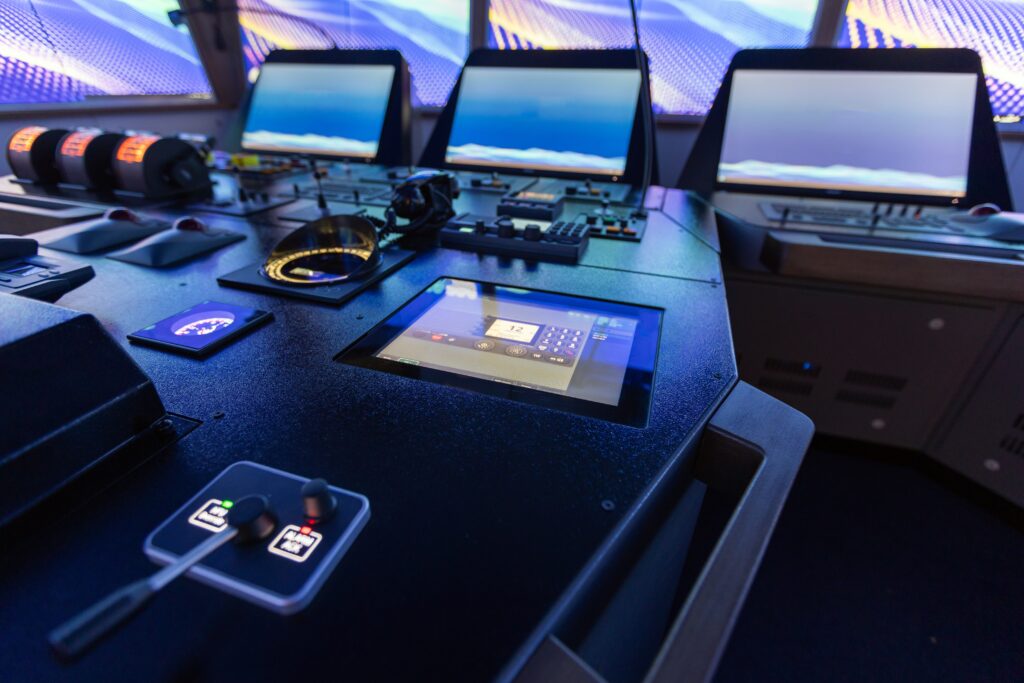
Training programs for maritime operators will now include UAV operations integrated with USVs, data analysis from automatic identification systems (AIS), radar and electro-optical/infrared (EO/IR), satellite systems, as well as maintaining operations during cyber-attacks and GPS signal loss in nautical areas.
Not surprisingly, the market demand for cross-domain drone training has mushroomed in growth in parallel to maritime and offshore industry adoption of connected unmanned systems. The simulation and multi-domain training market segment alone reached $13.7B in 2024. Experts predict it will reach $22.8B by 2034, according to Global Market Insights.
Why simulators? Because these new operational capabilities create additional risks which simulation technology helps organizations to manage effectively, at least in the opinion of Cale Griffith, the Chief Pilot at Canadian RPAS traffic management service provider, AIRmarket. According to Alex Fraess-Ehrfeld, CEO of high-payload manufacturer, AIR6 Systems agrees. “Simulation has become essential for preparing operators who need to work in cross-domain and BVLOS environments,” he said.
Timeline for Cross-Domain Drone Training Adoption
The adoption of complete cross-domain training will follow a predictable three-stage timeline, dependent on regulatory advancements and operational complexity and technological readiness.
Stage One: One-Two Year Targets
Over the next two years, expect that training institutions will add fundamental cross-domain principles to their existing UAS training programs. Some of the early adopters of MDO training included the U.S. Navy & Naval Research Laboratory, the Royal Navy and various offshore energy and maritime security contractors. These first organizations started adding maritime mission training, vessel coordination exercises and basic sensor fusion education in simulated environments. Their initial training programs shared operational understanding between aerial personnel and maritime specialists to develop their ability to perform complex multi-platform operations.
Stage Two: The Next Five Years
By 2030 we should witness substantial changes to the industry. The FAA Part 108 framework will reach mid-stage maturity, which will enable operators to perform beyond visual line of sight (BVLOS) operations, and increase the need for advanced training programs. (See prior AG coverage of Part 108 training). Simulation platforms will transform into mandatory tools for training because they provide authentic environments to practice complex missions that unite UAVs with USVs, radar systems and distributed communication networks in a low-risk manner. Students will practice decision-making through digital replicas of ports, offshore facilities, coastal areas which simulate communication breakdowns, sensor malfunctions, GPS signal interruptions and weather pattern changes. For optimal effectiveness, the training programs will start to include UAV and USV coordinated operations during live exercises.
Stage Three: The Ten Year Horizon
From 2030 and into the next decade, we should start seeing fully integrated multi-domain training. This shift will include a move from experimental simulators for new crews to a fully integrated machine learning operational practice. Operators will need to manage multiple interoperable unmanned systems across air and surface and subsea domains through satellite connections, edge computing, and autonomous decision-support systems.
Training schools that want to stay competitive will need to create immersive multi-domain training spaces that teach students to work as teams, instead of focusing just on individual pilots. The drone pilot profession will transform into multi-domain unmanned systems mission professionals to execute air-sea-land-cyber operations in complex maritime environments. So, how should training schools prepare?
What Training Schools Should Invest In
So, how should training schools prepare? Here’s a checklist of must-buys to get ready for the new MDO training reality.
High-Fidelity Simulation Environments
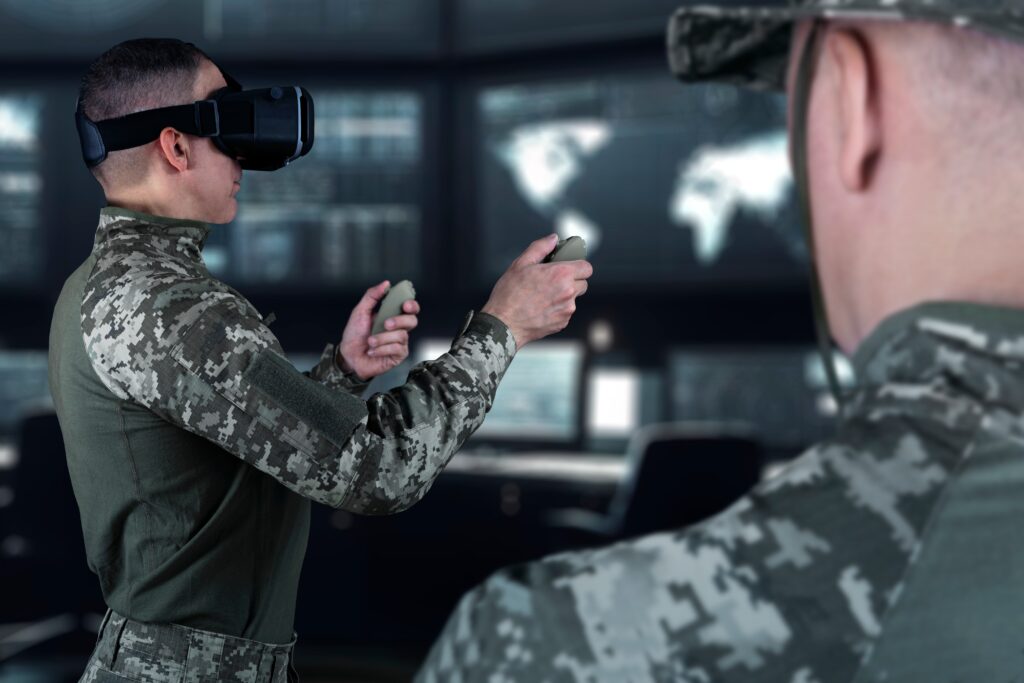
Advanced simulation is an essential element for developing cross-domain operational capabilities. AIR6 Systems demonstrates that simulation has become essential for both BVLOS operations and high-risk missions. As one example, the company’s AirborneSIM platform, together with the UAV Navigation-Grupo Oesía’s VECTOR-HIL (hardware-in-the-loop) system, creates realistic training environments that include GNSS-denial situations, adverse weather conditions, sensor malfunctions, and complex communication systems.
Integrated Ground Control Stations (GCS) and Mission Systems
Operators need to operate from control environments which unite different platforms to execute MDO missions. The GCS system must show UAV telemetry data together with USV navigation information, vessel Automatic Identification System (AIS) and radar overlays and satellite link status. The success of operations will depend on tools which enable platform coordination and link status tracking and vehicle transfer management…and people who know how to operate them.
Multi-Domain Unmanned Systems for Field Training
While simulation technology provides essential training, operators will still need to practice in reality, with actual equipment. Educational institutions should acquire or establish partnerships to obtain UAVs, compact USVs and maritime robotics systems for their training programs. The new USV line from Red Cat addresses the defense market need for systems which enable seamless air-sea operational capabilities and can be useful for commercial and public safety crews as well.
Cross-Domain Curriculum Development
Educational programs will need to move past their current focus on Part 107 basic training. New educational programs for MDOs in air and sea should include these key elements:
- Combining data from AIS systems with radar data and electro-optical/infrared sensors;
- Performing BVLOS in maritime operations;
- Drone cybersecurity principles, data protection workflows, and maintaining communication systems with reduced latency
- Making decisions when working with multiple vehicles; and
- Effective human-machine collaboration.
Distributed, Networked Training Infrastructure
The distributed nature of MDOs requires schools to establish networked simulation portals, remote instruction labs and distributed exercises that enable training between multiple locations. Partnerships will become increasingly important as there are many points of hardware, software, and sector expertise required for effective skill building.
Equipment Checklist
Educational organizations that want to deliver valid cross-domain training programs should consider:
- Digital twin systems and multi-domain simulation platforms;
- Testbeds that use hardware-in-the-loop (HIL) technology;
- Multi-vehicle GCS systems and mission-planning software;
- Training equipment includes UAVs and USVs and other unmanned autonomous systems;
- AIS and radar and EO/IR sensors and LEO satellite communication systems;
- Secure data-transport and comms infrastructure;
- Cybersecurity tools to protect telemetry and secure data;
- New curricula and instructor training for these programs
Why Training Schools Must Act Now
The autonomy market continues to undergo a fast-paced transformation. The upcoming generation of unmanned operators will function as multi-domain mission leaders, instead of operating single-platform systems. The practice of drone training across different domains will become the standard operational requirement within the next few year and fully entrenched within the decade. Educational institutions that teach air-sea-land MDOs will attract major clients from offshore energy, maritime security, port authority operations, coastal monitoring and defense contracting. As part of the MDO training toolkit, simulation-based training can help students learn complex missions that cannot be safely practiced in real environments, while minimizing operational risks. The bottom line: the training and educational institutions that prepare now will surely establish themselves as leaders in the new MDO world.