
By: Dawn Zoldi
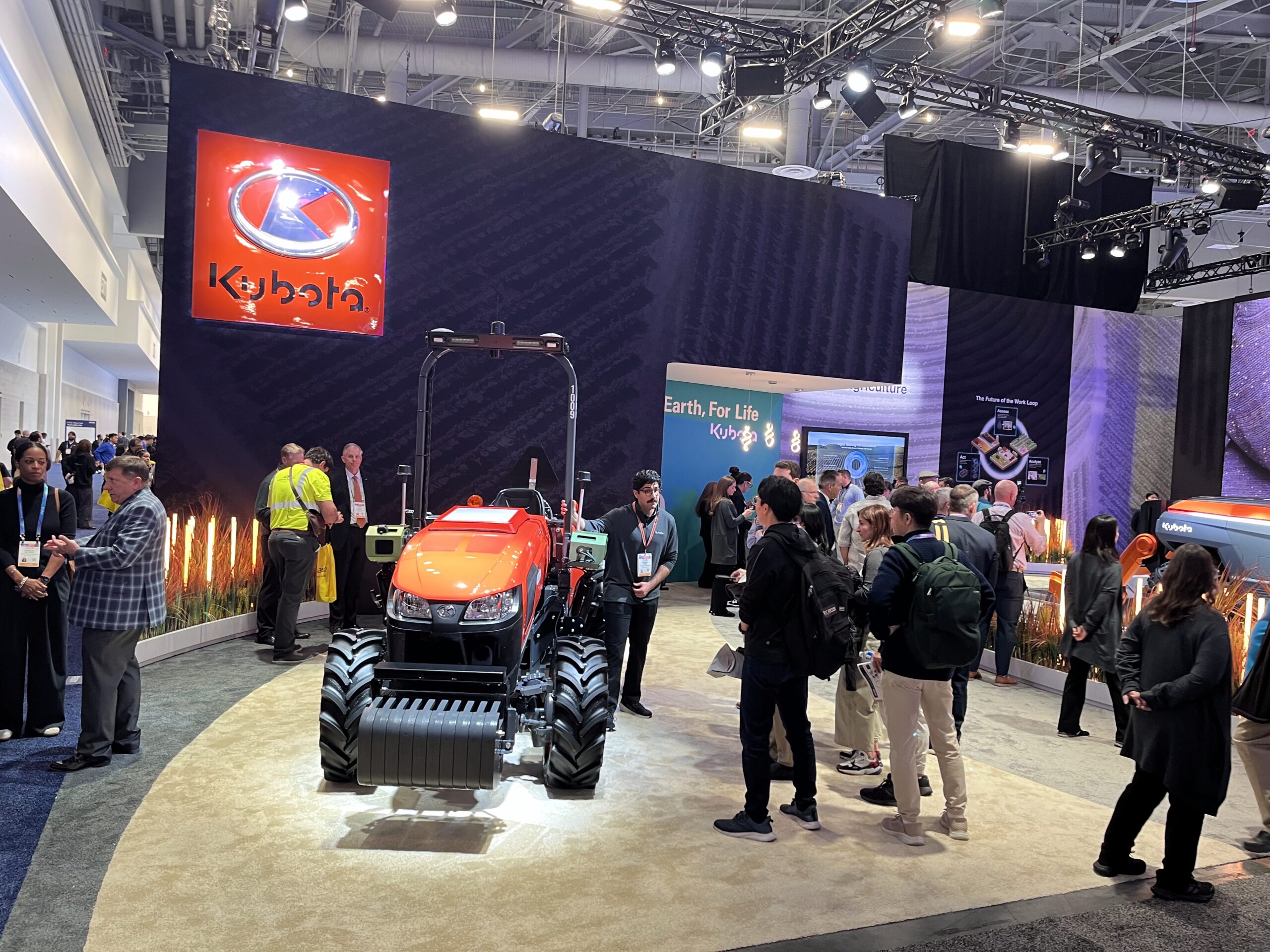
Unlike many other companies on the CES 2026 show floor in Las Vegas, Kubota and Agtonomy were not talking about hypothetical robots or distant roadmaps. They were showing vineyard‑ready, ROI‑proven autonomous systems that are already changing how specialty crops are grown, managed and harvested.
Kubota’s Vision: Smarter, Not Bigger Machines
Kubota used its CES presence to promote a future of agriculture focused on smarter equipment that works together as an integrated, data‑driven system. A series of Kubota leaders opened by tying the company’s 130‑plus‑year history to today’s pressures: labor shortages, aging populations, productivity demands and the need to feed a growing world while protecting the environment. Their mission, as articulated, is to tackle these global challenges with reliable, versatile, intuitive solutions that give farmers more choice and confidence whether they are in the field or managing fleets from afar.
Chief Technology Officer (CTO) Dr. Brett McMickell underscored that autonomy at Kubota is an evolution, not a rip‑and‑replace revolution. He noted the company is “adding the intelligence onto an already proven vehicle,” building on machines that growers know and trust while working closely with customers to both automate existing workflows and “reimagine how they do things using technology.” In his words, “these big challenges don’t need bigger equipment, they need smarter equipment and equipment that works together.” This philosophy shows up in Kubota’s digital twin concepts and multi‑machine operations strategy (more on that below).
The KVPR: Transformer Robot for Specialty Fields
The Kubota team unveiled the KVPR, a transformer‑style robotic concept platform designed to compress multiple machines into one adaptable, omni‑directional, AI‑enabled system. The KVPR’s core capabilities include:
- Vertical and horizontal transformation: The center frame can rise and widen, allowing the machine to adjust track width and height to fit different crop geometries and maintain proper implement position across rows and terrain.
- Dynamic center‑of‑gravity control: A hydraulically actuated system shifts the battery and mass to eliminate the need for heavy counterweights, enabling stable operation with a wide range of implements while saving time and effort otherwise spent swapping ballast.
- Autonomous implement hookup: Cameras and onboard AI identify the correct implement for a given task, align the machine and autonomously connect, minimizing manual hitching, improving safety and accelerating task changes.
- Omni‑directional mobility: Independent wheel control supports auto‑turning, lateral and diagonal movement, boosting maneuverability in irregularly shaped fields and on uneven terrain while increasing operational precision.
Equally important for multi‑machine operations, Kubota’s autonomy team has invested in human‑machine communication. The autonomy department’s lead designer highlighted a language of light patterns that clearly signal system states: startup, ready, transforming, moving and low‑visibility modes that warn nearby workers at night. This visual language is central to Kubota’s strategy of building trust in automation through clarity, safety and predictable behavior.
From Autonomy Global’s lens, the KVPR is less a one‑off concept and more a reference architecture: a modular, reconfigurable robotics platform that foreshadows how future fleets could dynamically adapt to tasks, seasons and crop systems without requiring a different piece of iron for every job.
From Concept to Commercial: The Autonomous M5 in Vineyards
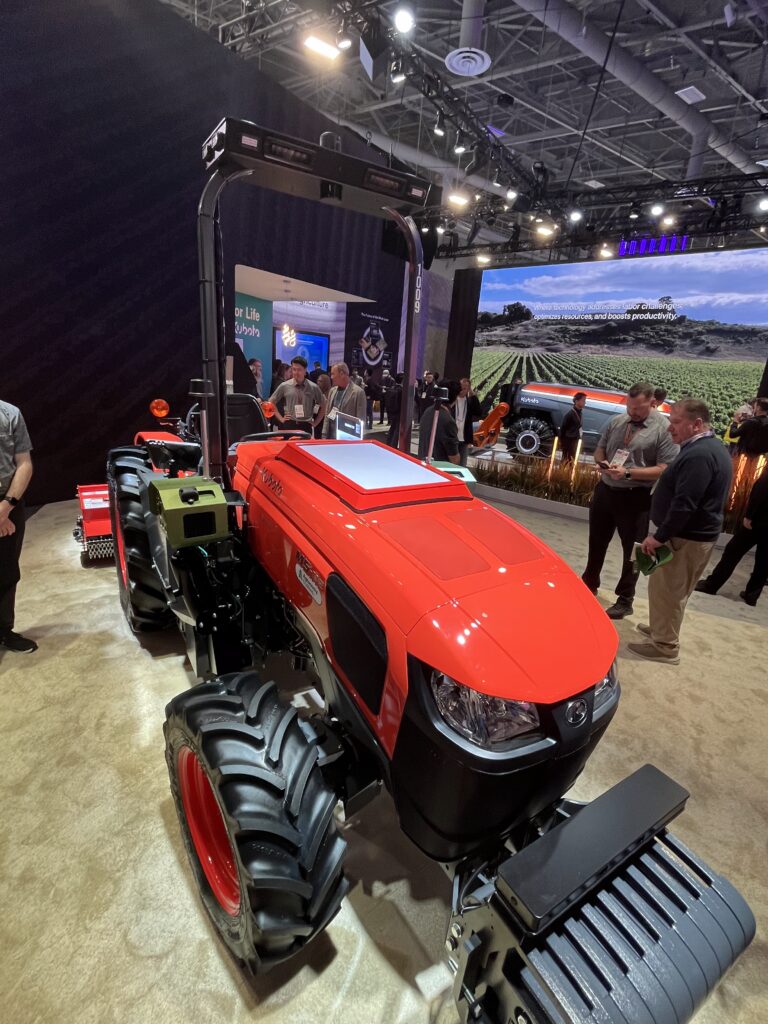
The second act of the showcase pivoted to a commercially available solution: the autonomous M5 Narrow tractor, built on Kubota’s proven 105‑horsepower platform and co‑developed with Agtonomy for specialty crops such as vineyards.
This Smart Integrated Autonomous solution layers Agtonomy’s physical AI and sensor stack onto the M5 to create a high value crop‑ready workhorse that can mow, spray and perform other tasks (e.g., under vine) with consistent precision. Bloomfield Robotics sensors, from a recent Kubota acquisition, ride on the machine to gather high‑resolution crop data as it works, enabling AI‑driven insights into crop health, anomalies and harvest forecasting.
During a CES conversation, Dr. McMickell emphasized that as the M5 performs its operations, it is “collecting data and providing that artificial intelligence recommendation,” going far beyond simple counts to consistent, objective measurements, such as color analysis that replaces subjective human color charts in crops like blueberries. This shift enables downstream optimization: better harvest timing, packaging plans, workforce allocation and logistics, tying operational autonomy directly into the economics and risk management of the farm.
Kubota’s commercial momentum came into sharp focus with Treasury Wine Estates (TWE), one of the world’s largest wine producers, which is working with Kubota and Agtonomy to pilot and scale autonomous tractors across approximately 7,000 acres in California. TWE’s regional manager, Marc di Pietra, called out three pillars driving their adoption: efficiency and bottom line performance, operator safety and environmental impact. From Treasury’s vantage point, autonomy:
- Takes the operator off the tractor, keeping them “out of harm’s way” while eliminating common manual errors and attention lapses.
- Uses multiple optical sensors to maintain 360‑degree situational awareness, detecting objects a human driver might miss, especially in tight vineyard rows where vines can be damaged for decades if struck.
- Allows one operator to manage multiple machines simultaneously, scaling productivity without scaling headcount in a market where younger workers are increasingly unwilling to take on dusty, physically demanding field jobs.
Di Pietra stressed that the goal is not necessarily speed. Tasks like mowing in 6–10‑foot rows cannot tolerate mistakes, so human operators often go slower than the tractor could physically handle. Autonomy, he explained, allows the machine to maintain the optimal speed for quality while the sensor suite protects both people and vines. Even a half‑mile‑per‑hour gain in some operations is a meaningful efficiency boost at vineyard scale.
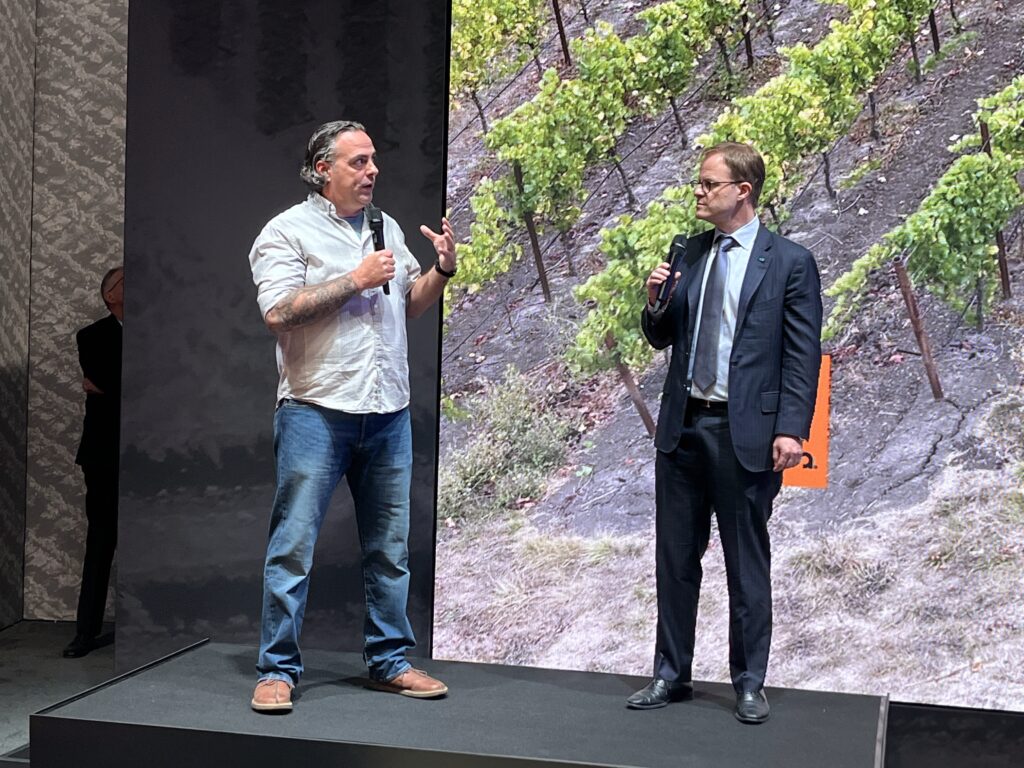
For the 2026 growing season, TWE is receiving its first production run of M5 tractors with the autonomy system enabled, moving from test platforms into real commercial deployment with the expectation of improving the bottom line, safety and environmental performance simultaneously.
Agtonomy’s Physical AI: A Farmer‑Engineer Builds for High‑Value Crops
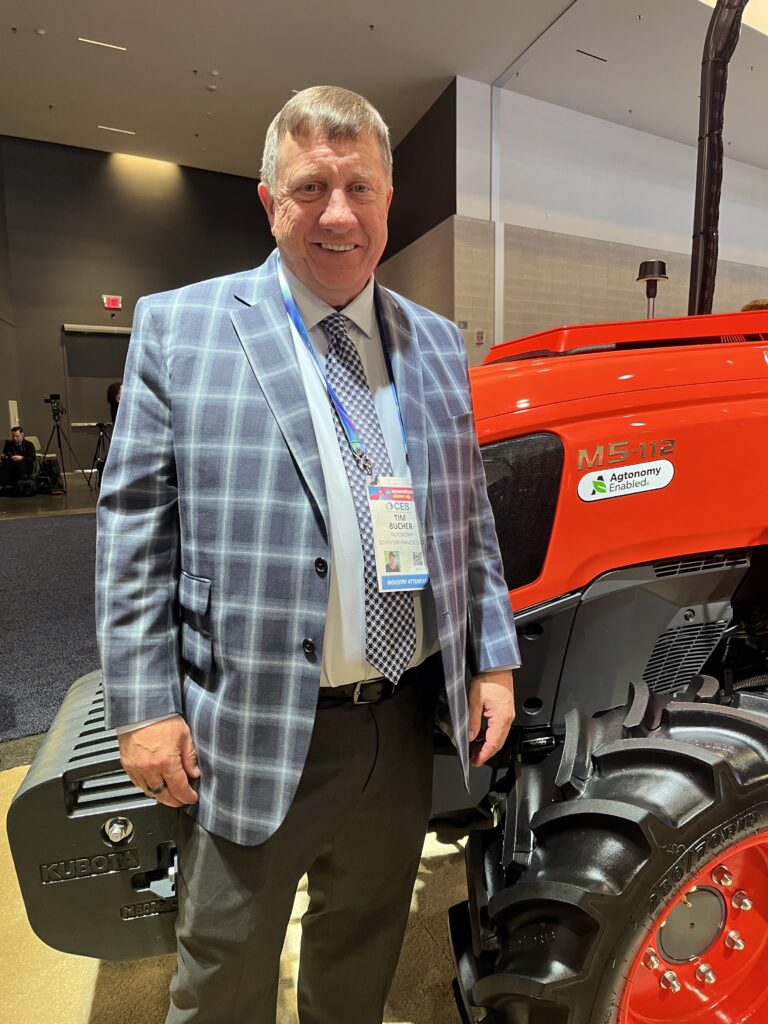
Agtonomy’s physical AI software and sensor‑rich autonomy stack forms the heart of Kubota’s autonomous M5, shaped by CEO Tim Bucher’s unusual dual identity as Silicon Valley product leader and lifelong farmer.
Bucher grew up on a farm, started his own operation as a teenager, and later founded Trattore Farms, a vertically integrated vineyard and olive operation in Northern California. Parallel to this, he built a high‑tech career that included working for Steve Jobs (twice), Michael Dell and Bill Gates, and leading development on iconic products such as the original iPad and the first Xbox.
Despite automating portions of his farm, Bucher saw that the “outside work” in orchards and vineyards remained stubbornly manual, largely because the technology to safely automate high‑value permanent crops was not mature. Unlike broadacre row crops, where taking out a corn stalk is “a bummer” but not catastrophic, damaging a mature olive tree, citrus tree or grapevine can mean losing thousands of dollars and years of production. Permanent crops pose demanding technical constraints:
- They often grow on hillsides and complex terrain where GPS is unreliable and connectivity is intermittent or absent.
- High‑value plants are closely spaced, making acceptable error margins far tighter than in row crops.
By around seven years ago, Bucher saw that compute and sensor technology had advanced enough to address these constraints. At the same time, his own operation was feeling acute pressure from rising costs, especially labor he could no longer reliably hire as younger generations moved away from field work. While peers in Silicon Valley chased self‑driving cars and urban convenience services, he realized that industrial sectors such as agriculture, construction and energy were “more desperate” for autonomy and actually represented larger markets.
His response was to bring “physical AI” to these industrial environments: AI embodied in physical machines that can understand their surroundings, make decisions and execute work without relying on cloud connectivity.
The first prototype, built on his farm with a small group of collaborators, worked “better than expected.” When he showed it to colleagues, his future co‑founder told him, “this is not just about saving Trattore, this is about saving all growers…this is about saving the world,” a realization that led directly to founding Agtonomy in 2020.
Bucher describes physical AI as:
- On‑board brainpower: roughly 250 trillion operations per second of compute on the autonomous Kubota M5, processing about 40 sensors on the vehicle in real time to understand what is in front, behind and to the sides.
- Safety‑first perception: classifiers for humans, animals, trees, plants, vehicles and more, with the ability to simply stop when confronted with an unknown object – a powerful advantage in fields, where halting is safe and practical.
- Continuous learning: as the systems encounter new phenomena, they can be labeled and learned. Bucher cited an example in Washington apple orchards where the system repeatedly saw spider webs across rows; once identified and cleared as safe, the AI learned to recognize webs and continue without escalating to a supervisor.
Crucially, Agtonomy designs autonomy for supervisory control at scale. A single grower can manage fleets of 10, 20 or more tractors from a smartphone or from the comfort of a truck or office, responding only when the system requests guidance. Over time, as the AI encounters more edge cases, those interventions become less frequent, further amplifying labor efficiency.
The ROI case is already emerging in vineyards like Treasury’s. Bucher pointed out that autonomy has delivered unexpected gains such as fuel savings, driven by more precise routing, perfect turns every time and the elimination of human idle time – no checking phones, no unscheduled breaks while the engine runs. At scale, those marginal gains compound, cascading through lower operating costs, improved asset utilization and more predictable work scheduling.
Precision ROI in Vineyards: Time, Money and Safety
The vineyard use case at CES provided perhaps the most concrete proof that autonomous precision agriculture is moving from concept decks to measurable ROI. From the grower’s side, TWE is focused on:
- Operator safety: Removing people from tractor seats in cramped rows dramatically reduces exposure to rollovers, collisions and repetitive‑strain injuries.
- Quality and consistency: Autonomous tractors can maintain optimal speeds and trajectories, delivering work quality that is “just as good, if not better” than human operators while avoiding vine damage that can erase decades of investment.
- Efficiency and data: Machine‑collected sensor data on crop health, canopy, color and anomalies flows into AI models that inform harvest timing, input decisions and risk assessments.
From the technology provider’s perspective, Bucher highlighted some of the specific ways autonomy saves time and money:
- Labor flexibility: Instead of one operator per tractor, a single supervisor can manage multiple machines from a comfortable, centralized location, upskilling existing staff into fleet managers.
- Reduced idle and fuel burn: Perfectly optimized routing and turns shrink unproductive time, while machines do not pause for human distractions, driving meaningful fuel savings Treasury is already observing.
- Adaptive mission profiles: Growers can assign autonomous “transport missions” – moving bins of fruit or materials over kilometers – freeing human labor for higher‑value tasks and compressing harvest and build schedules.
Bucher framed the broader imperative succinctly: industrial markets such as agriculture, construction and energy are “so much more important for our global society” because “we cannot build the world [or] feed the world if we don’t bring this into existence.” In his view, accelerating digital transformation in these sectors via partnerships with OEMs is essential “for the sake of our global society.”
Toward Multi‑Domain Operations: Ground Vehicles, Drones and Persistent Data
Both Dr. McMickell and Bucher hinted at a future in which today’s autonomous tractors are just one node in a broader multi‑domain autonomy ecosystem that spans ground vehicles, aerial drones and rich digital twins.
Kubota already has operational drone programs in Asian markets, with integrated systems in Japan and Thailand and a “farm of the future” in Thailand where water control, crop production and risk prediction are tied together. Those platforms already integrate third‑party sensors and data feeds for water management in rice paddies, weather prediction, satellite and GIS data, and risk assessment for pests and diseases.
On the CES floor, Kubota’s digital twin demos visualized a world in which real‑time and persistent data from autonomous tractors, fixed sensors and potentially aerial drones are fused into a single operational view. Using these, managers can “assess, analyze and act anywhere, anytime,” using AI‑derived insights to make smarter decisions faster.
Dr. McMickell noted that in North America, Kubota is currently concentrating on vehicle‑based sensing on platforms such as the autonomous M5, but the existing drone integrations in Asia show a clear path to full multi‑domain orchestration where aerial views and ground‑level perception reinforce each other.
For Autonomy Global’s audience, several implications stand out:
- Data gravity moves to the field edge: Tractors and robots become high‑bandwidth data collectors, not just power units, with on‑board AI distilling insights where connectivity is weak and syncing to cloud platforms when possible.
- Standards and interoperability become strategic: As OEMs like Kubota, software providers like Agtonomy, and sensor companies like Bloomfield converge, common data models, APIs and safety frameworks will determine how quickly multi‑domain ecosystems can scale.
- Policy and certification will need to span domains: Regulatory frameworks that currently treat drones, tractors and ground robots in silos will need to evolve toward integrated safety and operational concepts that reflect mixed‑fleet, mixed‑domain operations on commercial farms.
Standing amid the bright lights of CES, Kubota brought forward a blueprint for how physical AI, embedded in trusted machines and coordinated across domains, can solve the labor, safety and sustainability challenges that define the future of agriculture. For Autonomy Global readers tracking the convergence of robotics, AI and critical infrastructure, Kubota and Agtonomy’s collaboration is a live case study in how to move from flashy autonomy promises to durable, multi‑stakeholder value, one vineyard row, and one autonomous mission, at a time.