

The Department of War’s Joint Interagency Task Force (JIATF) 401 has released its 2026 Counter-Small Unmanned Aircraft Systems Quick Reference Guide, an 89-page practical resource for the Joint Force and broader counter-UAS community. The guide addresses a continually evolving threat environment in which small drones have become increasingly accessible, adaptable and capable of supporting surveillance, disrupting operations and conducting attacks.
JIATF-401 does not present the guide as doctrine, a technical manual or a one-size-fits-all answer to the drone threat. Instead, it serves as a practical reference covering common terminology, threat types, counter-sUAS systems, tactics, battle drills, reporting procedures and lessons learned. Its purpose is to help leaders and operators understand the C-sUAS landscape, identify options suited to their missions and apply current operational experience. It identifies RF-Cyber takeover technology as a key component of any layered defense.
From First Principles to Practical Reference

The Quick Reference Guide complements the more foundational thinking reflected in JIATF-401’s broader counter-UAS work. (See prior AG Coverage of JIATF 401’s “First Principles” Handbook). Its value lies in moving from enduring principles into operational application, which includes understanding the threat, identifying critical assets, developing layered defenses, coordinating authorities, selecting appropriate mitigation mechanisms and reporting incidents rapidly.
The guide emphasizes that no single capability resolves the counter-UAS challenge. Effective defense integrates passive and active measures into an installation or unit’s force-protection framework while accounting for the threat, terrain, electromagnetic environment, operational priorities and applicable engagement authorities.
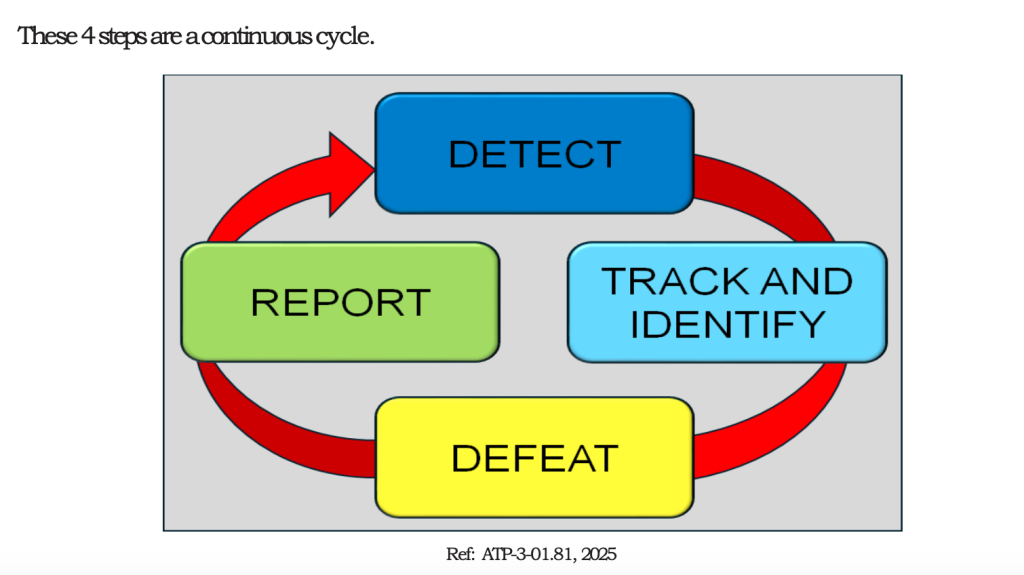
It frames counter-UAS operations as a continuous cycle: detect, track and identify, defeat, and report. It also directs planners to establish redundancy and complementary capabilities while considering critical assets, likely avenues of approach and site-specific factors that can affect system employment.
The Threat Driving the Guide
JIATF-401 grounds the Quick Reference Guide in a threat characterized by accessibility, adaptability and rapid change. Small UAS remain abundant and difficult to detect, while falling costs and expanded capabilities have enabled state forces, proxy groups, criminal organizations and individual actors to employ them at scale.
The threat extends well beyond a drone flying near protected airspace. The guide identifies small UAS use for intelligence, surveillance and reconnaissance; command-and-control support; direct and indirect attack; one-way attack; harassment; and coordinated swarm operations. In homeland settings, it also cites risks ranging from contraband delivery and cross-border smuggling to flight-safety disruption and malicious use by terrorists or criminal organizations.
For security teams, this creates a dual imperative: detect and understand the aircraft early, then apply a response appropriate to its behavior, the site and the operational consequences of mitigation.
Enemy TTPs Raise the Stakes
The guide’s section on enemy tactics, techniques and procedures reinforces why counter-UAS planning cannot center on a single aircraft or a single engagement moment. It describes reconnaissance drones that identify targets and pass coordinates to first-person-view operators, as well as “free hunting” strikes against pre-identified targets. It also examines group attacks in which reconnaissance supports multiple FPV strikes, potentially alongside artillery or mortar fire.
These examples underscore the value of early warning, clear identification, layered defenses and response options that enable operators to manage an incursion before it escalates. Where a drone may support surveillance, targeting or a broader attack sequence, operators need both situational awareness and the ability to respond precisely while protecting the mission below.
RF-Cyber Takeover Technology Profile
Within the guide’s counter-sUAS systems section, page 32 features D-Fend Solutions’ EnforceAir2. A next-generation, RF-Cyber-based system, it passively detects, identifies and locates small-drone threats, then safely takes them over and lands them in a predefined zone without jamming or kinetic force.
EnforceAir2’s inclusion places RF-Cyber takeover among the capabilities operators can consider as they assess their missions and operating environments.
EnforceAir addresses a central counter-UAS requirement: mitigate an unauthorized drone without creating unnecessary effects elsewhere. Passive detection supports situational awareness without transmitting during the detection phase. RF-Cyber takeover then enables controlled mitigation by taking control of the aircraft and directing it to a designated landing area.
The guide identifies tactical stationary, vehicular, backpack and maritime configurations, linking the capability to fixed-site, mobile, man-portable and open-water operational needs.

Low-Collateral Counter-UAS Operations
JIATF-401 asks planners to consider a system’s operating range, terrain, line of sight, RF propagation, frequency use and other transmitting systems before they employ counter-UAS capabilities. It also calls for electromagnetic-spectrum deconfliction when systems use electromagnetic sensing or attack capabilities.
Those considerations become particularly important at active bases, sensitive facilities, critical-infrastructure sites and major events. Security teams must counter a potentially hazardous or hostile aircraft while protecting personnel, sustaining communications and avoiding secondary hazards that could disrupt the very operation they are protecting.
The guide characterizes EnforceAir2 as a non-kinetic, non-jamming RF-Cyber takeover solution intended to prevent collateral damage or communications interference. That targeted approach is particularly relevant in settings where falling debris or communications disruption could introduce additional risk.
Supporting Continuity of Operations
For domestic base and facility protection, counter-UAS planners must protect mission-critical assets while integrating systems into a broader defense posture. The guide advises to identify priority assets, establish early-warning networks, select defeat mechanisms and use layered coverage to reduce gaps as a threat approaches protected areas.
The same requirements carry into homeland-security, critical-infrastructure and major-event settings. Each may involve crowded airspace, dense RF environments, public-safety operations, high-value assets and complex coordination among stakeholders. In these settings, mitigation must support the broader protective mission rather than create avoidable operational disruption.
EnforceAir2’s inclusion in JIATF-401’s Quick Reference Guide connects RF-Cyber takeover to this operational imperative. Its passive detection, surgical mitigation and controlled landing capability offer a relevant option for authorized operators seeking to resolve drone incidents while maintaining continuity of operations.
Lessons Learned: Plan for the Full Counter-UAS Cycle
The guide’s lessons-learned section reinforces a central point, that counter-UAS success depends on more than fielding a system. Organizations need trained personnel, defined authorities, site-specific planning, interoperable command-and-control processes and rehearsed reporting procedures that connect detection through response and recovery.
For high-consequence locations, the lesson is to assess a counter-UAS capability not only by whether it can stop an unauthorized drone, but also by how it affects the broader mission. EnforceAir’s passive detection and controlled RF-Cyber takeover capability aligns with that requirement by supporting targeted mitigation designed to avoid communications interference and collateral damage.
A Focused Option for a Complex Threat
JIATF-401’s Quick Reference Guide reflects a counter-UAS reality shaped by rapidly changing threats, diverse operating environments and the need for mission-specific responses. Its emphasis on layered defense, operational awareness, planning and appropriate mitigation reinforces that counter-drone protection is not simply about stopping an aircraft. It is about protecting people, assets and missions throughout an incident.
EnforceAir2’s inclusion on page 32 places D-Fend Solutions’ RF-Cyber takeover capability within that practical operational context. By combining passive detection with controlled, non-kinetic and non-jamming mitigation, EnforceAir can help authorized operators address unauthorized drone activity while seeking to avoid communications disruption, falling debris and unnecessary interruption to protected operations.
For domestic installations, homeland-security missions, critical-infrastructure sites and major events, that ability to manage a drone incident precisely can be as important as the ability to detect it. RF-Cyber takeover offers a focused approach for organizations seeking to maintain continuity of operations while protecting the airspace above sensitive environments.