

According to Washington insiders, the counter-UAS mission in the United States has moved past a policy fight to new execution challenges. That was the theme across a recent Washington-area counter-UAS event, where officials from across the federal government laid out how detection, mitigation and technology procurement continue to converge into a single, whole-of-government effort. Under Chatham House Rules, specific speaker attributions are withheld, but the substance of the discussions reveals an evolving interagency architecture that spans the Department of War (DoW), the Department of Homeland Security (DHS), the Federal Bureau of Investigation (FBI), Cybersecurity and Infrastructure Security Agency (CISA), the National Nuclear Security Administration (NNSA), while branching out to state, local, tribal and territorial (SLTT) law enforcement agencies.
DoW Builds a CUAS Marketplace
The DoW’s Joint Interagency Task Force (JIATF 401) just marked its first anniversary. It formed last August with a mandate to provide a bridge for commercial counter-UAS technologies to reach all military services and the interagency. JIATF 401 does not deploy capability directly. Instead, it leverages existing statutory authorities to rapidly develop and send hand-proven technology to the military services, which field it. Programs already moving through that pipeline include the Drone Dominance initiative, which ran live exercises at Fort Carson during the last week of August, and a new uncrewed aircraft effort projected to go from prototype to production in around four months.

The TF has also stood up a functioning marketplace meant to connect industry directly with government buyers, organized around three lines of effort: defending the homeland, supporting warfighter lethality and enabling joint force training. (Note– no hotlink because access on drones.mil is strictly limited to pre-cleared, vetted individuals). It convened a 200-member summit recently to set its next sprint objective, a cadence that reflects how central speed has become to the mission. That speed also shows up in how the marketplace functions. Rather than a static catalog, it operates as a matchmaking model, using flexible funding to compress acquisition timelines from months down to days and weeks.
Key themes from the dais included a shift from policy obstacles to technical and manufacturing ones, an emphasis on software-defined capability over hardware and a warning that lessons from the Ukraine battlefield show yesterday’s effective countermeasure may not work tomorrow.
Quick Hits:
- The Domestic Shield effort (formerly Replicator 2) is actively equipping critical infrastructure, the southern border and major events including the FIFA World Cup and America250 commemorations.
- A directed energy pilot program that spans installations in 12 states has a planned December “shoot-off” evaluation at Dugway Proving Ground in Utah, expected to convert directly into purchase orders.
- The DoW requested $54 billion for uncrewed and counter-uncrewed systems in its most recent budget cycle.
- An $100M SWAP-USV (Suitable Warfighting Adaptive Payloads) maritime threat initiative launched alongside the Defense Innovation Unit (DIU) is offering an initial $100 million, with more to follow.
- A newly launched DIU Bridge Program announced is intended to speed transition from prototype to fielded capability.
- New training pipelines at Fort Sill, Oklahoma to stand up a dedicated counter-UAS training cadre.
- The JIATF mission now spans “seabed to space,” reflecting an expanded counter-uncrewed systems (UxS) scope beyond aircraft alone.
NORTHCOM and DHS Align on Homeland Protection
The division of labor between military and civilian authorities for protecting domestic airspace continues to mature. For example, a DoW homeland UAS synchronizer role, established in 2024, now coordinates capability gaps across the services and feeds recommendations up through defense acquisition channels.
Officials again stated they believe policy is no longer the primary obstacle, as it had been for much of the past six to seven years. The harder problems, they say, now involve supply chains, manufacturing and building systems that interoperate reliably across agencies. Officials also highlighted a “systems of systems” defense-in-depth approach for counter-UAS, and noted that SLTT partners increasingly serve as first responders to drone incidents, with new pathways opening for those agencies to procure and deploy their own equipment.
Quick Hits:
- NORAD and NORTHCOM C-UAS flyway kits provide a 24-hour rapid-response capability, deployable through service-level requests when sites need surge capacity.
- Interagency coordination for the FIFA World Cup and NASCAR events tested rapid data transfer between military and civilian commands.
- The JIATF framework helped resolve information-sharing friction between DHS and the DoW, particularly along shared border missions with the Department of the Interior and Customs and Border Protection.
- A new initiative is working to fix chronic overclassification of counter-UAS data to improve interagency sharing.
- A follow-on national capital region initiative, tentatively targeted for 2027, aims to unify communication and data sharing among the many agencies with a counter-UAS mission in Washington.
CISA and NNSA Modernize Critical Infrastructure Protection
Officials representing CISA, the NNSA and outside legal and policy experts focused on how new statutory authorities are reshaping protection of critical infrastructure. The conversation centered on two major regulatory developments: an interim final rule (IFR) implementing counter-UAS authority under SAFER SKIES. (See prior AG coverage of SAFER SKIES’ IFR).
The NNSA has expanded its counter-UAS mission well beyond its traditional footprint protecting nuclear weapons production, to align with a new task force focused on restoring domestic industrial and technological sovereignty. The 2026 defense authorization bill broadens that mandate to protect all eight NNSA sites plus use a mobile response capability. Additionally, a possible new test range is under survey consideration.
CISA, meanwhile, continues to track the FAA’s proposed rule that would allow flight restrictions over critical infrastructure and impose penalties for violations, a change that has already drawn more than a thousand public comments. (See prior AG coverage of Section 2209). The rule could eventually cover 16 infrastructure sectors rather than the four originally contemplated, a scope expansion that could touch as many as 300,000 potential flight-restricted sites and facilities nationwide. Sector eligibility thresholds, such as power generation capacity or visitor counts, may determine which facilities qualify for future flight restrictions. CISA can assist critical infrastructure owners with risk assessments ahead of any final rule. Critical infrastructure operators are urged to begin documenting drone activity now, pursue remote identification capability and fold UAS threats into existing security and response plans.
Quick Hits:
- A new executive order is expected soon to sustain and formalize counter-UAS lessons learned over the past two years.
- The 2026 defense authorization act expands nuclear site protection beyond special nuclear material production areas.
- Officials floated revisiting older wiretap-adjacent “pen register” style authorities for counter-UAS applications.
FBI and NCUTC Detail the SAFER SKIES Framework
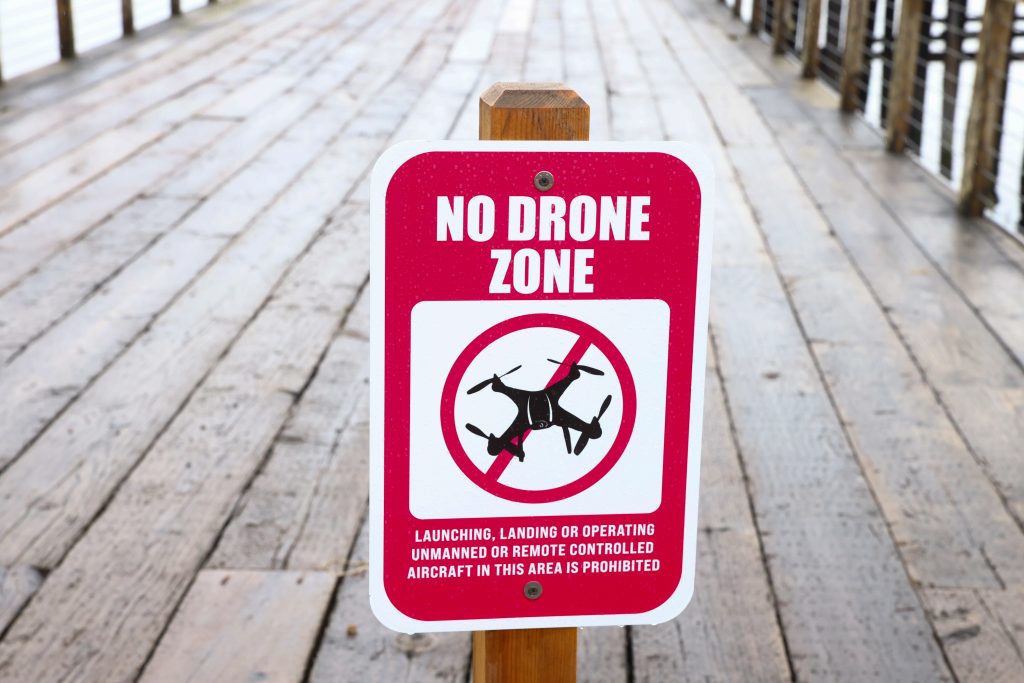
The most detailed regulatory walkthrough involved an unpack of how the newly enacted SAFER SKIES Act will reshape state and local drone response. The law, part of the fiscal year 2026 defense authorization act, expands detection and mitigation authority to SLTT law enforcement and correctional agencies for the first time on a broad scale. (See prior AG coverage of SAFER SKIES).
Officials were careful to separate what is already legal from what requires new statutory cover. Passive detection methods, including remote identification, electro-optical and infrared cameras, acoustic sensors and radar, have long been lawful. Mitigation, and any detection method that intercepts electronic communications between a drone and its controller, requires authority under the relevant federal statute. Officials noted that federal teams have made contact with a drone operator in 78 percent of encounters historically, underscoring that most incidents resolve without escalation.
A new interim final rule took effect July 1, jointly issued across two sections of federal code by the Department of Justice and DHS, with the public comment period running through September 4. The rule sets training standards, an approved technology list maintained jointly by the Department of Justice, DHS, the DoW, the Department of Transportation, the FCC and NTIA, and strict reporting timelines for any mitigation action taken.
Agencies seeking authority must become accredited, adopting model policies covering detection, warning and full mitigation, with legal counsel required to review privacy and data-handling provisions. To accommodate this, the FBI-run training center is scaling rapidly, moving from standard 16-person classes to 32-person cohorts by October, with a goal of training roughly 3,000 personnel by next year, up from 92 this year. So far, more than 140 agencies have reached certified or accredited status, with 22 additional requests on file. Organizational detect and warn certification is on line and a precursor to mitigation authority. So far, only 6 agencies have completed it.
Quick Hits:
- A structured coordination timeline governs mitigation requests: a 30-day advance notification, a 7-day operations plan sign-off, real-time air traffic control notification on the day of operation, a 48-hour post-operation report and a 180-day data retention decision point.
- A FEMA counter-UAS grant program totaling roughly $500 million is supporting SLTT technology purchases, with an additional $250 million available this fall, following an earlier $250 million allocation tied to World Cup and America250 security needs.
- Authority granted under the SAFER Skies Act sunsets in 2031 unless renewed.
- Violations by state or local agencies can trigger fines up to $100,000 and potential suspension of authority.
What DC’s Counter-UAS Consensus Means Next

Every session telegraphed that the technology and legal foundation for domestic counter-UAS defense now exists, and the challenge has shifted to scaling training, clarifying data sharing and getting proven systems into the hands of federal and SLTT operators faster. Agencies described a genuine effort at coordination rather than turf protection, with shared task forces and cross-agency accreditation pathways replacing the fragmented approach of prior years.
For critical infrastructure operators, public safety agencies and industry, the near-term priorities are clear.
- Track the SAFER SKIES IFR comment period, closing September 4, and prepare for the companion critical-infrastructure 2209 flight-restriction rule, which could expand well beyond its original scope.
- Document existing drone activity and incorporate UAS threats into facility security plans ahead of new sector-eligibility requirements.
- Pursue federal online training and accreditation now, given the rapid scaling of available class capacity.
- Watch for a forthcoming executive order intended to lock in recent counter-UAS gains and streamline authorities further.
- Engage early with the DoW’s marketplace model, particularly for small companies seeking a faster path from demonstration to fielded capability.
The next 12 to 18 months will test whether this interagency alignment can keep pace with the technology itself, especially as major events like the 2028 LA Olympics and other major events place sustained pressure on the system.