

By: Dawn Zoldi
Drones and ground robots have become force multipliers for a wide swath of public safety agencies. Their value, however, hinges on one invisible factor: whether the network link holds when everything else is falling apart. As these mission critical operations move toward routine Beyond Visual Line of Sight (BVLOS) operations, “good enough” connectivity creates a significant operational risk. When lives, liability, and trust in unmanned systems are on the line, the network can no longer be the weakest link in the response.
Drones as First Responders, Not Just Flying Cameras
Fewer than 10 percent of the roughly 18,000 U.S. law enforcement agencies have any drone program at all. This means most departments still rely entirely on ground-based response. But for departments that have drones, Drone as First Responder (DFR) programs in particular have changed the game. Sending a drone to the scene first, often in under 70 seconds after receipt of a 911 call, has been reported to resolve 20–30 percent of calls without ever having to dispatch an officer. This frees up personnel and reduces risk.
Agencies use drones to clear false alarms, scout active shooter incidents, support search and rescue (SAR) and provide thermal imagery in hard-to-reach areas. They also help reduce use of force by replacing uncertainty with live video, audio and sensor data that let teams choose the least risky response. Yet for all their promise, public safety drones and robots are only as effective as the data link that connects them to operators, dispatch and recording systems.
The Hidden Weak Link: Connectivity Under Stress
BVLOS operations, central to DFR and large-area disaster response, demand real-time, low‑latency command and control (C2) plus continuous global navigation satellite system (GNSS) positioning to satisfy Federal Aviation Administration (FAA) safety requirements. If that link drops or degrades, the drone must return home or land. Link failure can turn a life‑saving asset into dead weight, at the worst possible moment.
Traditional connectivity models were never designed for this environment:
- Single-Carrier Subscriber Identity Modules (SIMs) – these cards/chips securely store subscriber identity and network credentials in a device. In this case, they only subscribe to one carrier.
- Roaming-Based Internet of Things (IoT) plans – connectivity plans that rely on roaming agreements to attach devices to partner mobile networks outside their “home” network footprint
- Generic Mobile Virtual Network Operators (MVNOs) – providers that offer cellular service using other carriers’ networks rather than owning radio access infrastructure themselves
Roaming connections are more likely to be slow and flaky. If the signal drops, they usually take longer to switch over to a different network. This leaves operators with a gap in service right when they need it to keep working. This can prove dangerously long in a BVLOS context.
MVNOs typically don’t control how their underlying cell networks behave. Instead, they have to accept whatever settings and priorities the main carrier gives them, so they can’t finely tune things like speed, reliability or how traffic is handled. They also cannot guarantee Quality of Service (QoS), the set of mechanisms and guarantees that control how traffic flows across a network so important data gets better treatment. Concretely, this is about managing things like bandwidth, delay (latency), jitter, and packet loss so that critical, real‑time applications (voice, video, command‑and‑control links, etc.) stay smooth and reliable even when the network is busy. Finally, they struggle to deliver the end‑to‑end security, SIM traceability and regulatory integration the FAA requires.
“Worldwide coverage is a talking point,” according to Robb Monkman, Chief Marketing Officer at TEAL, “but in public safety it’s the wrong metric. The real question is if there’s failover to the next best available network if there’s a outage, if the drone encounters a dead spot, loses or connectivity due to roaming restrictions?”
“Connectivity can be one of these big hurdles to completing the mission. For us, it’s really about redundancy.” That’s why having multiple forms of connectivity including cellular, RF, and in some areas, satellite, is critical when it comes to DFR missions.
If you think about big cities where there are tall buildings and other obstacles. RF can be blocked and can be jammed. You need to make sure that your drone operations can continue, especially if it’s mission critical.
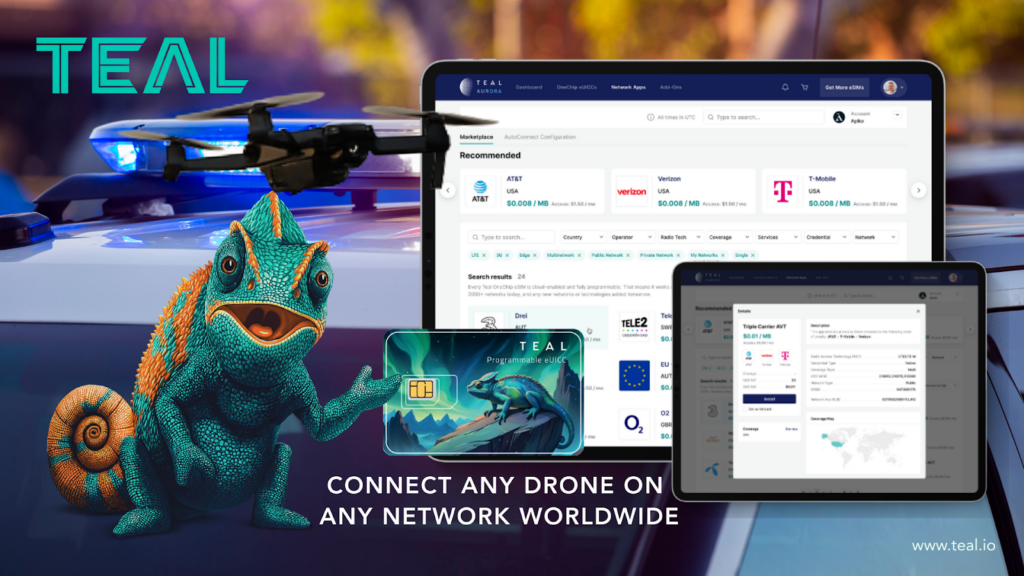
Beyond visual line of sight (BVLOS) drones need low-latency, high-throughput connectivity, especially in urban and suburban areas. TEAL’s Network Orchestration Service (NOS) ensures mission success by providing seamless access to tier-1 networks globally, automatic failover and dynamic, over-the-air carrier switching for ultimate redundancy.
BVLOS Demands Control, Not Just Coverage
The FAA’s forthcoming Part 108 framework puts performance-based standards around BVLOS. It ties operational approvals directly to how well operators manage C2 links, cybersecurity and integration with Uncrewed Traffic Management (UTM) systems. That means agencies and their technology partners must have more than just signal bars on a device. They must demonstrate that connectivity can be prioritized, traced, secured and documented in real time.TEAL answers that call with a carrier‑agnostic, mission‑critical connectivity platform built around its own patented and GSMA-certified eSIM technology and a Network Orchestration Service (NOS).
TEAL’s eSIM (eUICC) technology has been tested and approved for official compliance and security schemes by the GSM Association (GSMA), the main global industry organization that represents the interests of mobile network operators and the broader mobile ecosystem (think: device makers, equipment vendors, software companies). GSMA also develops common technical, security, and interoperability standards for mobile communications, including eSIM. This stamp of approval confirms that it meets the industry’s specifications for security, interoperability and remote SIM provisioning across mobile networks worldwide.
TEAL’s eSIM (eUICC) technology is GSMA-certified, meeting global standards for security, interoperability, and remote SIM provisioning across mobile networks. Unlike traditional solutions that rely on slow roaming or single-carrier constraints, TEAL’s Network Orchestration Service (NOS) allows drones to dynamically switch in real time to the strongest available network, ensuring resilient, low-latency command and control links even across patchy coverage and fully aligned with FAA Part 108 reliability requirements.
TEAL’s platform also provides secure SIM-based identity, end-to-end SIM traceability, and geofenced policy enforcement. These capabilities help operators maintain compliant connectivity across different airspaces and support regulatory requirements for BVLOS drone operations.
How does it work? TEAL’s Network Orchestration Service (NOS) manages eSIM connections in real time, allowing drones to connect to the strongest available network as conditions change. It provides control over connectivity and enforces policies based on location, helping maintain reliable links and compliance with operational and regulatory requirements. In plain language, NOS acts like a smart traffic controller for a drone’s network, ensuring connectivity stays consistent and predictable.
“BVLOS operations don’t just require more coverage,” Robb Monkman explained. “They need full control over which networks and technologies are used, how they perform, and insight into all data flowing through them.”
What “Mission-Critical Connectivity” Means in the Field
For public safety users, TEAL’s value becomes palpable in scenarios that test every part of the system at once: wildfires, mass-casualty crashes, storms that down infrastructure, or multi‑agency manhunts. In these environments, networks can be congested by civilian traffic, partially impaired, or stretched across rural dead zones. TEAL’s eSIM and NOS approach addresses those conditions in several ways:
- It gives DFR and BVLOS programs over-the-air access to connect to any network globally via a single, programmable eSIM managed through TEAL’s NOS. This simplifies deployment and logistics for agencies that support mutual aid or cross-border operations.
- It uses native Tier‑1 profiles rather than roaming, improving latency and throughput so live video, telemetry, and detect‑and‑avoid (DAA) data remain usable.
- It provides intelligent network redundancy and automatic failover, allowing drones to switch seamlessly between networks if one becomes congested or unavailable.
- It enables one pilot to control multiple drones by maintaining fast, reliable links, which is critical when a single operator manages a fleet of overwatch or perimeter assets.
In security and public safety more broadly, TEAL’s mission‑critical connectivity supports robots and drones that patrol facilities, monitor public events and augment fixed camera networks. It turns them into a cohesive, high‑reliability sensor layer rather than standalone gadgets. That same resilient connectivity can also underpin drone‑based cellular “bubbles” that temporarily restore coverage after disasters to extend the value of airborne assets beyond pure reconnaissance.
From “Best Effort” to Trustworthy Connectivity
TEAL distinguishes between connectivity as a commodity and connectivity as infrastructure. In the commodity model, agencies accept higher latency, unpredictable failover and little visibility into how networks treat their traffic. Those conditions that might be tolerable for low‑risk IoT but not for aircraft sharing airspace with manned aviation. In the infrastructure model, connectivity is engineered, monitored, and contracted with Service Level Agreements (SLAs) that reflect the stakes of public safety.
TEAL’s NOS provides network‑level QoS and multi‑carrier redundancy designed specifically to meet stringent latency and reliability needs associated with BVLOS operations. Its U.S.-built, secure platform and SIM‑based identity architecture support alignment with FAA and NIST cybersecurity expectations. Its integration hooks into UTM and other FAA‑approved systems position it as a compliance enabler, not just a data pipe.
“Trustworthy, flexible connectivity can make the difference between a drone program that scales and one that stays in pilot-project limbo,” Monkman noted. “Without a clear view of how your connectivity performs under stress, regulators, insurers, and your own command staff may hesitate to approve the missions that matter most.”
Why This Matters Now for Public Safety Leaders
Driven by more capable airframes, maturing autonomous workflows and evolving regulations in the U.S. and abroad, market forecasters project the public safety drone market will grow steadily through the rest of this decade. The technology remains solid. But staffing, policy and infrastructure, especially connectivity have become the primary bottlenecks.
For chiefs, Chief Information Officers (CIOs) and program managers, the strategic question now is “What infrastructure do we need so we can trust them when the stakes are highest?” TEAL proposes that mission‑critical, carrier‑agnostic and technology agnostic connectivity provides that missing layer of assurance. It turns drones from useful gadgets into dependable extensions of public safety operations.
When the drone is first on scene, the network truly cannot be last. When it comes to BVLOS and DFR, “good enough” connectivity is the one compromise agencies can no longer afford to make.