
By: Dawn Zoldi
As 2026 begins, autonomy and geospatial technologies have transitioned from side projects to core tools to how agencies plan, operate and defend. From federal civilian programs to the Department of Defense (DoD), state and local agencies, the focus has shifted to practical deployments that deliver measurable outcomes, not just big ideas or novel prototypes.
Government Technology’s New Pace in 2026
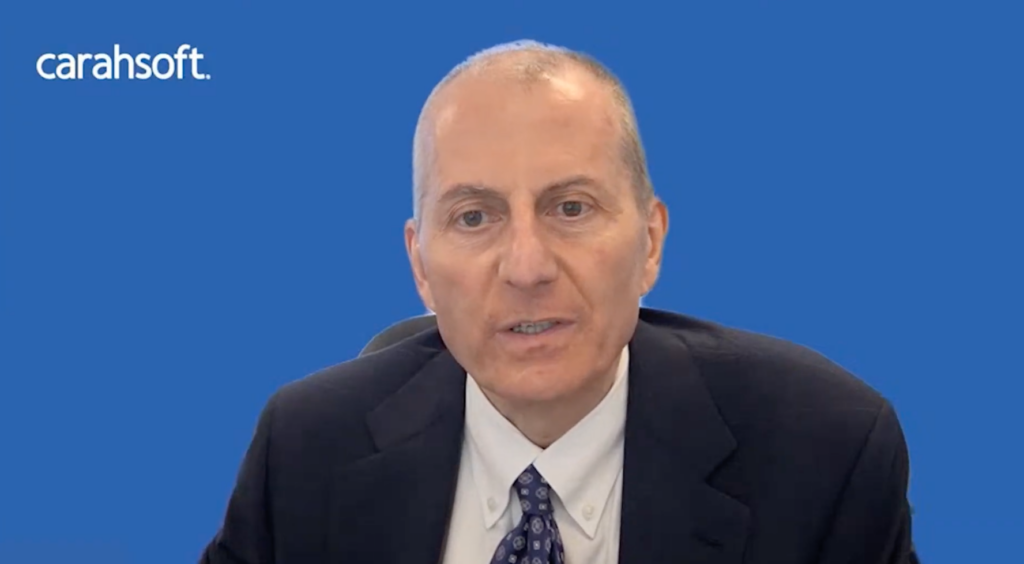
During the official kick off for the 2026 Dawn of Autonomy season, Carahsoft President, Craig P. Abod joined the event. Abod founded Carahsoft in 2004 with a focus on helping innovative technology companies bring mission‑driven solutions into the federal, state and local public sectors, described a public sector that is moving faster and demanding more from its technology partners.
As one recent example of accelerated timelines, in May 2025, the Federal Aviation Administration (FAA) announced its contract opportunity for Air Traffic Control Systems. Within just seven months, the agency successfully released and closed the solicitation, culminating in the award of the contract to Peraton (a Carahsoft Partner) on December 4th.
Abod shared, “Agencies are looking beyond innovation. They require speed through procurement, implementation and proving measurable ROI,” he explained, framing a 2026 agenda that centers on performance and accountability.
In his estimation, recent modernization push points, from Secretary of Defense-level transformation efforts to updates in the President’s Management Agenda, have reinforced expectations around efficiency, partnership and measurable impact. Abod noted that agencies “want the most effective procurement and acquisitions possible” as they prioritize cybersecurity, cloud, AI, autonomous technology and secure digital infrastructure.
Where Autonomy Is Actually Getting Funded
Senior Sales Director Lacey Wean, who leads Carahsoft’s autonomy and geospatial portfolio, sees clear patterns in how Federal civilian agencies are buying. “We’re seeing Federal procurements moving faster than ever… but specifically when it comes to the civilian agencies, they’re moving forward mostly with existing programs and existing contracts,” she said. That translates into near-term opportunities around data‑centric geospatial analytics, software sustainment and integration work tied to already funded missions.
New hardware starts, Wean explained, remain challenging. “However, solutions that help an agency do more with what they already have and improve efficiency, compliance or decision‑making continue to advance.”
Within the defense sector, Wean sees more consistency in funding “readiness, sensing, autonomy and operational data.” Carahsoft’s customers, she said, “have moved further along in integrating autonomous capabilities into real world missions.”
Procurement Overhaul: From Years to Months
Behind this acceleration, a significant overhaul of how the government buys technology continues to take shape. As one example, Wean pointed to the pending Federal Acquisition Regulation (FAR) refresh designed to streamline prescriptive rules, add practical buying guides and cut administrative delays so agencies can adopt critical systems faster.
On the defense side, she highlighted new authorities such as the SPEED (Streamlining Procurement for Effective Execution and Delivery) Act. It restructures requirements pipelines and aims to shrink timelines “from nearly 800 days into a matter of weeks” for certain capabilities.
Abod underscored Carahsoft’s role in this environment. “Our goal is simple: make it easier for the government to find great technology, acquire great technology and deploy technology quickly and successfully,” he noted.
Drones, Defense and Counter‑UAS at Scale

In 2026, drones sit at the center of both opportunity and urgency. Lessons from the Russia–Ukraine conflict, combined with a new American drone dominance initiative led by Secretary of Defense (SecDef) Pete Hegseth, are reshaping how the DoD approaches small uncrewed aircraft systems (sUAS). Wean described the effort as “a bold, accelerated initiative” backed by roughly a billion dollars over two years to help the DoD “rapidly scale the military’s capabilities with some small really cost‑effective drone capabilities.” The goal: to procure hundreds of thousands of small drones designed for one-way attack missions. This fast-track program is structured in four critical phases (“gauntlets”) to ensure rapid development, testing and deployment
At the same time, a Federal Communications Commission (FCC) ruling on foreign drones and components, paired with DoD exemption pathways, creates some friction for a market where few platforms are entirely domestic in their supply chains.
In the homeland security arena,, the Safer Skies Act extended long‑sought counter‑UAS (C-UAS) authorities to state, local, tribal and territorial (SLTT) law enforcement, backed by programs that are funding airspace security for mega‑events throughout the decade.
Security for FIFA, 250th and Beyond
The 2026 FIFA World Cup, America’s 250th birthday, and future large‑scale events like the Los Angeles Olympics in 2028 are already shaping investment decisions for airspace and ground security. Wean pointed to “about $500 million in federal grant funding” earmarked for host cities to deploy C-UAS systems to combine drone detection, jamming and mitigation around critical venues.
A White House Task Force has worked with DRONERESPONDERS and the Commercial Drone Alliance to understand required capabilities. It aims to coordinate efforts so local agencies can deploy cohesive solutions rather than isolated point tools. For autonomy and geospatial vendors, this opportunity creates a time‑bound, mission‑specific market where relevance to event security and urban infrastructure will determine who wins.
Data, Software and AI as the Foundation
Even with tight budgets, agencies see data and integration tools as non‑negotiable. “Government agencies, they see data and IT as foundational,” Wean said. Software and integration products usually require less capital than new platforms and can be layered onto existing systems.
This changes the sales conversation from platform features to workflows and outcomes. “It really just shifts the discussion from what does your platform do to how does this help make decisions faster or complete the mission faster,” she explained, adding that agencies respond best to companies that understand “how the data flows, how systems integrate and how users are actually interacting with the technology.”
How Agencies Want AI in 2026
AI is everywhere at CES and in government conversations, but public‑sector buyers are skeptical of the hype. “AI is absolutely a priority… but it’s being approached much more thoughtfully,” Wean cautioned. Agencies have little interest in standalone AI for its own sake. They want “practical trusted applications… tied into data quality, security, and mission outcomes.”
That means AI embedded in workflows that power inspection analytics, triages video feeds, elevates geospatial insights or accelerates planning has a much smoother path than tools positioned as shiny add‑ons. For technology companies, success in 2026 will depend on showing how AI is governed, how it improves performance and how it fits inside the agency’s existing digital infrastructure.
Messaging That Resonates With Government Buyers
For autonomy and geospatial companies, Wean recommended leading with mission alignment and integration instead of abstract capability claims. “Messaging that shows how the solution fits into an existing environment, how it reduces risk or how it’s supporting current priorities is landing a lot better than a broad narrative,” she noted.
She also warned against assuming agencies will fund “big new ideas without a clear path to implementation or ignore the central role of contracting vehicles, partnerships and timing.” A clear value proposition, anchored in defined outcomes and realistic timelines, matters more than ever in this constrained but still active market.
Who Will Benefit When Budgets Loosen
Despite uncertainty, “the government hasn’t stopped buying. It’s just a little bit more selective,” Wean emphasized. Areas tied to data integration, autonomy enablement and operational scaling seem poised to rebound quickly once funding clarity improves, especially where programs were defined but not fully resourced in prior cycles.
Companies that stay engaged, support existing customers and invest in integration and partnerships during lean periods will be best positioned when new money flows. “Agencies are going to remember who helped them navigate the uncertainty,” Wean said. In the current environment, relationships and consistency are strategic assets.
Carahsoft’s Role: Contracts, Events and Ecosystems
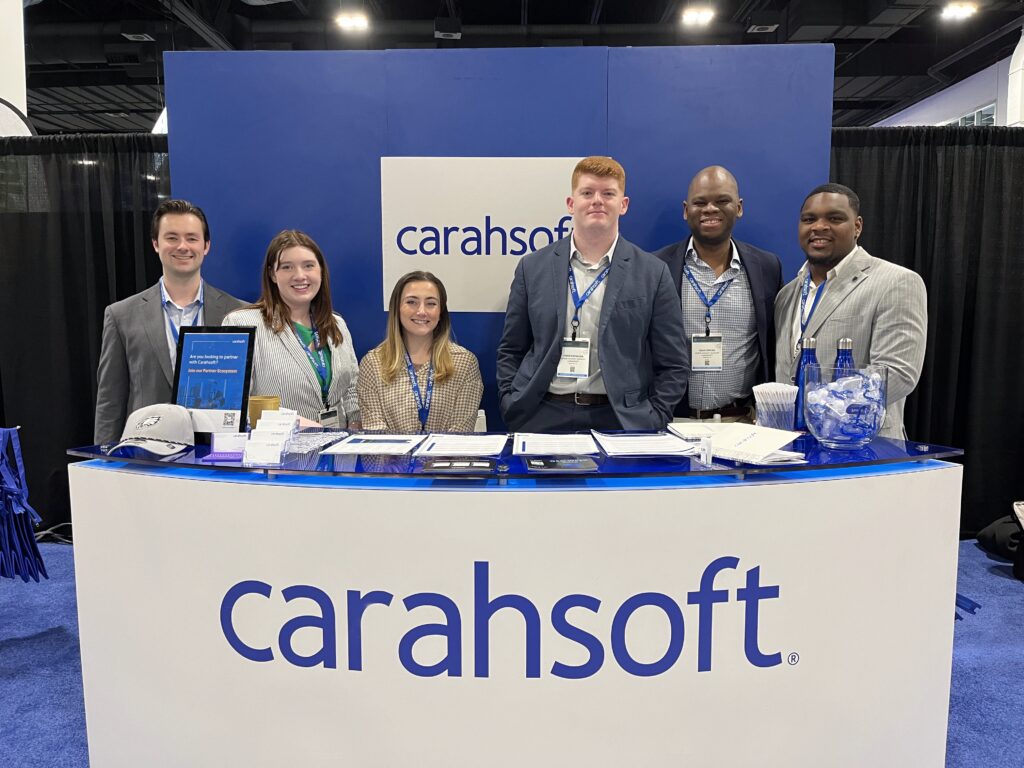
In 2025, Carahsoft’s scale has enabled it to generate more than $22 billion dollars in annual business, and support thousands of manufacturers across its portfolio, giving it a unique position to discuss how autonomy, AI, cyber, 5G, space and defense technologies converge. Abod and his team have built what has become one of the most influential government technology distributors in the United States. Wean pointed to the company’s “very robust AI portfolio, massive cyber business and significant space and 5G efforts that together support comprehensive end‑to‑end solutions for government.”
The company also invests heavily in ecosystems and events (think: GeoWeek and GEOINT to AFCEA West, SOF Week, DRONERESPONDERS and AUVSI’s XPONENTIAL), often anchoring large partner pavilions and joint marketing efforts. For startups that cannot afford their own footprint, Carahsoft’s shared booth, demo kiosks, executive briefings and networking events offer a practical route to visibility in front of targeted public‑sector audiences. (See, e.g., prior AG coverage of Carahsoft’s AI companies at SOF Week 2025).
How to Learn More
Public sector buyers and industry partners who want to plug into the government autonomy landscape have several paths in 2026.
Technology vendors can start at Carahsoft’s Partner Form, where a brief intake form triggers an introductory discussion about goals, go‑to‑market strategy and relevant contract vehicles, from NASPO and OMNIA to GSA and NASA SEWP V. (See prior AUVSI coverage of Carahsoft’s business model).
Federal, state, local, tribal and territorial agencies can engage Carahsoft to discuss mission requirements, see demos, arrange pilots and understand the “art of the possible” across a wide range of technology verticals.
Both Abod and Wean provided the same overarching message for 2026: mission impact, integration and trust will determine which technologies rise to the top as the government modernizes. As Wean put it, “staying engaged and focusing on how you can best support the government… with those mission-driven outcomes” is what will shape who wins in the year ahead.
Watch Craig Abod and Lacey Wean on Episode 103 of the Dawn of Autonomy Podcast.