
By: Dawn Zoldi
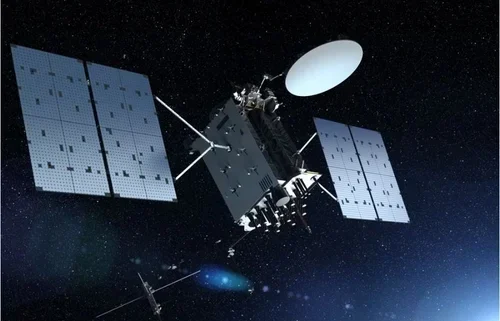
Lockheed Martin continues to move quickly to close gaps in the nation’s aging GPS constellation, with the final GPS III satellites ready to launch and a ramp to the more capable GPS IIIF line already underway, company executives told reporters at the Air & Space Forces Association Warfare Symposium.
An Aging But Indispensable Backbone
GPS is woven into both civilian life and military operations as critical position, navigation and timing (PNT) infrastructure. Every financial transaction, from ATM withdrawals to stock trades, as well as grid synchronization for power networks and large-scale logistics, depends on precise timing signals from GPS satellites operating continuously around the clock.
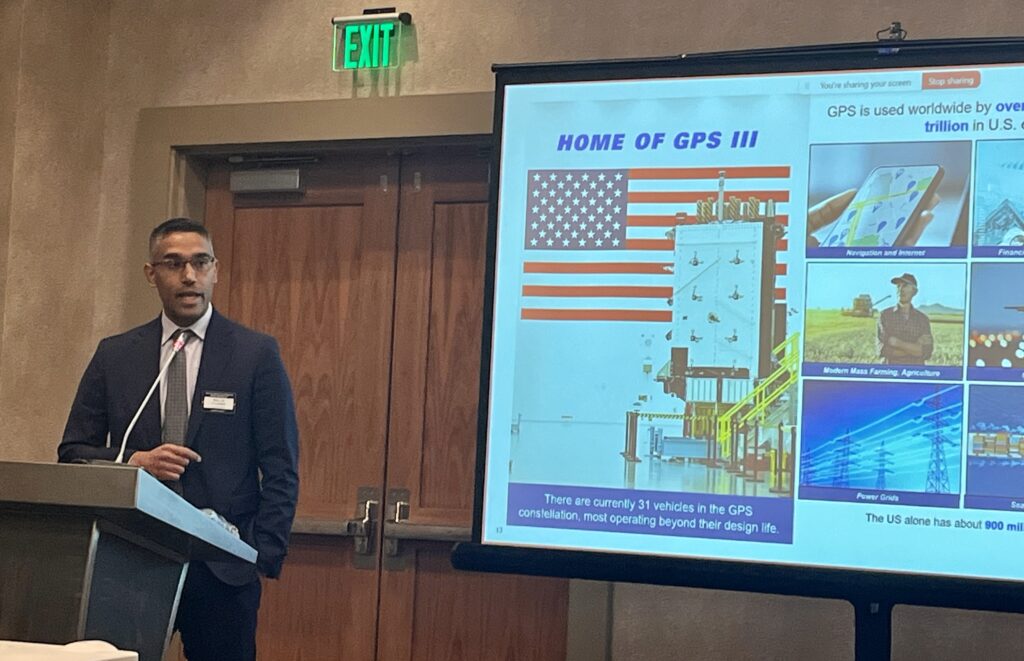
The current constellation consists of 31 satellites in medium Earth orbit (MEO), spanning four generations: GPS IIR, IIRM, IIF and GPS III. Many of the older IIR and IIRM spacecraft are operating at roughly three times their original design life, with average ages on the order of two decades. That puts the system on what Malik Musawwir, Vice President, Navigation Systems at Lockheed Martin described as “borrowed time,” with a heightening the urgency for replenishment.
GPS III: Strengthening The Signal And Launch Cadence

GPS III is the first step in that refresh. According to Lockheed Martin, the new generation delivers roughly three times better accuracy and about eight times the anti‑jamming capability of legacy satellites, while also adding a “safety‑of‑life” signal and a new civil L1C signal compatible with other global constellations. Musawwir described the L1C upgrade as an evolution of the legacy L1 C/A signal that improves performance in urban “canyons” where multipath and blockage can degrade service.
Every GPS III satellite carries the encrypted M‑code signal for military users, transmitted at higher power to improve resistance to jamming and spoofing. More power from space makes it harder for an adversary to overpower or imitate the signal at the user’s receiver on the ground or in the air.
On January 27th, Lockheed Martin launched GPS III SV09, the ninth vehicle in the series. It now prepares SV10 as the final GPS III spacecraft. The company has engineered both the satellites and the deployment process for resilience, as evidenced by its answer to the recent rapid launch call‑up campaigns for SV07, SV08, SV09, in which it switched launch providers, moved satellites from Colorado to Cape Canaveral and executed launch preparations within just a few months.
GPS III SV10: Optical Crosslinks, Rapid Tech Insertion
GPS III SV10 will match SV09’s core capability but add a first‑of‑its‑kind optical crosslink demonstration for the program. Musawwir said SV10 will be the first GPS satellite to fly an optical payload designed to support space‑to‑ground laser communications, with data rates in the megabits‑per‑second range. This is far above what GPS telemetry actually requires, but sufficient to prove the technology and open the door to future satellite‑to‑satellite links.
He stressed that the real story is not just the payload itself, but the speed of integration. From the decision to add the optical crosslink demo to having SV10 integrated, tested and ready to ship to the Cape took about 18 months.This demonstrates that new capabilities can be inserted on an operational platform without disrupting the core navigation mission.
SV10 will also host a digital rubidium atomic frequency standard experiment, part of a push to diversify suppliers and evolve the “beating heart” of GPS timing while proving new clock technologies on orbit. Musawwir presented these demonstrations as a template for using production‑line satellites as technology pathfinders, rather than waiting for purpose‑built experimental missions.
GPS IIIF: Regional Military and Nuclear Protection Plus Search & Rescue
While SV10 will close out the GPS III line, it also serves as a bridge to GPS IIIF (GPS III Follow‑On), which Musawwir described as both an evolutionary and, in some respects, revolutionary step. GPS IIIF retains the M‑code and enhanced civil signals of GPS III but adds two headline capabilities: a boosted secure M‑code and Regional Military Protection (RMP).
The boosted M‑code increases signal power by a factor of about eight, while RMP uses a reflector array to concentrate M‑code into a spot beam roughly 1,200 kilometers in diameter. Within that footprint, the system can deliver on the order of 63 times the power of today’s encrypted GPS signal, which Musawwir characterized as a “game changer” for resilience against jamming and spoofing. Such higher power means adversary jammers must operate closer to GPS‑dependent forces and at much higher output levels. This fundamentally changes the geometry and risk calculus for electronic attack.
Musawwir also pointed to less visible payloads that will carry over from GPS III into GPS IIIF. One is the nuclear detonation detection system, a suite of sensors for geolocating nuclear events and relaying timing and location data to ground systems, which he described as “core to the architecture and design” of GPS satellites. To support that mission and space operations in general, GPS spacecraft are built to be nuclear‑hardened, with requirements to withstand certain nuclear events in space.
Another is the search and rescue (SAR) payload. GPS satellites can receive distress beacons from first responders or others in remote areas, using onboard antennas to capture the signal, determine position and help guide rescue teams to people in trouble. Musawwir noted that SAR on GPS III/IIIF is aimed at scenarios such as wildland firefighting in backcountry terrain, where reliable location updates can be the difference between life and death.
The Future Is Looking Up
When asked whether GPS IIIF could make long‑discussed “GPS alternatives” less central, Musawwir argued that the future lies in an ecosystem of PNT sources, rather than a single replacement. In his view, GPS IIIF’s spot‑beam protection will dramatically improve GPS survivability in contested environments, but underground or otherwise GPS‑denied scenarios will still require complementary PNT modalities rather than a wholesale shift away from space‑based navigation.
And so it’s full steam ahead for Lockheed Martin on GPS III and IIIF. On the production side, Musawwir said all 12 GPS IIIF satellites under contract are now somewhere on the line, with the first vehicle fully integrated and in test and four in single‑line flow across various assembly stages. He framed that steady‑state production, combined with rapid integration of new payloads like optical crosslinks, as central to ensuring both continuity of service and the resilience demanded in a future contested space environment.