
By: Dawn Zoldi
LiveU has developed a public‑safety streaming stack designed to deliver broadcast‑grade live video for command-and-control (C2), even when cellular networks are congested, degraded or distant from the incident scene. Building on its 20 year broadcast track record in some of the world’s most challenging RF environments, the company is now packaging those capabilities for agencies that need assured real‑time visuals from the edge-drones, vehicles, helmets, fixed cameras-to the people making decisions.
Resilient Video for the COP
For first responders, the tempo of modern incidents has outpaced voice alone. Active threats, fast-moving fires, severe weather and search-and-rescue all demand shared, real-time visual context that can cut through uncertainty and compress decision cycles. Yet live feeds are often trapped inside siloed systems, limited to a single agency, only visible to a single pilot, or prone to failure just as radio traffic spikes and networks come under stress.
LiveU’s public safety team frames the core problem as the inability to share real-time video across agencies and command levels, especially when legacy systems do not interoperate. The operational goal is a true Common Operating Picture (COP): the same live feeds available to incident command, mobile command posts, real‑time crime centers and operators in the field, so everyone works from the same facts instead of fragmented views of the incident…the classic game of telephone. LiveU positions its public safety portfolio, including the LU‑REQON1 tactical encoder, as a way to establish that COP by moving live video reliably from multiple sources to multiple destinations.
Purpose-Built Situational Awareness
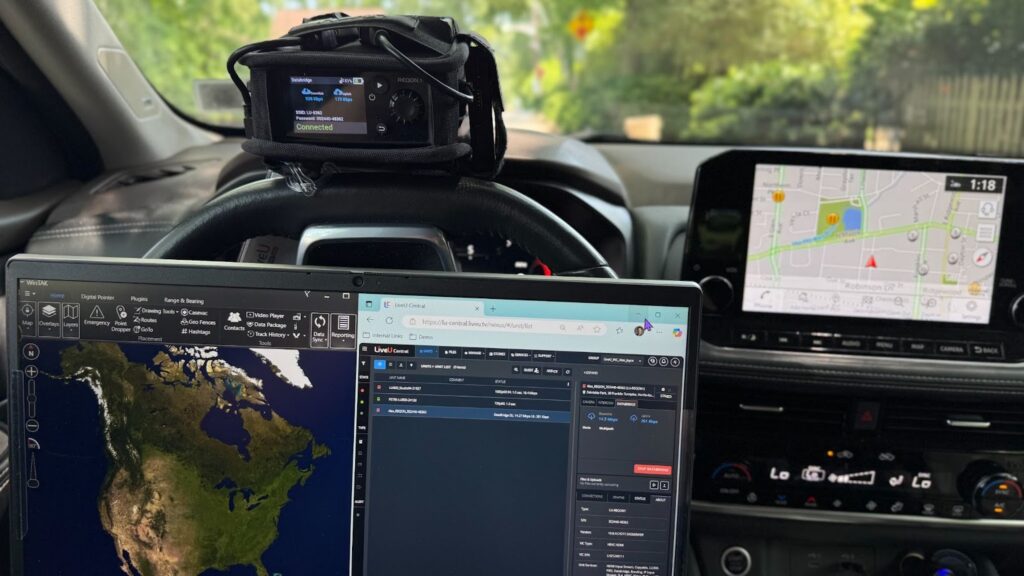
LiveU’s public safety offering is built around secure, real‑time video “from any source to any destination,” including headquarters, mobile command centers and field devices. That architecture supports not only “upward” reporting to command, but also lateral sharing across mutual‑aid partners who need to see the same incident as it unfolds. Typical use cases include streaming from drones, body‑worn cameras and vehicle‑mounted systems back to command centers, even in congested urban cores or remote environments with limited infrastructure.
The company now packages these capabilities into a Situational Awareness Solution that functions as a turnkey IP‑video backbone for public‑safety and tactical teams. The bundle centers on the LU‑REQON1, paired with a decoder and lightweight software for video and data transmission, with out‑of‑the‑box integration into existing visual‑intelligence ecosystems such as VMS platforms and UAV fleets.
At the technology layer, LiveU’s approach is anchored in its LRT (LiveU Reliable Transport) protocol and IP bonding. LRT is a low‑latency, high‑resiliency IP‑video protocol optimized to bond multiple IP connections-cellular, satellite, Wi‑Fi, Ethernet-into a more robust path, applying techniques such as acknowledgements and resends, packet duplication, forward error correction and adaptive bitrate to keep video stable as bandwidth fluctuates.
That transport layer underpins a hardware and software portfolio tuned for field use. Portable encoders like the LU‑REQON1 are compact bonded‑IP units that ingest feeds from UAS payloads, vehicle‑mounted systems, body‑worn cameras, fixed cameras and ad‑hoc tripod‑mounted lenses, then push those feeds back to command over whatever connectivity is available. On the receiving side, LiveU decoders and servers, deployed on‑premises or in the cloud, feed operations centers, real‑time crime centers or VMS platforms, while LiveU Central provides a unified C2 layer to view, route and control streams with sub‑second delay.
In practice, the design supports:
- Reliable real‑time video from ground, maritime and aviation assets to HQ, mobile command centers or first‑responder devices.
- Secure mobile viewing for dozens of recipients via unique, temporary links that extend situational awareness beyond the primary organization
- Mission‑critical ISR workflows across law enforcement, emergency management, border security and other agencies that require assured live feeds from the field to command.
“It’s critical that any solution is compatible with existing agency assets and platforms, is easy to deploy & maintain, and adds value to the mission capabilities” says Alex Joyce, Senior Director of the LiveU Public Safety & Critical Infrastructure technology division.
Crucially for public safety, the stack is built not just for vertical reporting, but for agile, lateral video sharing among vetted partners, whether that means HQ, a mobile command center, field units on mobile devices or mutual‑aid agencies. LiveU’s IP Pipe feature extends this model by tunneling control traffic, enabling remote operation of IP‑based devices such as PTZ cameras and trailer systems over the same bonded links so commanders can steer sensors as incidents evolve.
Law‑Enforcement and Tactical Workflows
For law enforcement, LiveU positions its technology across the full workflow: from initial call intake through patrol operations, tactical deployments, investigations and event security. Drone, vehicle and fixed‑camera feeds can stream directly into C2 centers and real‑time crime centers, giving analysts and commanders immediate visual context on active calls while maintaining stream stability in dense or patchy coverage areas.
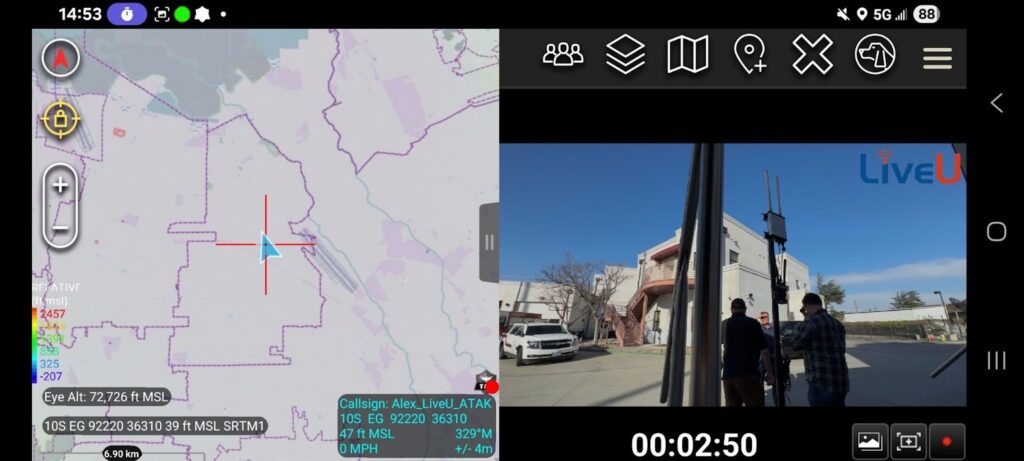
During SWAT operations, warrant service and other high‑risk events, exterior, interior and ground-based robots can send secure, low‑latency video to tactical command, which can then mirror curated views back to entry teams.
Stress‑Tested at Super Bowls, Olympics and FIFA events
Large sporting events are natural stress tests for communications systems, characterized by high RF noise, enormous cellular load and complex multi‑agency security architectures. These are the kinds of environments public‑safety planners worry about most, and they mirror the conditions where LiveU’s broadcast business has long operated.
LiveU’s public safety team points to recent deployments supporting state, local and federal partners around Super Bowl operations in Santa Clara as a proof point for the stack’s ability to maintain live video under heavy congestion and tight security constraints. The company has also briefed FIFA host-city stakeholders, including Kansas City, Miami, LA & Seattle, on how bonded‑IP live video can support distributed security architectures that span public‑safety agencies, venue security, private partners and, where applicable, federal entities. Those major‑event engagements are informing how LiveU packages its workflows for day‑to‑day policing, emergency management and planned special events.
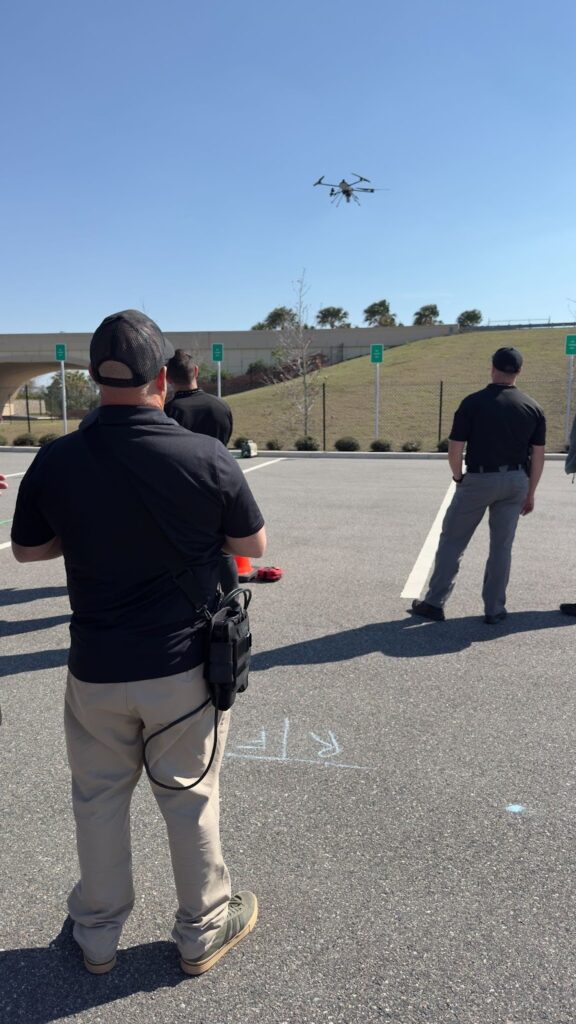
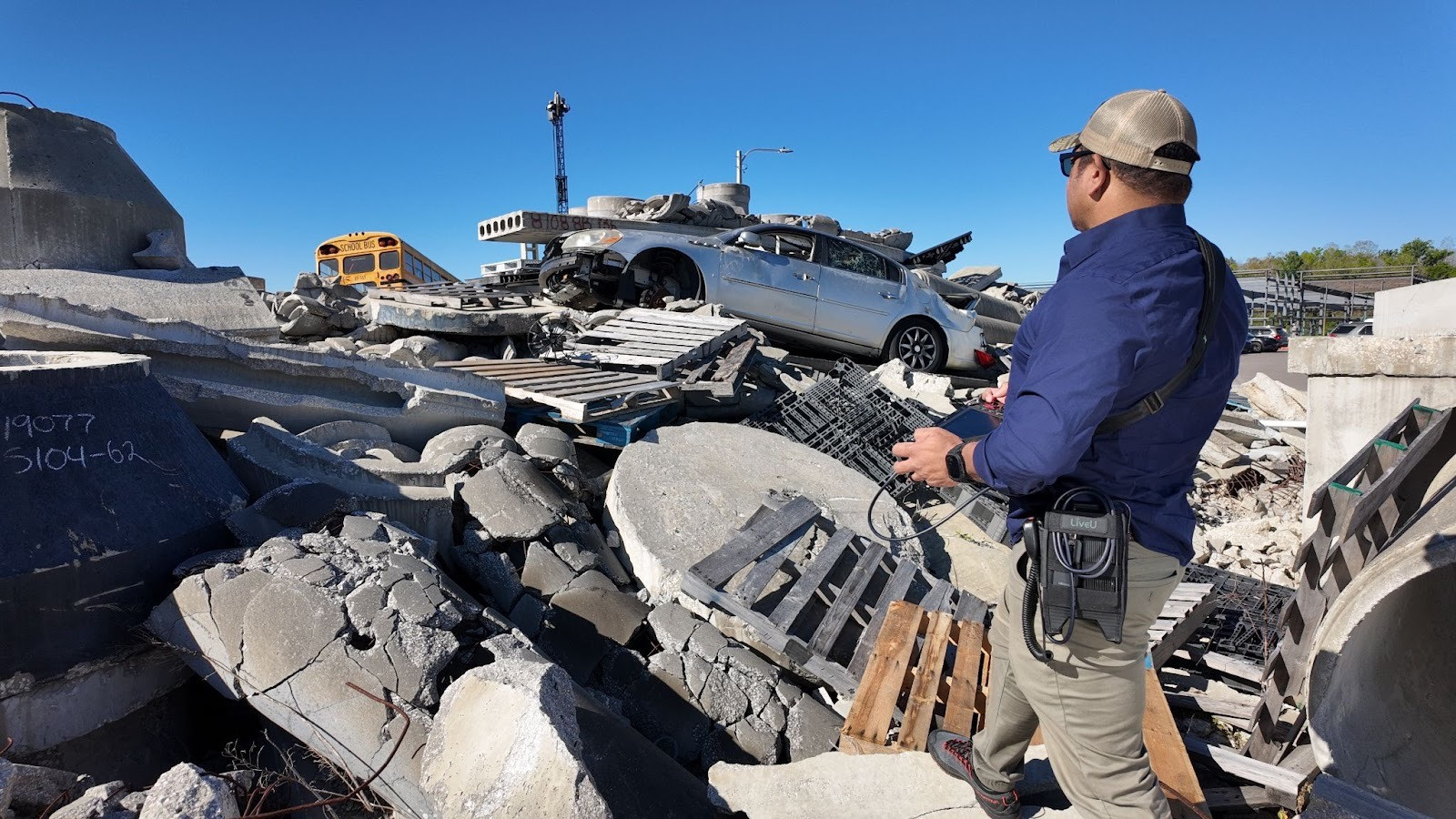
“We oversee and provide UAS teams for NFL events at Arrowhead Stadium and struggled to share this critical situational awareness video with law enforcement and EMS teams when a call for service was received during an event” says Tyler Grosser, KCFD Captain and USAR expert. “The ability to share video in real time from any of our ground-based or aerial robots with internal and external stakeholders has been easy and reliable when using LiveU bonded cellular field encoders. The additional options of the internet hotspot and accelerated file upload supports our mapping efforts to create 3D digital twins and detailed pre-planning and after-action reports”.
From Broadcast Roots to Public Safety Backbone
LiveU’s public safety focus builds directly on its broadcast heritage, where its bonded‑cellular backpacks and encoders became fixtures on sports sidelines and in electronic newsgathering (ENG) fleets well before “situational awareness” entered the public‑safety lexicon. That history, and the scale at which LRT‑based systems already operate, gives CIOs and operations chiefs a level of confidence that is often missing with bespoke tools that have not been hardened in real‑world conditions.
The same converged model that moves live 4K sports and breaking‑news coverage now underpins ISR‑grade video for law enforcement, border patrol, disaster response and critical‑infrastructure protection. In practical terms, that can mean a sheriff’s office streaming drone footage from a remote wildfire line back to county and state emergency operations centers, supporting a SAR team to find a missing person and helping to guide rescuers to their location, or a stadium security team sharing selected feeds with local and federal partners without rebuilding networks for every event.
Often referred to as a “Swiss Army Knife”, the LiveU EcoSystem contains numerous tools to support public safety and transportation agencies. The ability to encode and transport realtime video, provide resilient internet to the edge, enable ultra-fast upload of video files and folders full of image datasets following reconstruction and mapping missions, and even a tie-in to LMR communications systems to share talk channels across mobile devices, desktop and field units are just a few of blades of this virtual knife.
For agencies wrestling with how to build a resilient video layer that spans drones, vehicles, fixed cameras and mobile users, LiveU is positioning its public safety portfolio as the connective tissue that turns fragmented, sensor‑by‑sensor deployments into a coherent, bonded and shareable live‑video backbone for real‑world C2.