

By: Dawn Zoldi
Just as space has moved from a passive communications backdrop to an active warfighting domain, L3Harris Technologies burst forth on the 2026 Space Symposium scene with concrete progress to report. The Colorado Springs-based Space Defense Solutions team, a key node in the company’s broader ground-to-space enterprise, announced two significant milestones: operational acceptance of its Ground-Based Optical Space Surveillance (GBOSS) system at the Maui Space Surveillance Complex, and a $150 million option year seven award under its long-running MOSAIC contract with the U.S. Space Force.
From Space Situational Awareness to Space Domain Awareness
“Space is now a warfighting domain,” explained Art Loureiro, L3Harris Director & Program Manager, Space Superiority in Colorado. “And we used to not be able to say that.”
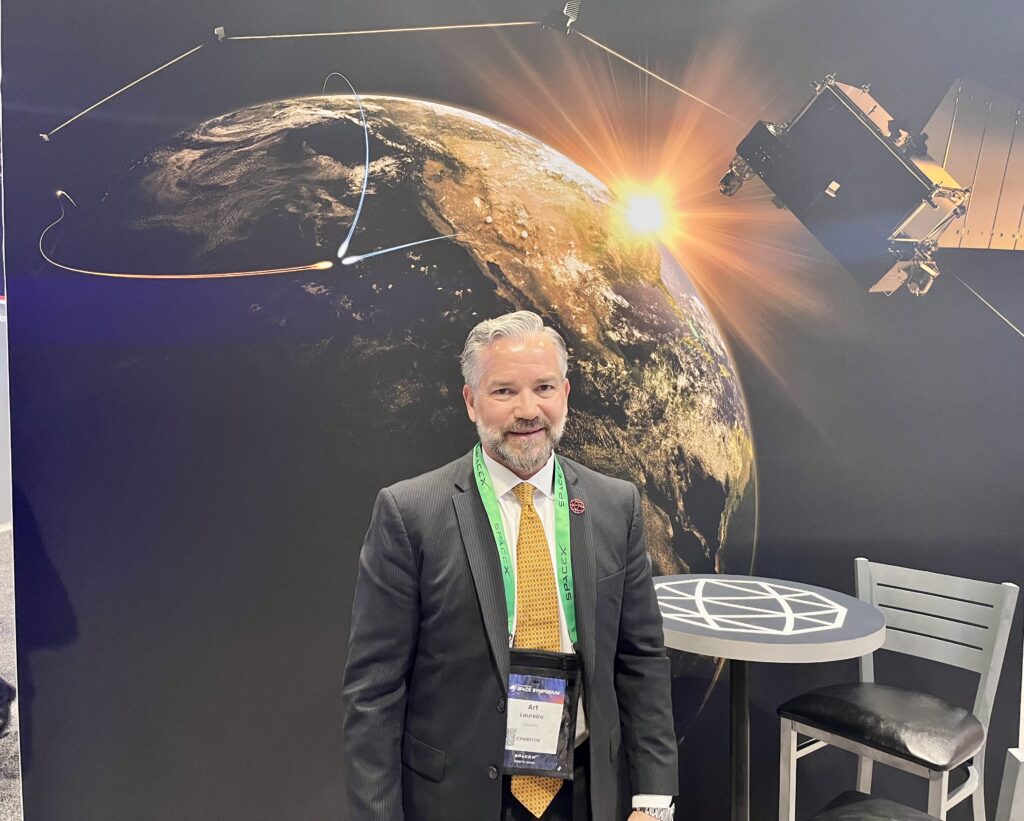
The language shift from “space situational awareness” (SSA) to “space domain awareness” (SDA) may sound subtle, but Loureiro, a retired Army infantry officer who cut his teeth at NORAD/NORTHCOM and Army Space and Missile Defense Command, emphasized that words matter. The older concept of SSA revolved largely around collision avoidance, such as tracking where the International Space Station was relative to debris fields. SDA by contrast, acknowledges that objects in orbit may now have adversarial intent that must be characterized, attributed and assessed.
“It’s not just an object in orbit anymore,” Loureiro said. “You have to ask: What is it? What is it doing? What is its intent? Can you attribute it to anybody?” He pointed to publicly reported cases of Russian satellites declared defunct that have since moved under their own power as a clear indicator that what was once labeled as “junk,” might actually be an active counter-space asset.
China’s 2007 anti-satellite missile test, which generated a debris field that persists in orbit today, also fundamentally changed how the Pentagon views orbital operations. The U.S. followed with its own anti-satellite (ASAT) demonstration, though at a lower altitude where debris burned up in the atmosphere.
Since then, a combination of congestion from commercial satellite constellations and deliberate adversarial action has transformed the orbital environment from permissive to contested. L3Harris has spent years positioning itself to operate across every layer of that challenge.
GBOSS: A Complete Sensor Overhaul, Not Just a Software Patch
The centerpiece of L3Harris’ Space Symposium story involves its Ground-Based Optical Space Surveillance system, an upgrade to the decades-old Ground-based Electro-Optical Deep Space Surveillance (GEODSS) network. L3Harris operates that network at three geographically distributed sites: White Sands, New Mexico; Haleakalā, Maui; and Diego Garcia in the Indian Ocean. The three sites together provide near-continuous visibility across the globe to reach past the geosynchronous belt and into deep space.
GBOSS is not a software update. Loureiro described a full system overhaul in which even the physical sensor hardware was replaced. It involved ground-up hardware replacement that included new cameras, new algorithms, as well as new software. “The only thing that looks the same is the exterior,” Loureiro said.

The previous camera was roughly 40 pounds. L3 Harris’ new one fits in a shoebox. Despite the size reduction, sensitivity and tracking acuity have improved dramatically. The result, according to L3Harris, is four times the coverage area with significantly greater clarity when characterizing orbital objects.
The U.S. Space Force declared operational acceptance of GBOSS at the White Sands site in 2025, and its operational acceptance at Maui followed. L3Harris described this latest milestone as demonstrating consistent execution across the global GEODSS network.
Jeff Hanke, President of Space Systems at L3Harris, framed the capability in direct operational terms. “GBOSS delivers exactly what today’s warfighters need: faster, more precise awareness in a domain where seconds matter,” he said.
The Maui acceptance is particularly significant given the site’s positioning atop Haleakalā volcano, which provides a wide southern viewing angle over the Pacific and Indian Ocean orbital corridors. It sits on prime real estate for tracking high-value geosynchronous satellites and any objects maneuvering near them.
Loureiro noted that L3Harris delivered GBOSS ahead of schedule and under budget, two phrases that rarely appear together on major defense programs, and which he acknowledged carry real weight with government customers evaluating whether to continue long-term partnerships. “Those are words the government likes to hear,” he said.
MOSAIC Option Year Seven: $150 Million to Continue Critical Work
Alongside the GBOSS milestone, L3Harris secured a $150 million contract award for option year seven under MOSAIC, an acronym that stands for Maintenance of Space Situational Awareness Integrated Capability.
Now in its seventh of ten years, the contract funds a portfolio of programs including the Eglin Radar System, a deep-space radar based in Florida capable of tracking objects out to and beyond the geosynchronous belt, as well as the GEODSS/GBOSS optical network and the command-and-control (C2) infrastructure that ties sensor data together.
Closing the Kill Chain from Ground to Deep Space
What also distinguishes L3Harris’ approach from single-sensor competitors is its end-to-end position across the space domain kill chain. The company’s ground-based Space Defense Solutions division, Loureiro’s team in Colorado, covers the find, fix and assess functions. It has radars, telescopes, and operation centers embedded in every Title 10 space operations center as well as in Intelligence Community (IC) facilities. A separate L3Harris division handles the “engage” function through directed energy and other emitters. C2 software then stitches it all together.
Crucially, the C2 layer ingests data not only from L3Harris’ own sensors but also from commercial providers. It converts third-party observations into the standardized formats the Space Force loads into the Unified Data Library (UDL), a centralized repository that on peak days handles roughly 900,000 individual observations. With more than 7,000 commercial satellites now contributing data, the volume makes human analysis alone untenable. L3Harris’ operation centers apply software algorithms and machine learning to correlate and prioritize what matters, whether that means flagging a potential conjunction requiring a satellite maneuver or identifying an adversarial asset changing its orbital plane.
Expansion: Hiring in Colorado Springs and Hypersonic Detection
Despite ongoing discussion about the U.S. Space Command’s headquarters move to Huntsville, Alabama, Loureiro pushed back on any narrative that Colorado Springs is losing relevance. The operational units that actually execute space missions, the personnel at Schriever Space Force Base and Peterson Space Force Base, are staying put, and L3Harris is actively hiring across every discipline at its Colorado Springs offices to keep pace with the workload.
The company is also expanding beyond ground-based systems. L3Harris’ hypersonic and ballistic tracking space sensor (HBTSS) program, developed at its Fort Wayne facility, was accepted by the Missile Defense Agency following a competitive fly-off. Four Tranche 0 satellites are already on orbit, with 52 more planned across Tranches 2 and 3. Those satellites form a proliferated space layer designed to track hypersonic missiles, a capability Loureiro tied directly to the broader Golden Dome discussion. “We don’t have PowerPoint presentations,” he said. “We have hardware that works.”
The combination of a proven optical upgrade, a funded long-term contract and a growing satellite tracking layer positions L3Harris as one of the most deeply integrated players in the SDA enterprise. These capabilities could not come at a better time, especially as the U.S. government is under growing pressure to outpace adversaries who have spent years demonstrating they view America’s space infrastructure as a legitimate target.