

By: Dawn Zoldi
As the year comes to a close, in reflection, one of the most shocking events this year for aviation occurred just at the year’s start, in January 2025, when a routine evening flight ended in horror. A U.S. Army Sikorsky UH-60L Black Hawk and an American Airlines CRJ700 collided in mid-air just a half mile southeast of Reagan National Airport. Sixty-seven souls were lost in what became the deadliest U.S. aviation disaster in decades. As details later emerged during contentious National Transportation Safety Board (NTSB) investigative hearings, the data illuminated an obvious opportunity for technological intervention which might have averted disaster altogether: next-generation collision avoidance, known as Airborne Collision Avoidance System X (ACAS X).
Unpacking NTSB Testimony and a Missed Safeguard
The NTSB’s exhaustive three-day hearings took place from July 31 to August 3, 2025, with extensive investigative sessions and testimony. Officials scrutinized every facet of the incident, from air traffic controller (ATC) workload and communications breakdowns to limitations in cockpit awareness. Evidence highlighted multiple systemic gaps that allowed a helicopter and regional jet to fatally cross paths. The revelation that while ATC failed to alert the airliner to the helicopter’s presence was bad enough. Particularly damning, however, was the fact that the Black Hawk pilots weren’t fully aware they were in the path of the incoming jet. Expert testimony and real-world simulation studies both revealed stark limitations in traditional “see-and-avoid” philosophies and underlined the role technology should play in modern airspace. One MIT simulation, using the exact geometry of the DC accident, tested multiple collision-avoidance solutions. Of all the systems modeled, which included traditional Traffic Alert and Collision Avoidance System (TCAS), pilot procedures and new tech, only the ACAS-Xr system (the ACAS version designed for rotorcraft) consistently avoided the collision.
TCAS, Achievements and Gaps
For decades, the TCAS has formed the backbone of airborne safety nets. TCAS, mandated in large commercial aircraft since the late 1980s, provides pilots with visual displays of nearby transponder-equipped aircraft, issuing Traffic Advisories (TAs) as aircraft draw close, and Resolution Advisories (RAs) recommending last-ditch maneuvers to avoid impact.
Yet, as illustrated in both training environments and real-world events, TCAS has crucial weaknesses. It traditionally handles only fixed-wing aircraft and issues advisories in the vertical dimension. Its logic assumes highly predictable flight paths and crew reactions, banking on older dynamic programming and a relatively simple set of scenarios. In complex airspace, especially with helicopters, emerging electric vertical takeoff and landing (eVTOLs) or uncrewed aerial vehicles (UAVs), TCAS assumptions often break down.
Additionally, during final approach at airports, TCAS incorporates several automatic inhibitions to prevent nuisance alerts that could distract or unnecessarily alarm pilots. Specifically, TCAS is programmed to automatically suppress RAs below 1,000 feet above ground level (AGL) and TAs below 500 feet AGL to minimize irrelevant or unsafe maneuver recommendations during the most critical phases of landing and takeoff. In some operational environments, such as parallel runway approaches or tightly spaced arrivals, crews may manually set TCAS to a less sensitive mode, or even switch advisories off, following company or national procedures, to avoid frequent nuisance alerts that can occur in dense traffic situations. This process, known as “TCAS inhibition,” is necessary because the traditional TCAS logic does not adequately account for the complexity of close approaches, especially with helicopters, eVTOLs, or UAVs operating in proximity to runways and controlled corridors. While inhibition improves situational relevance, it also leaves a significant safety gap.
ACAS X Modern Collision Avoidance
ACAS X stands as the direct successor to TCAS. It leverages Monte Carlo simulations (computational techniques that use thousands to millions of randomized scenarios to predict how future conflicts between aircraft might develop in three-dimensional airspace) and machine learning (ML) to assess not just probable but possible future conflicts across a full spectrum of airspace participants. It consists of a family of systems: ACAS Xa (for large commercial aircraft), Xo (for special operations), Xu (for unmanned fixed wing aircraft), and Xr (for rotorcraft, including traditional helicopters, new eVTOLs and unmanned rotorcraft).
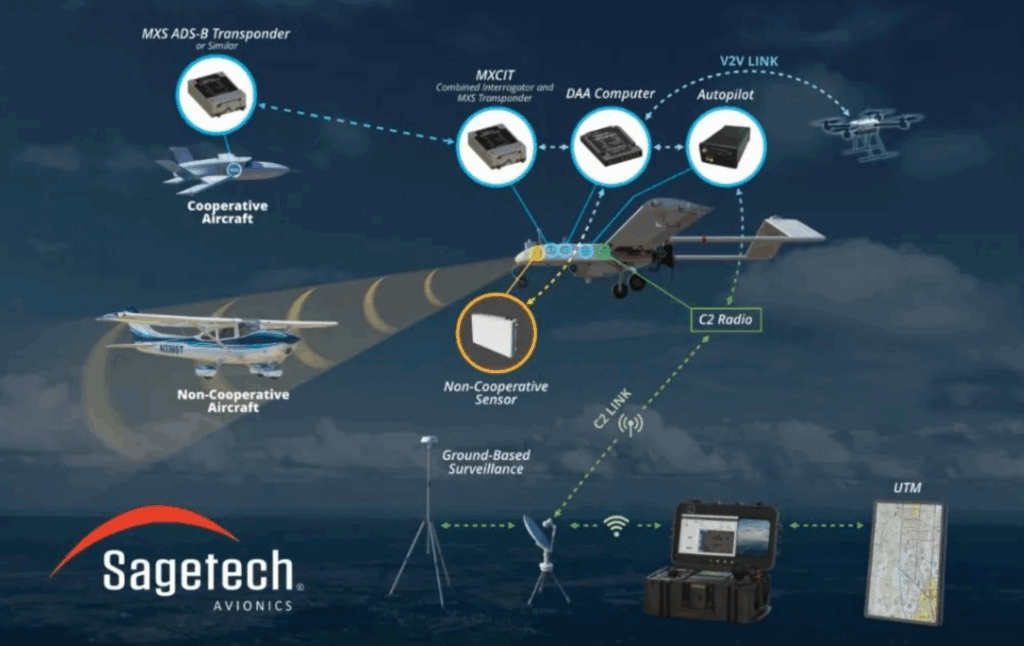
Unlike TCAS’ limited, largely vertical advisories, ACAS X can offer guidance in both horizontal and vertical axes, or blended maneuvers. This provides pilots with optimum escape paths for their unique platform. Using inputs from a range of sensors and modern dynamic algorithms, it tailors advisories to an aircraft’s specific performance and operational context. Whether the threat is a fixed-wing jet or a low-flying drone, ACAS X adapts, reduces nuisance alerts and delivers actionable direction in seconds.
MIT and NASA Simulations: ACAS-Xr’s Performance
The real world is unpredictable, but simulations can illuminate otherwise hidden peril. MIT’s extensive Monte Carlo-based studies, underpinned by NASA’s high-fidelity helicopter motion simulators, revealed the striking deficiencies of conventional technology and the life-saving power of ACAS-Xr. In simulation scenarios reproducing near-miss geometries, including the tragic profile of the DC mid-air, systems such as TCAS II (the most current version of TCAS) and human procedures failed to avoid catastrophe. Only ACAS-Xr, designed specifically for rotorcraft using machine learning-optimized logics, consistently provided resolution advisories in time to avert impact. In the simulations, ACAS Xr not only provided the largest miss distance between the conflicting aircraft, but it also provided substantially earlier alerting, giving the aircrew plenty of time to react to avoid a collision.
Pilot assessments further validated these findings. All participants in NASA’s human-in-the-loop helicopter studies complied with ACAS-Xr’s RAs within the required time, and no near mid-air collisions occurred during testing. Its suggestive (cautionary) and directive (imperative) advisories offered crew both early situational awareness and precise last-minute guidance. Both of these were sadly absent on that fateful night in D.C.
ACAS X Is Needed for Emerging Aviation
The airspace of tomorrow will host unprecedented diversity. Air taxis, cargo drones, military UAVs and legacy helicopters will intermingle in urban and rural skies. Each type will have different operating envelopes, speed, and capabilities. This renders one-size-fits-all solutions, like traditional TCAS, obsolete.
ACAS X’s architecture, particularly ACAS-Xu (for fixed wind unmanned systems) and ACAS-Xr (for rotorcraft), is fully programmable to account for non-cooperative targets, dense traffic and variable pilot compliance. It enables advanced DAA capability not just for the fresh cohort of air vehicles, but also for operators seeking to fly Beyond Visual Line of Sight (BVLOS), such as with urban cargo delivery or eVTOL passenger operations. The technology provides a bridge between the realities of modern traffic and the vision of seamless, safe and integrated skies.
To help make this vision a reality, Sagetech Avionics offers a robust suite of ACAS X-integrated products engineered for both crewed and uncrewed aircraft, with a particular focus on scalability, low size, weight, and power (SWaP) and high certification standards for emerging aviation needs.
The company’s hallmark offering, the ACX-3000 platform, doubles as a civil transponder and an ACAS X-enabled interrogator. This means it combines transponder, detect-and-avoid (DAA) logic and compatibility with sensor-agnostic radar-based non-cooperative inputs in one compact unit. Prototypes of this all-in-one solution have been part of ground-breaking BVLOS waivers, have been used for FAA data collection, and are currently being used in a wide variety of unmanned aircraft. This system is SWaP optimized for use in eVTOLs and UAS to support safe beyond visual line of sight (BVLOS) flight and autonomous operations in mixed-density airspace.
For smaller aircraft, such as light drones, Sagetech is developing the ACX-2000 series. This ultra-low SWaP, passive DAA solution will incorporate ACAS sXu variant, which was designed for smaller UAS. Both ACX platforms can fuse radar, ADS-B and UAS traffic management (UTM)-derived inputs to provide reliable collision avoidance and safety enhancements regardless of whether the aircraft is remotely piloted, autonomous, or fully uncrewed.
On a recent Dawn of Autonomy podcast, Tom Furey, CEO of Sagetech Avionics, said, “Our goal isn’t just retrofitting safety for today’s drones or eVTOLs. It’s laying the foundation for every aerial vehicle that will share the sky, whether piloted, autonomous, or somewhere in between. When your avionic system can think ahead, sense more and guide smart decisions in real time, you’ve moved beyond compliance. You’ve made safety actionable.”
Sagetech’s modular, integrated approach is designed to flex with evolving regulatory and operational frameworks. This gives operators and manufacturers a clear path to implement next-generation ACAS X capabilities, now and into the future.
Moving Forward: What Must Change
The DC mid-air collision was a harrowing warning. The technology to avoid repetition is now at hand. As the NTSB’s hearings made clear, relying solely on human vigilance as the last defense is a recipe for disaster. Integrating next-generation airborne collision avoidance technology, such as ACAS X, is both achievable and essential.
Regulatory bodies must move with urgency to clear certification pathways and require compatible systems, particularly in complex, mixed-mode airspace around major cities. Flight operators, meanwhile, should view advanced collision avoidance as a core element of responsible operation.
The events over Washington, D.C. compelled the aviation world to reexamine outdated assumptions. The MIT and NASA findings show conclusively that, in scenarios where human cognition and old tech fall short, ACAS X rises to the challenge by literally taking aviation safety to a higher level. According to Furey, the future of airspace will depend on layers of safety. Pilots and operators, onboard and ground-based sensors, air traffic control, UTM, and intelligent systems like ACAS X will all be needed to eliminate tragic mid-air collisions. “Only then can we ensure that every kind of aircraft can safely integrate into the airspace of the future,” he said.