

Warren County Community College, one of the most credentialed drone programs at the community college level in the country, is stepping into one of the fastest-growing corners of the drone industry. At Commercial UAV Expo, Peter Miller, Chief Pilot of the WarrenUAS program told attendees that the school is rolling out a new counter-UAS concentration, adding a security-focused track to a program that has spent nearly a decade training pilots for agriculture, mapping and public safety work.
A New Concentration Built Around Threat Detection

WarrenUAS has offered an associate degree in unmanned systems since 2018, through which students can choose from concentrations that include photogrammetry and precision agriculture. Starting this fall, counter-UAS joins that list as the program’s newest specialization.
The concentration is built around three courses layered into the standard degree track. The first, UAS Illicit Activities, Terrorism and Warfare, focuses on identifying threats and hardened targets. The second covers UAS laws and regulation. The third, UAS Detection and Mitigation Technologies, dives into the hardware and software used to spot and neutralize hostile drones.
“This class is being taught by an actual national expert,” Miller said, consistent with the program’s efforts to bring practitioner-level instruction into the classroom rather than relying solely on textbook theory.
The counter-UAS launch fits into a broader expansion timeline. WarrenUAS plans to add airport operations and air traffic management coursework in fall 2027, followed by maritime operations in fall 2028. Those additions will sit alongside two existing degree tracks: an associate in applied science designed for students headed straight into the workforce, and an associate degree intended for those planning to transfer into a bachelor’s program.
Field Work Over Classroom Theory
Throughout the presentation, Miller returned repeatedly to the theme that real-world exposure matters more than lecture time. “We’re big on taking it out of the classroom because when you’re in the field, there’s glitches, there’s real-life problems that have to be solved, and you have to know what you’re doing,” he said.
That philosophy shows up in the program’s research portfolio. Students have monitored algae growth on a lake, partnered with Rutgers University to measure black bear damage to corn crops in northern New Jersey using drone-based imaging instead of low-tech ground surveys, and worked with New Jersey Transit to scan a thousand-foot, century-old train tunnel with LiDAR before it was partially demolished.
One project stood out for its unconventional method. WarrenUAS trained the New Jersey Department of Fish and Game to count deer populations using thermal drone imaging, This replaced a system that relied on spotting eyeballs with flashlights in the woods at night. “They were counting up all the eyeballs and dividing by two,” Miller quipped, before WarrenUAS brought drones to the table.
Custom Training for Law Enforcement and Government Agencies
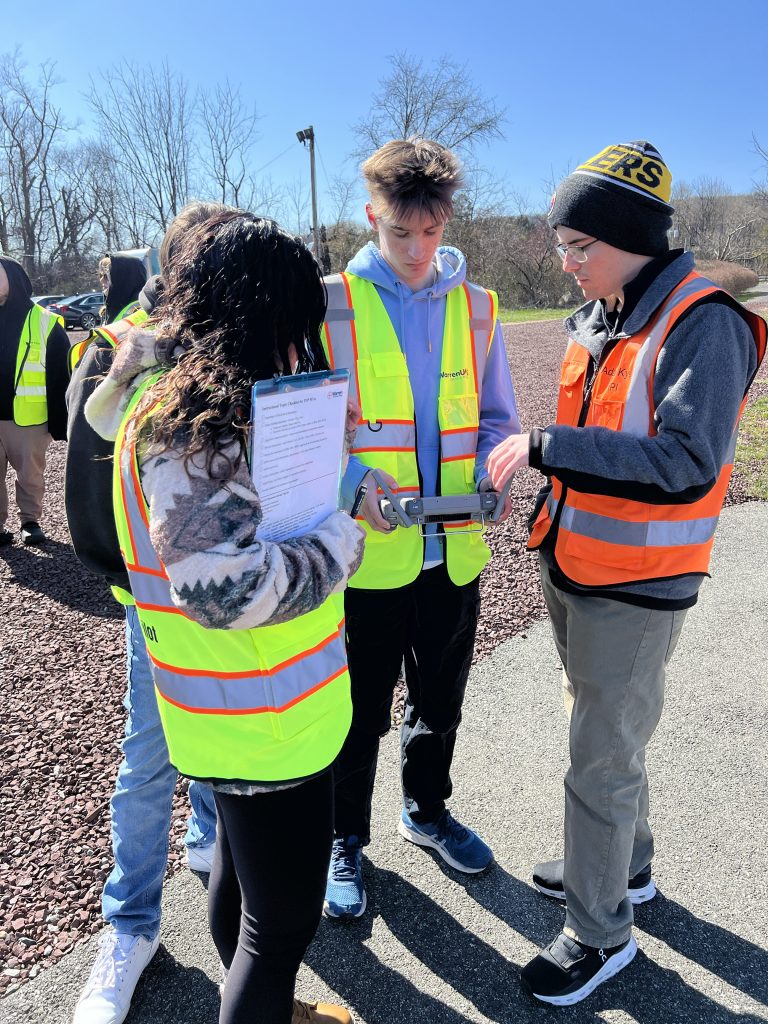
Beyond degree-seeking students, WarrenUAS runs a robust custom training operation for external organizations. The long list of groups supported includes law enforcement agencies, first responders, high school STEM teachers, military branches, state and federal government agencies and utility companies.
Course offerings for these stakeholders include Part 107 exam prep, fixed-wing flight operations, advanced technical and first-person-view operations training for law enforcement at two skill levels and specialized night-operations training for public safety teams. The breadth of that curriculum reflects a program built to serve working professionals, not just traditional two-year students.
Fleet Size and Federal Certifications Set the Program Apart
WarrenUAS operates roughly 90 aircraft, a fleet size Miller attributed directly to the college’s community college model. “We don’t require our students to purchase a drone,” the speaker explained. “They get to use our drones when they fly.”
The program holds several credentials that distinguish it from peer institutions. WarrenUAS is a member of the FAA’s Collegiate Training Initiative and holds ASTM certification. All instructors are certified as AUVSI Trusted Operator Level 3 Remote Pilot Instructors, and students can graduate at Level 3. The college also holds certificates of waiver for beyond-visual-line-of-sight (BVLOS) operations and operations over people, along with a rare 44807 exemption that allows training on aircraft over 55 pounds.
Physical infrastructure backs up the credentials. The program’s flight training area has been designated as a FRIA (federally recognized remote ID area) and supports outdoor operations. A 5,000-square-foot laboratory houses lab classes capped at 10 students each to maximize hands-on instruction. The program has separately secured a partnership allowing graduates to transfer directly into Embry-Riddle Aeronautical University’s Worldwide Campus.
Growth Trajectory Points to Continued Expansion

The counter-UAS concentration is not an isolated addition. Industry coverage from earlier this year noted that WarrenUAS expected to enroll more than 70 students this fall, working across roughly 80 to 90 unmanned systems and newly expanded facilities. The college represents a broader trend from Commercial UAV Expo, where more community colleges and universities seem to increasingly be building dedicated drone and autonomous systems degree tracks .
For hiring managers and industry recruiters, Miller’s closing message doubled as a pitch for the program’s graduates. “I want to give you an idea of what our program’s all about for the time when a resume passes your desk and you see the name Warren Community College,” he said.
As counter-UAS threats continue to shape security planning for airports, utilities, and public events, WarrenUAS is positioning its graduates to fill a labor gap that many employers are only beginning to recognize. The program’s combination of field-tested research, federal waivers and now a dedicated counter-UAS track suggests the school intends to keep pace with exactly where the drone industry is headed.