
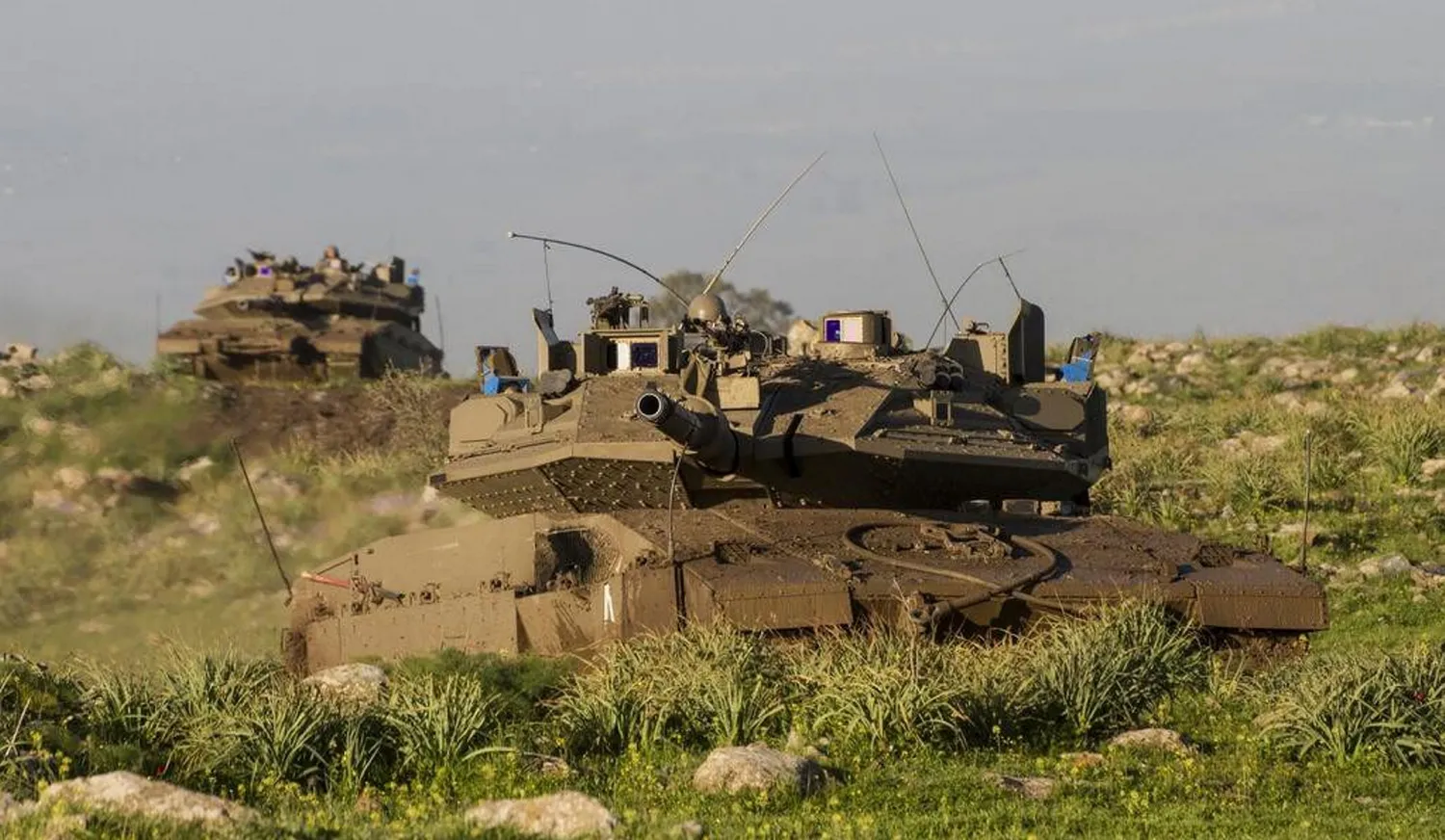
Is the main battle tank (MBT) still valid in the new combat zone?
According to Israeli experts the current design will have to undergo many changes, including the heavy use of AI that will help the platform to survive against fast evolving threats.
The question has been in the air for quite some time, but the wars in Ukraine and Israel have brought it to the top of the list: Is the main battle tank (MBT) still valid in current and future wars, and if the answer is positive, what changes are needed?
The Israeli Defence Forces (IDF) are operating one of the most advanced MBT’s the Barak, an upgraded version of the Merkava 4 , but the question is asked in the armored corps and the defence industry.
Brig. General (Res ) Guy Hasson was the commander of the armored corps. of the IDF. He told Autonomy Global that the challenge of protecting an MBT has become very complicated ” Active protection systems work very well against horizontal threats like ant tank missiles, but when the threat is a drone that problem gets more complicated. Some tanks are equipped with active protection systems like the Rafael Trophy, but these will have to be further upgraded to deal especially with the detection of the tg09ratet”
Hasson added that while detection is critical, identification is super critical as the battlefield is characterized by different aerial systems not only of the enemy.
” Early detection will allow the tanks to take elusive maneuvers even before it protection systems are operate d
Hasson said that the tank remains a very important platform, but it will have to perform more functions in battle. ” The systems in new tanks will have to supply the crew with enhanced situational awareness, and this will be supported by AI”
The Israeli officer said that the tank will also have to become more networked so that its operations are in full coordination with other platforms in the battle. ” This upgrade is already being performed on the Israeli Merkava tanks, but I cannot elaborate”
Battle-hardened Ukrainian drone operators successfully located and nearly destroyed an entire rotating U.S. Army armored brigade during recent NATO war exercises in Germany (such as Exercise Combined Resolve). The strong debate over whether the classic MBT is becoming obsolete was sparked by this stunning drubbing, which revealed serious frontline drone and counter-drone weaknesses for heavy legacy assets..
Heavy armor is deprived of conventional concealment by small, inexpensive FPV and reconnaissance drones that prevent any secure hiding places.
Without strict electronic warfare integration and short-range air defense, conventional heavy armor, such as Bradley combat vehicles and M1A2 Abrams, which cost billions of dollars, struggles against agile aerial threats.
Mid-exercise, units must quickly become proficient in localized counter-UAS procedures, electromagnetic signature reduction, and active dispersion.
The MBT is experiencing a significant conceptual transition away from thick steel and brute heft and toward digital connectivity and survivability, far from being completely abandoned.
Cooperative next-gen European projects—like the Franco-German Main Ground Combat System (MGCS)—have faced severe political and industrial delays, pushing deployment deep into the 2040s and forcing nations toward interim stopgap platforms and automated turret designs.
The future of the main battle tank depends less on traditional armor thickness and more on active protection systems, artificial intelligence, and integration into a broader multi-domain drone ecosystem. .
According to a research paper written by Prof. Azar Gat from the School of Political Science, Government, and International Relations at Tel Aviv University, tanks will no longer come within the kinetic firing range of each other.
” The tank’s heavy armor has similarly reached the limits of its ability to withstand precision, tandem hollow-charge, fire-and-forget munitions, which target the tank’s top. The wholesale destruction of the hapless Armenian army in the 2020 war against Azerbaijan, like the stranded and harassed Russian convoy en route to Kiev and the image of the Russian armored battalion massacred during its attempted river crossing in the Donbas, with the shattered bridge in the middle, starkly demonstrates the current reality. The same can be said of the rash retreat from the Saluki wadi by the Israeli army’s 401st Brigade Merkava Mark 4 tanks during the Second Lebanon War (2006) when faced with second-generation Russian Kornet anti-tank missiles fired by Hezbollah. Since then, there are now third-generation, fire-and-forget anti-tank missiles, but there are also advanced new defensive capabilities available for tanks.”
According to the Israeli researcher this does not mean that the tank and other fighting vehicles are history. But the answer is not to be found in further reinforcing the heavy armor or in improved tactical practices, clumsy as Russian tactics proved to be.
”Rather, the answer lies in a full-scale adjustment of land fighting vehicles to the ongoing electronic revolution – above all, in adopting active defense systems, such as the Israeli Trophy and Iron Fist, now purchased and installed by the US, German, and British armies. Active defense means electronic detection, disruption, and interception of incoming projectiles, launched from land or from the air – the same revolution that sea and air warfare have already undergone. Electronic systems designed to disrupt and down unmanned aerial vehicles and drones – those that launch munitions and kamikaze drones, either individually or in a swarm – are also in advanced stages of development. That is the future”.
According to Pro. Azar Gat Active defense systems (APS) are currently installed on heavily armored fighting vehicles as something extra, whereas they are in fact destined to replace the heavy armor, whose effectiveness has in any case plummeted. Current fighting vehicles installed with active defense systems are thus intermediate breeds that combine two eras – the old and the new. This is true for the latest models of the American Abrams, German Leopard, British Challenger, and Israeli Merkava alike. The heavy armor is no more necessary for land fighting vehicles than the 350-400mm steel armor of the past is necessary for warships today. In fact, it is a disadvantage.
”Indeed, relying on electronic detection and interception systems enables a drastic reduction in the armor of fighting vehicles for what is necessary against small arms, shrapnel, and blasts. Thus there is an expected reduction in their weight to about 10 to 25 tons; a parallel reduction in engine size and weight; and design re-orientation to electronically guided defensive and offensive systems. This, I believe, is the direction in which land warfare and land weapon systems is heading in the electronic-computerized age.”
The significance of this revolution in terms of the structure of units and battle formations is no less far-reaching. Here, too, open sources indicate that the IDF has already made extensive changes: the number of tanks has been drastically reduced, innovative electronics have been introduced, efforts are underway to increase cooperation between the various arms and “dimensions”, and the army has formed, on an experimental and semi-experimental basis, integrated combat units for “multidimensional” combat, in order to examine groundbreaking troop structure, weapon systems, and military doctrines.
This is indeed the direction – without delving into complex techno-tactical questions. It does bear mentioning, however, that there is no room in the modern army for the old-fashioned tank brigades. All the changes and adaptations to their structure and equipment, and the plan to operate them as part of multidimensional combat units, are necessary steps – but they are not enough. Combat teams are designed to adapt basic formation structure to suit specific forms of warfare. But the basic structure itself is supposed to provide an answer to the kind of fighting one would typically expect. In the past, it was patently clear how armored formation were used as the main element of maneuver warfare. But there is no scenario today in which tanks would be used in this way. The glorious legacy of these formations will have to be adapted to the new era. Both the armored fighting vehicles and the structure of units and formations will have to undergo a major redesign, in which all the other elements of the electronic revolution will play central roles: connectivity, automation, and cyber – defensive and offensive
The question is in the air but there is still no clear answer about the changes that the MBT needs in order to stay an important war tool/
Recent conflicts in Gaza and Lebanon demonstrate that tanks remain the ultimate ground-pioneering tool in built-up areas when paired with active protection.
In June four IDF soldiers were killed when a Hezbollah attack drone struck ta tank in Lebanon.
Rapid adaptation focuses on mitigating loitering munitions, FPV drones, and top-attack hazards through roof-shielding and intelligent sensor countermeasures.
Prototypes and future designs explore minimizing operational burdens, potentially moving toward automated loading and smaller crew requirements.
Bottom line – the MBT will continue to be one of the important tools in ground warfare, but changes, deep changes will have to be introduced to keep its survivability.