
By Dawn Zoldi
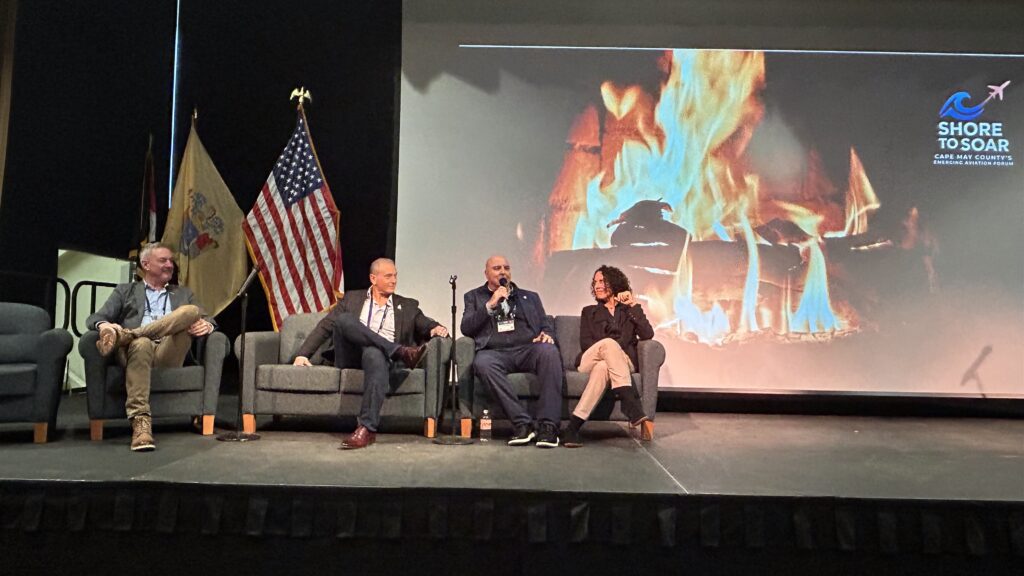
When I walked up to the stage to moderate a “fireside chat” about the Cape-Atlantic UAS Test Range panel at Shore to Soar (S2S) 2026, an electric fire blazed a few feet away on the big screen at the Cape May Convention Center. That production touch fit, because the conversation focused on something heating up fast…the Cape-Atlantic UAS Test Range. Three men who have spent years building one of the most strategically situated test ranges on the East Coast told the story of how it came to be, and where it’s headed. But well before we even got to that panel, Cape May County’s elected leadership had already set the tone for the day. They made clear that the political will behind the test range is as real as the airspace above it. And that matters.
Political Will Meets Runway
In aviation, there is an old saying: airspace is not enough. You need people in power who understand why it matters. They showed up in force for S2S.
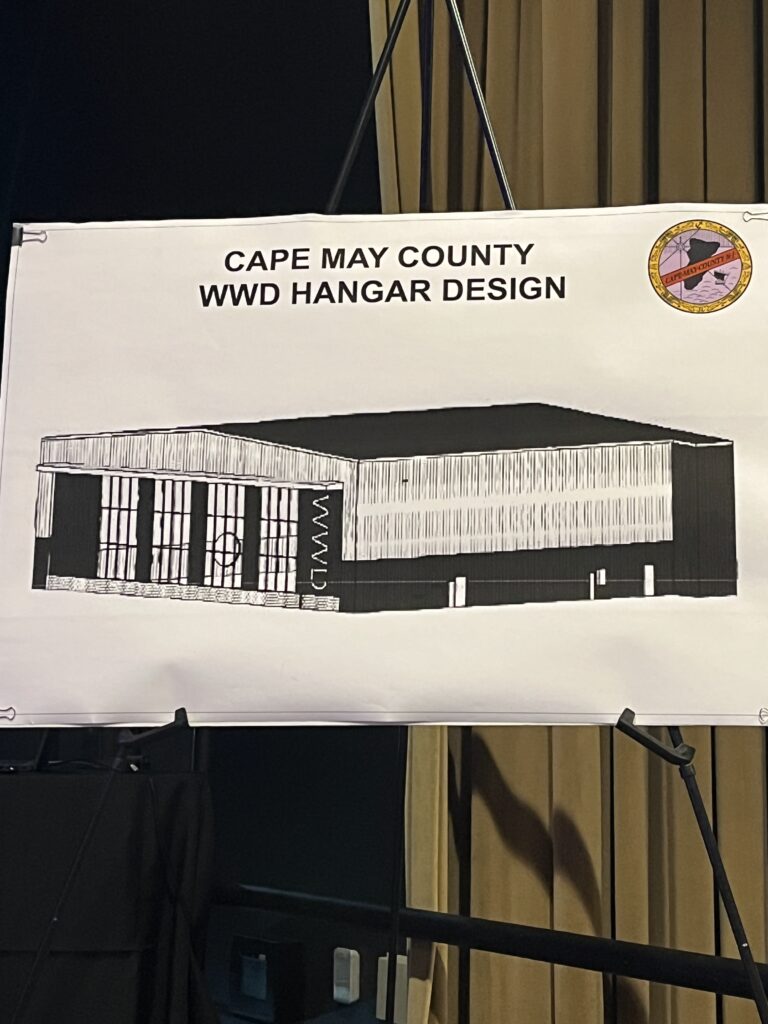
Cape May County Commissioner Director Leonard C. Desiderio opened the event with a big announcement. “I am proud to announce that the Board of Commissioners recently awarded a $7 million contract to construct a public use hangar at our airport, set to begin construction on May 11th,” he said. The county government is putting some real capital behind a real commitment.
Assemblyman Antoine McClellan of New Jersey’s First Legislative District piled on. He pointed specifically to Cape May County Airport, alongside regional hubs in Ocean City and Woodbine, as assets that may look underutilized on paper but are, in his words, “ripe for the picking for unmanned systems.”
County Planning Director Will Hanson gets credit for perhaps the best one-liner of the day. “Why would you want to fly in the middle of nowhere, when you can fly in the middle of somewhere?” he said. That “somewhere, Cape May County, provides more than just a tourist destination and the commercial businesses around it. For the UAS test crowd, the county’s footprint offers coastal airspace, barrier islands, farmland, wetlands and dense municipal areas, all within striking distance of Cape May County Airport. As Hansen put it, that makes the range “one of the most diverse operational testing markets on the East Coast.”
One of Cape May County’s Economic Development gurus, Joe Molineaux, has been building that ecosystem for years. Today, as reflected in the string of local leaders who stood on the stage to support S2S, counties and municipalities that once operated in separate silos now actively coordinate. The synergy between Cape May and Atlantic County, across multiple airports and multiple government layers, has produced something truly unique.
An Idea Becomes An FAA-Affiliated Range
Every endeavor has an origin story. Ron Leach, Principal of Leach Strategic Partners, credited Molineaux and Ray Adams, Founder of Airde Elevated Thinking who co-created the Urban Low Altitude Transport Association (ULTRA) with Leach, as visioneers for Cape May’s potential. In 2016, prior to taking an economic development role in Cape May County, he explained, early partnership discussions first started taking shape, under a previous economic development initiative. Then COVID created a two-year gap which stalled momentum in South Jersey and across the industry. But when the world opened back up, with the current players on board, the team was ready and reconnected with Cape May County to begin to rebuild the foundation, update original plans and generate early economic activity around UAS operations.
That effort eventually caught the attention of the University of Alaska Fairbanks, which operates one of the seven original FAA-congressionsally authorized UAS test sites in the country. Being accepted under that umbrella, as a designated extension of the Alaska test site, changed everything.
Adams, the operational backbone of the range, explained what that designation actually means in practice. Alaska does not simply hand out affiliations. They send personnel to evaluate. During one early client engagement, something did not go exactly as planned mid-operation. The Alaska team watched carefully to see how the Cape-Atlantic team would respond. “They wanted to see how we handled an aircraft that had a malfunction,” Adams said. “It wasn’t catastrophic. It wasn’t an accident. They just wanted to see how we handled it.” The range passed that “check ride,” and earned the authority to operate under Alaska’s FAA designation. As a result, the Cape May Range carries expedited approvals and a different regulatory posture than a standard waiver applicant could ever achieve.
What “Test Range” Actually Means
I have covered enough states doing work in the UAS space, from North Dakota, Michigan to Texas and Alaska, to know that the words “test site” or “test range” can mean very different things in different places.

Adams explained the Cape-Atlantic Test Range is not a single runway or one airport. It is a collection of operational environments connected under a common safety and regulatory framework. The primary launch point sits at Cape May County Airport. However, the range extends across roughly 2200 square miles of diverse airspace, stretching toward the Delaware border and encompassing multiple smaller, underutilized airports that serve as additional launch and recovery points. Adams noted they are also expanding the range further, connecting toward Dover Air Force Base, adding roughly 50 linear miles of additional operational corridor and effectively doubling the size of the range.
The range operates across different altitude bands across controlled and uncontrolled airspace, all while residing in the busy northeast corridor. This means operators can conduct meaningful BVLOS and advanced testing in scenarios where the level of commercial traffic can be managed, while still benefiting from proximity to controlled fields and air traffic control resources.
One-Stop Shop, Trust-First Model
What separates the Cape-Atlantic Range from simply having airspace and a runway is the service model that Airde and its partners have built around it. When a client comes in, Adams and his team start with a relationship.
“We work with companies and people that we trust,” Adams said. “That’s really the foundation. We work with trust because it’s ultimately our brand. We’re on the hook.”
As a practical matter, that translates into walking clients through a full safety management system (SMS) review, identifying risk profiles, developing and reviewing operational safety cases, working through FAA waiver packages, providing or sourcing qualified pilots, connecting clients to radar and weather service providers and standing by for debriefs when things do not go quite perfectly.
That last piece matters more than it sounds. Adams described one early client whose safety protocols were not yet where they needed to be. The range team had to make corrections and deliver hard feedback. “I watched them tow that line,” Molineaux said, as he recalled his observations of the debrief. “They put safety first and did it in a very diplomatic and openly communicative way.” The company came back and conducted multiple test campaigns, even after the initial stumbles, because the relationship flourished through growing pain points guided by the supportive expertise that was provided.
Why This Region Now and What Comes Next
The combination of factors converging in Cape May County has resulted from years of deliberate planning and hard work. Today, you have:
- A team that has spent years earning trust with clients, with regulators, and with each other.
- An FAA test site affiliation that opens regulatory doors
- Geography that tests virtually every operational environment, from maritime to suburban, from open farmland to barrier island shoreline, within a single range footprint.
- A state legislature sending its members to show up and speak at a UAS conference; and
- County commissioners willing to commit millions of dollars to infrastructure.
On that last point, the new hangar announced by Commissioner Director Desiderio represents more than just a building. A $7 million public-use hangar tells industry that Cape May County is not dabbling. With a groundbreaking scheduled for May 11, the facility will give test clients storage, maintenance and operational staging capacity that currently requires improvisation. Adams acknowledged that, without a hangar, accommodating clients who need aircraft storage has meant creative problem-solving, saying simply. The team got the job done (in Adams’ words, “We make things happen”) but with the hangar, innovation at the Cape gets a permanent address.
“We say what we’re going to do, and we do what we say,” Adams said in closing. That kind of credibility is impossible to fake. In a field where the technology changes by the month and regulations continue to be written, the Cape-Atlantic Test Range has built something more durable, a reputation.
New Jersey is moving up in the world of UAS testing. The hangar going up in May may provide the most visible proof, but the real foundation was built long before any concrete will be poured and made from trust and credibility, things a bit harder to measure.
As Molineaux put it, looking around a room full of industry professionals who had traveled from across the country to a town known for its beaches, “We wouldn’t have a conference, or a test range, if you all didn’t show up.” They showed up. They keep coming back. In the end, that says everything.