
By: Dawn Zoldi
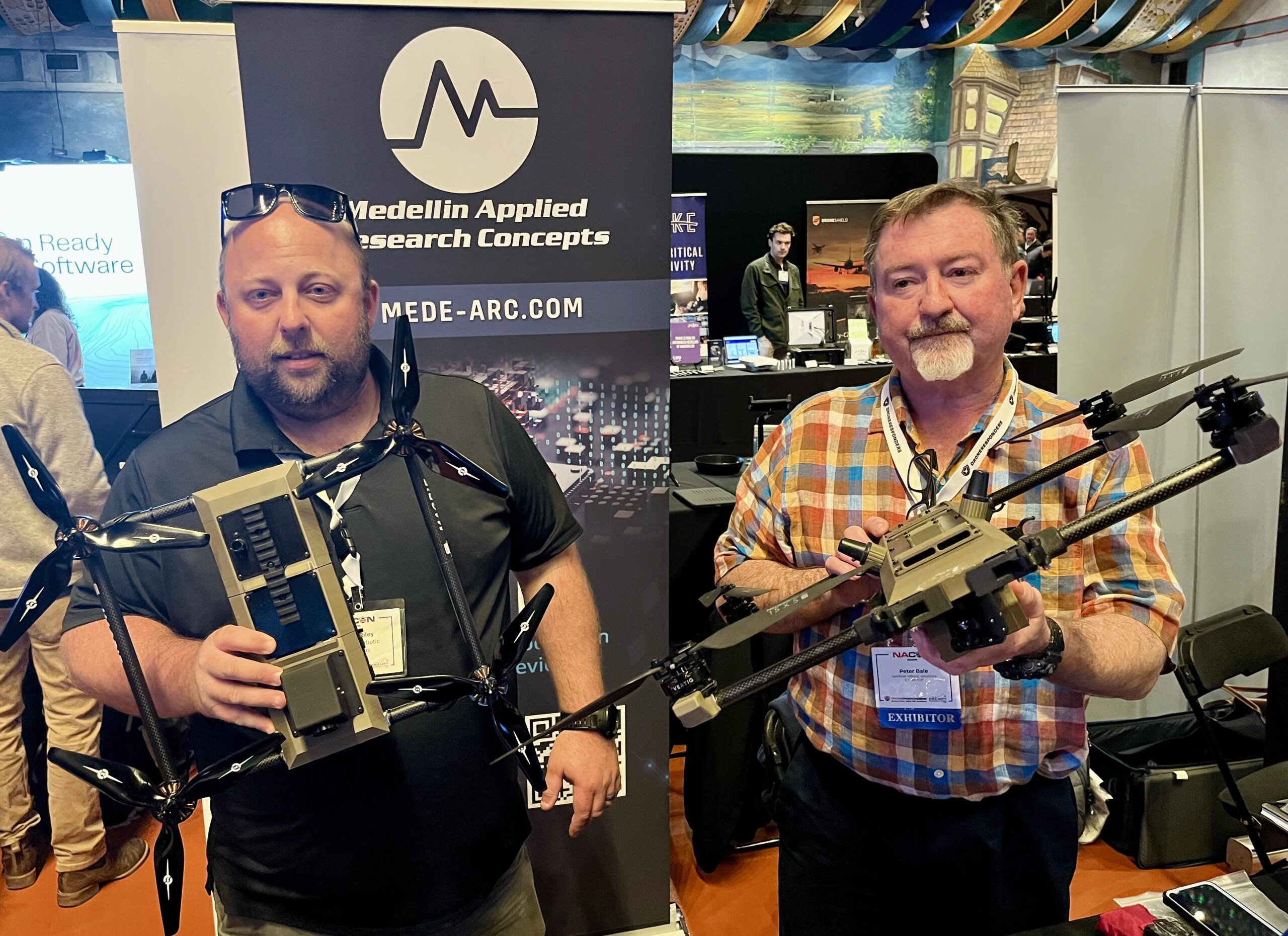
Sentinel Robotic Solutions’ Magpie family represents what happens when a company designs small unmanned aircraft for a conflict where the rules change with every sortie. Built around complete modularity and shaped by hard lessons from the Ukraine war, the Magpie UMS (Unmanned Modular System) and Magpie FPV give defense and public safety operators an American‑built, NDAA‑compliant modular unmanned system (UMS) that can be retasked in minutes, instead of replaced every few years.
Boeing SME Turned Modular Warfighter
Company founder Peter Bale has been in unmanned aviation since the early 2000s, helping bring the Aerosonde platform into U.S. service and flying missions with NASA and NOAA before joining Insitu ahead of its acquisition by Boeing. That career arc eventually led him to spin out Sentinel Robotic Solutions in 2012, initially as an engineering consultancy. It has since grown into a nationwide provider of training, product development and even a drone program that teaches students with special needs how to fly.
“Like every overnight success, we have morphed slowly into something different,” Bale said, describing Sentinel’s evolution from pure consulting into a solutions-oriented small business. Today, the company is a woman‑owned enterprise in a designated hub zone, supporting customers across most of the U.S. with services and now, drone hardware. “Magpie UMS is out of the closet and ready for prime time,” Bale explained.
Magpie UMS: A 60‑Minute Modular Workhorse
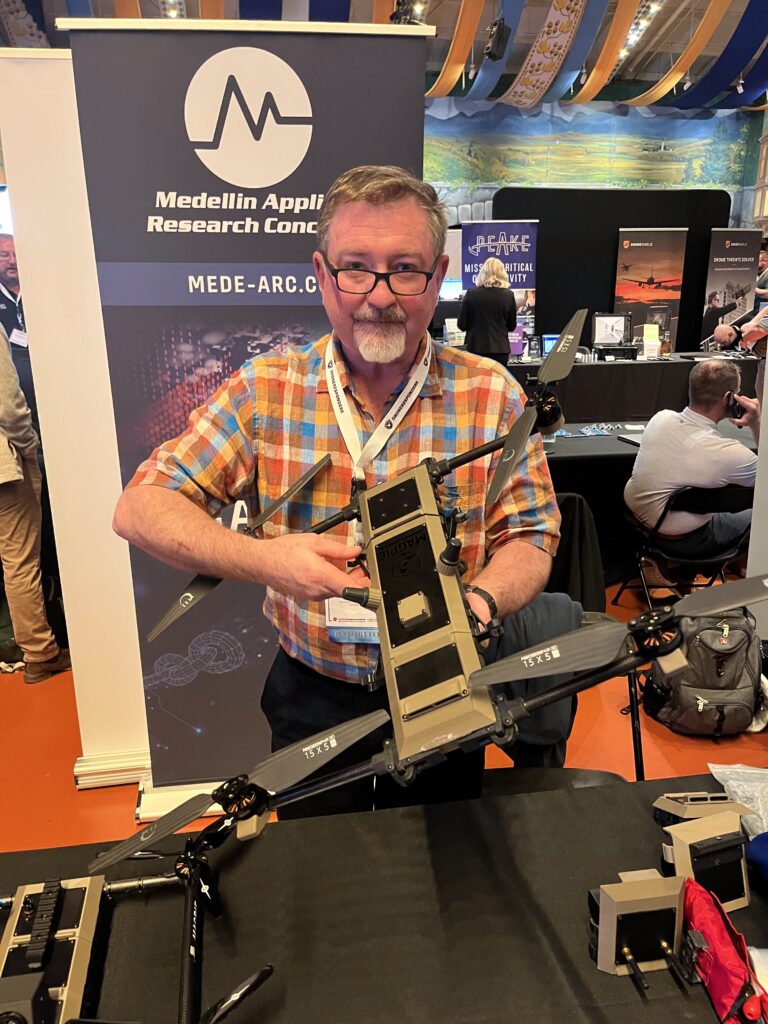
The Magpie drone is a Group 1 multirotor designed, first and foremost, for flexibility. In its standard configuration, it delivers roughly 60 minutes of endurance with one‑pound of payload. These flight times notably jump over the 30–45 minute window that still defines much of the small UAS market. With larger or smaller batteries, operators can trade endurance against payload weight, topping out around 4.5–5 pounds for short‑duration drops. For Bale, the point is to break away from rigid, single‑mission drones. “We’re a group one, we’ll fly for 60 minutes, but we’re completely modular,” he said.
Lead engineer Chase Riley, the “brains behind Magpie” as Bale described him, argued that endurance is where the architecture really stands apart. “Nobody’s touching the endurance in the group one platforms,” he said. “Everybody’s around the 30 to 45 minute mark. With our long endurance battery and a pound of payload, we’re around 60 minutes.”
Bale continued, “We also now no longer force the end user into one condition of form factor. If you have a payload you want to fly, you can snap and clip our payloads on and off.” Riley framed it even more simply. “It really comes down to the modularity,” Riley noted. “The system’s extremely modular, [it can] carry two different payloads, one forward, one aft.” Magpie UMS was designed with MOSA (Modular Open Systems Approach) in mind. To support that philosophy, Sentinel shares models and schematics so customers can integrate their own hardware. “The payloads are open source,” Riley explained. “We share all the models, the schematics, so the customers can integrate their own payload, they can get other companies to integrate payloads, or they can pay us to integrate them.”
On the hardware side, the team is already flying:
- A NextVision DragonEye 2 EO/IR turret for day/night ISR.
- Fixed camera sensors for customers who don’t need a gimbal.
- OEM communications modules, Doodle Labs, Silvus Technologies, Persistent Systems, and Trellisware
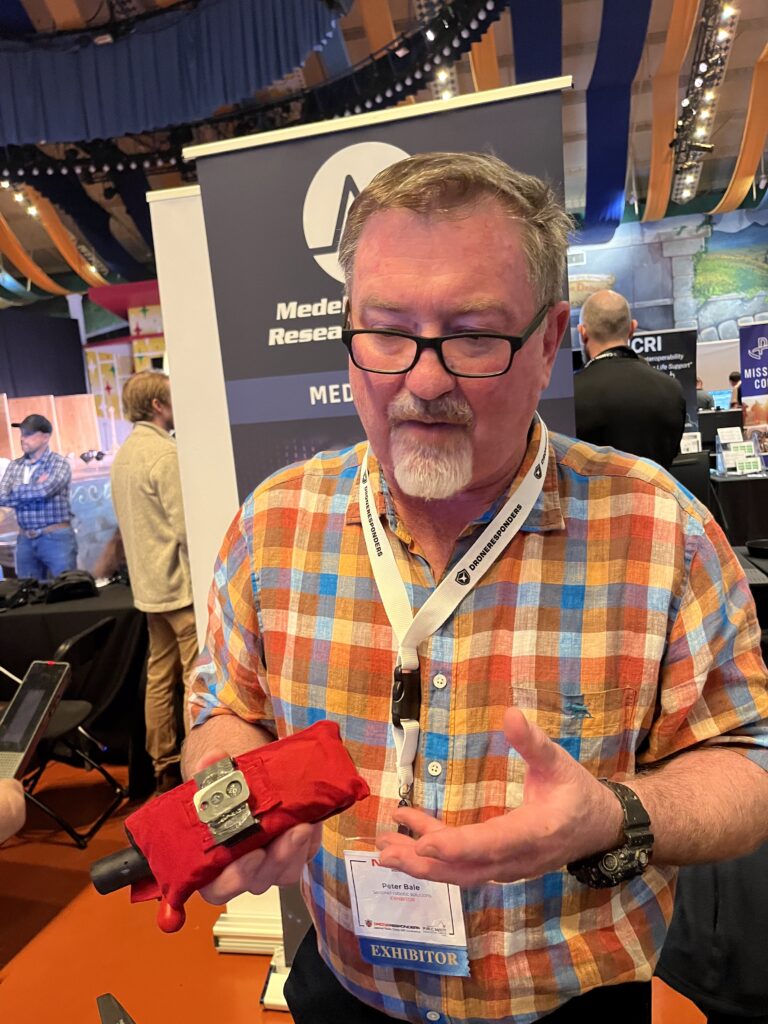
- An electromagnetic drop mechanism that turns almost any object with a glued‑on magnet or washer into a releasable payload.
- The ground control system is a Kutta KTAC (Kutta Tactically Aware Controller) 2.0, based around a Samsung S23 Tactical Edition smart phone. This allows Magpie to be fully TAK integrated and operationally relevant in today’s modern tactical operations.
“If you need to drop a magazine, you need to drop a pistol clip or anything like that to someone in need, we can quickly retrofit anything with a bit of super glue or tape in the field,” Bale emphasized. “Put a washer on it and then all of a sudden you can attach it to the bottom of Magpie.”
Ukraine War Lessons and Blockchain Hardening
Magpie’s recent evolution is inseparable from the drone fight over Ukraine, where combatants routinely jam, spoof and repurpose low‑cost platforms at unprecedented scale. Sentinel has been studying one‑way mission attack drones and the ad‑hoc drop mechanisms coming out of that conflict, then asking how to harden its own platform against the same playbook. “So whilst we’re not deployed, we’ve looked closely at the drop mechanisms that are being used in that theater of war,” Bale said.
The company has teamed with blockchain specialist, Medellin Applied Research Concepts, to add a second layer of protection on top of the standard AES‑256 encryption used for command and control (C2). “They are integrating a blockchain second layer of encryption into our platform,” Bale explained. “So if AES‑256 was compromised or anything like that, the adversary would need to get through the blockchain encryption to affect the status of the vehicle or the ability to drop the payload.”
That digital hardening is matched by physical signature reduction. Sentinel has invested “a lot of time and resources” into lowering the Magpie’s audible signature and shrinking its visual footprint. At the same time, the company has worked to ensure the platform is fully American‑built and compliant with NDAA requirements, an increasingly non‑negotiable box for U.S. defense and public safety buyers.
Magpie FPV: One‑Way Mission Speed, Shared Architecture

Magpie UMS is the multi‑mission utility drone; Magpie FPV is the family’s high‑speed specialist designed with one‑way mission profiles in mind. “We’ve been watching the architecture grow with the one‑way mission attack, and we have invested some IRAD money internally to bring Magpie FPV into the family,” Bale said.
The key decision was to keep the heart of the aircraft common. “As you’ll notice, the center configuration remains the same on the larger version to the smaller version,” Bale pointed out. “Thus, we can integrate different components of one baseline architecture to the bird.” That means many of the same avionics, batteries and payloads can move between Magpie UMS and Magpie FPV. This gives operators a true family of systems, rather than two unrelated drones.
Magpie FPV currently sits at roughly Technology Readiness Level 5, with baseline flight tests completed and performance targets set. “We’re expecting to see speeds of around 120 to 130 miles an hour,” Bale said. This will position the aircraft squarely in the lane of fast one‑way and time‑critical missions at a lower cost than many dedicated loitering munitions. Riley’s team built a Picatinny rail into the airframe as a payload module, in anticipation of future Department of Defense integration points. The Picatinny rail is following the new Army Standard called Picatinny CLIK (Common Lethality Integration Kit).
The configuration isn’t final, though. Bale noted they still need to add FPV capability and “some other smarts” including pixel tracking, target verification and modes to operate in GNSS‑degraded or denied environments. Those features speak directly to what both sides in Ukraine have learned the hard way about GPS‑dependent drones flying into sophisticated electronic warfare.
Avionics, Batteries and The Fixed‑Wing Future
Under the skin, both aircraft lean into the same modular philosophy. Riley said Sentinel offers several avionics packages on the Magpie airframe, covering “everything from full manual control up to full AI control,” so agencies can match capability and cost without changing the mechanical platform.
Battery choices are equally flexible. “We have multiple different size batteries,” Riley explained. “This allows us to fly a lighter battery so we can carry a heavier payload or a heavier battery to carry lighter payloads for a longer period of time, so you can kind of customize it for the mission at hand.” In practice, a public safety agency might run a long‑endurance overwatch mission with a thermal camera one day, then swap to a smaller pack and heavier drop payload the next, using the same aircraft.
Sentinel’s roadmap pushes the concept even further by turning Magpie from a multirotor into a fixed‑wing when needed. “We’re planning on taking the modularity a step further into allowing this to not only be a multi‑rotor,” Riley said, “but be able to remove the multi‑rotor booms and install wings and a rear motor and be able to be a fixed wing using the same avionics, same payloads, same batteries.” If realized at scale, that would give operators VTOL convenience and fixed‑wing range from the same core kit.
Small Business, Big Mission Set
Behind the hardware is a woman‑owned small business in a disadvantaged hub zone, serving defense, public safety, utility providers, and scientific customers, NASA among them. Sentinel’s team positions itself as solution driven rather than platform‑first, and invites agencies to bring specific problems in training, integration or operations.
As Magpie moves closer to broader fielding, Sentinel has also started lining up the manufacturing side needed to support higher production volumes. Bale said the company has partnered with Aerodine Composites to support production of the aircraft’s structural components and major assemblies.
“We’re focused on the system architecture, avionics and payload integration,” Bale said. “Aerodine supports the structural manufacturing side so we can scale production as demand grows. It lets us keep pushing the capability forward without getting pulled into the day-to-day of running a production line.”
The partnership allows Sentinel to keep its engineering team focused on developing new capabilities while leveraging Aerodine’s experience producing composite aerostructures for unmanned and defense systems. Sentinel remains responsible for system integration and final configuration of the Magpie platform, while Aerodine supports fabrication and assembly of the composite airframe structures that enable scalable production of the aircraft.
As Bale put it, “We’re about solutions.” For Magpie, that means building a family of drones that can adapt as quickly as modern conflicts and disasters evolve. Increasingly, that also means transitions as quickly as operators can swap out a payload, battery or even an entire wing.
Riley’s line about Group 1 endurance, “nobody’s touching” it yet, may prove prescient if buyers decide the next wave of small UAS procurement should prioritize modularity and survivability over single‑mission specialization.