

By: Dawn Zoldi
As construction firms modernize how they design, build and maintain infrastructure, changes continue unfolding in the air, on the ground and inside the walls. From drone imagery and GeoAI to lidar and SLAM-based indoor mapping, the jobsite has become a data-rich environment. But how that data is used looks very different in the United States and Mexico.
In a recent panel on “AI and Geospatial Intelligence in Modern Construction,” Esri’s Caroline Tyra and Brasfield & Gorrie’s Kyle Duncan showcased a mature, systematized U.S. approach to GeoAI-powered construction, while DAUCH founder Silvano Gómez offered a contrasting view from the Mexican and broader Latin American context, defined by fragmented processes, regulatory gaps,and a push to move from reactive fixes to predictive infrastructure intelligence.
The U.S.: Connected Workflows and Safety-Driven GeoAI
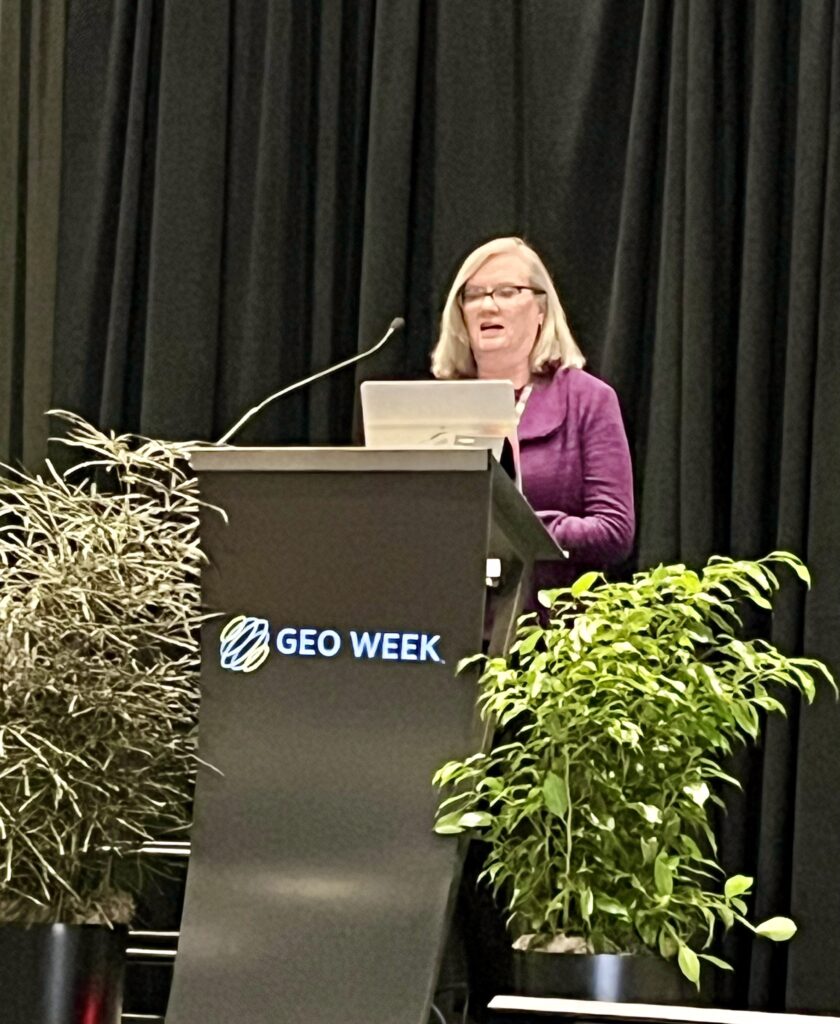
In the U.S., Esri and Brasfield & Gorrie painted a picture of construction as a data-centric, highly coordinated operation in which drones and GeoAI are embedded into everyday workflows rather than treated as one-off innovations
Tyra framed Esri’s “geographic approach” as a continuous cycle that collects, analyzes, models and understands diverse spatial data across the infrastructure lifecycle, from planning through operations. The foundation, the geospatial digital twin, a virtual representation of reality built on geography, can scale from county to city to site and is time-aware.
For Brasfield & Gorrie, GeoAI, drones, and GIS are not side projects, but embedded infrastructure in a company-wide technology stack that now touches more than half of the company’s active projects and every market sector it serves. The value shows up most clearly in safety, risk reduction, and field decision support.
Mature Integration of CAD, BIM, and GIS
A long-standing Esri–Autodesk partnership lets users bring Computer-Aided Design (CAD) and engineering models directly into ArcGIS for analysis, visualization, sharing and tying design intent to real-world conditions. Enhanced integration with Autodesk Forma brings predesign and schematic design into a geospatial context, allowing feasibility, siting and environmental considerations to be evaluated spatially from day one.
Operationalized drone programs at scale
Brasfield & Gorrie runs about 50 active monthly projects using drones, with a fleet of roughly 70 UAS and around 15 flights per day, producing over 100,000 images monthly. Site Scan for ArcGIS provides an end‑to‑end SaaS workflow for planning missions that captures imagery, processes it into 2D and 3D products and shares results as mosaics, meshes, point clouds or thermal and panoramic layers.
GeoAI models embedded in day-to-day work
Esri provides pre-trained deep learning models in the ArcGIS Living Atlas to classify buildings, trees and power lines from point clouds, detect distribution wires and poles, and extract vehicles from aerial imagery. GeoAI workflows go beyond simple object detection to change detection, 3D object recognition, and oriented imagery analysis, capabilities directly applicable to monitoring construction progress and asset conditions.
Utility strike prevention and “digital record boards”
Traditionally, safety boards have been plywood sheets with printed plans tacked on. Duncan’s team replaced these with “digital records” built on ArcGIS Online and Site Scan, accessible by QR code from a smartphone. Up-to-date orthomosaics and utility layers are pushed within 24–48 hours after a drone flight, so crews see current conditions, not satellite imagery that may be one or two years old. Web maps use GNSS-enabled positioning to show field staff their location within 5–10 feet relative to buried utilities and hazards, sharply reducing the risk of strikes and rework.
Inch-level positioning for non-surveyors
By pairing Esri’s Field Maps with high-accuracy GNSS receivers (such as Flex units), Brasfield & Gorrie gives superintendents, project managers, and safety coordinators the ability to locate utilities with roughly one‑inch accuracy, without ever touching a total station. This democratization of precision location means utility as-builts can be collected continuously by any competent field user, instead of waiting for scarce survey resources at the end of a job.
Volume tracking, site planning and claims defense
Drone-derived surface models support earthwork monitoring. Duncan cited one case comparing surfaces 19 months apart to quantify roughly 4,000 cubic yards of cut on a project. Civil 3D models are imported into ArcGIS to compare designed utility layouts with drone captures, helping verify placements at topping-out, support inspections and defend against later warranty claims by providing time-stamped imagery and 3D data.
Mexico: Data-Rich, Decision-Poor Until You Orchestrate the Ecosystem

If U.S. firms like Brasfield & Gorrie illustrate how GeoAI can refine already-structured processes, DAUCH’s story is about building structure when there is none.
Gómez described a Mexico where infrastructure stakeholders can access more data than ever, “maybe 300 percent more than a couple of years ago.” Yet they still suffer from chronic cost overruns, delays and distrust in technical information. In many projects, especially government or small-to-medium private works, there is little order in how data is collected, validated or used to drive decisions.
“Most of the time, 60 to 70 percent of the projects we’ve been helping have experienced delays due to bad site condition validation. Technical information that should help them actually creates more problems,” he explained. “Then they say, ‘I’m not going to invest in your technology. I will just use the traditional way.’”
DAUCH’s response is not to sell sensors, but to sell orchestration. Its ecosystem, represented in the acronym the company uses for its data, automation, urban modeling, compliance, and related highway/infrastructure work, connects:
- Multi-sensor capture: Lidar, photogrammetry, thermal imagery and ground-penetrating radar (GPR), initially offered purely as services.
- Analytics and validation: Machine learning and computer vision models for structural assessment, pavement condition, land-use classification and thermal analysis.
- Regulatory compliance: Translation of Mexico’s NOM and sector-specific standards into machine-readable rules. The platform embeds this context so outputs are not just maps, but technically and legally meaningful reports.
- Delivery as “data-certified” decisions: Instead of dumping point clouds and orthomosaics on clients, DAUCH’s platform generates standardized reports, severity indices, and prioritized interventions that align with local codes and budget realities.
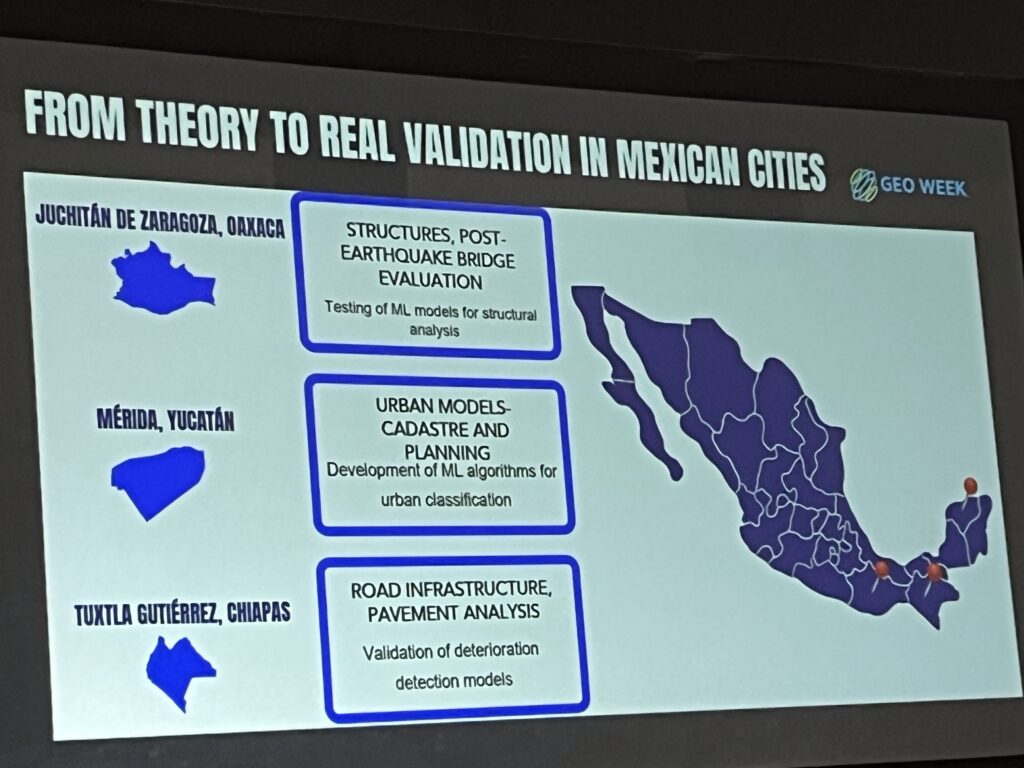
Three case studies illustrate how this looks on the ground:
Structural risk in seismic corridors
In southern Oaxaca, DAUCH partnered with a polytechnic university to test models that use lidar-derived data to assess deformation and structural conditions of bridges in earthquake-prone zones. Even achieving around 70–80 percent reliability in early models, the analysis allowed contractors to identify preventive works and propose additional scope to government clients based on quantified risk rather than intuition.
Urban heat and planning in Mérida, Yucatán
In one of Mexico’s fastest-growing, and hottest, cities, DAUCH combines urban land classification with temperature and, increasingly, thermal imagery to identify zones where expansion is driving extreme heat. The models support planning decisions about where to limit development and where to prioritize new green areas and parks, shifting municipal conversations from “where can we build?” to “where should we cool?”
Road networks in mountainous Chiapas
With more than 20,000 kilometers of curving roads in a highly complex topography in Chiapas, maintenance budgets are finite and political. DAUCH’s pavement models help quantify damage severity and prioritize stretches that deliver the greatest impact per peso, moving agencies away from anecdotal decision-making.
Convergence: Different Starting Points, Shared Destination
Where Esri and Brasfield & Gorrie emphasize GeoAI as a set of tools embedded in mapping and design platforms, DAUCH positions AI as the orchestrator sitting between raw data and final decisions.
Gómez described his company’s AI-enabled platform as an “orchestra” that accepts client-defined needs in plain language, updating the underlying database as those needs evolve. It selects the appropriate sensor stack (lidar, GPR, photogrammetry, thermal) based on the sector (industrial, urban, highway, structural). It then chooses the right model type (structural, pavement, urban classification, thermal risk) and applies the relevant Mexican norms. Finally, it outputs only the deliverables that directly support decisions (prioritized lists, severity maps, regulatory compliance reports) rather than overwhelming users with raw datasets.
This mirrors, in a very different context, the U.S. drive to lower the barrier to advanced geospatial tools. Duncan’s comment that construction “doesn’t know what to do with us half the time” echoes in Gómez’s accounts of Mexican clients who see high-tech deliverables as expensive add-ons unless the value is unmistakable. In both cases, the challenge remains cultural as much as technical.
While the contrast between U.S. and Mexican practice is striking, the destination is the same: moving from reactive construction and infrastructure management to predictive, data-certified decision-making.
As Gómez put it, DAUCH’s aim is to “transform infrastructure from reactive to predictive,” using AI as the intermediary between messy field reality and structured, traceable decisions. Tyra and Duncan, from their side, are pushing U.S. projects toward a future where digital twins, GeoAI, and high-frequency drone data make it possible to see hazards, clashes and deviations before concrete is ever poured.
In both countries, the future of infrastructure is being built not just on data, but on the workflows, regulations, and cultures that determine whether that data becomes intelligence…or just another pretty 3D model on a screen.
| Dimension | United States (Esri / Brasfield & Gorrie) | Mexico (DAUCH) |
|---|---|---|
| Primary driver | Safety, efficiency, and transparency on highly organized projects. | Overcoming disorder, cost overruns, and mistrust of technical data. |
| Data capture | Routine drone flights; structured programs with 70+ UAS and standardized workflows. | Mix of DAUCH-operated and client-operated sensors; capture often ad hoc but growing. |
| Core platforms | Tight CAD–BIM–GIS integrations, Site Scan, ArcGIS Online/Pro, Field Maps. | Proprietary platform integrating lidar, photogrammetry, thermal, GPR and AI. |
| GeoAI role | Pre-trained models embedded in Esri ecosystem for feature extraction and monitoring. | Custom models tuned to local regulations and risk profiles for structural, road, and urban analysis. |
| Main outputs | Digital twins, utility maps, earthwork volumes, digital safety boards, AR views. | Prioritized maintenance plans, structural risk scores, urban heat and land-use zoning recommendations. |
| Regulatory context | Mature, well-documented standards; data feeds into already-structured processes. | Patchy enforcement and capacity; platform embeds Mexican norms to make data decision-ready. |