
Lockheed Martin’s legendary Skunk Works, best known for its iconic black aircraft and Cold War secrets, is, at its core, a place that “solves problems,” says OJ Sanchez, the organization’s Vice President and General Manager. Today, his team has zeroed in on how humans and machines will fight together across long-range kill chains. They are “burning down the miracles” one by one, test by test, knitting fifth-generation fighters, collaborative combat aircraft (CCA), and tactical autonomy into a coherent, combat-ready whole.
Turning Miracles Into Milestones
Skunk Works has been consistently turning these “miracles” into milestones through a series of small, incremental demonstrations that prove long-range ecosystems spanning space, air and unmanned assets can share data, cue targets, and close kill chains at speed.
One of the most striking examples came during the Ramstein Flag exercise, when a non‑U.S. F‑35 in Europe took highly classified data in flight, offloaded it from the aircraft, and pushed it into a foreign command-and-control system to close a live kill chain (something that had never been done before). Sanchez said the architecture behind that event showed they could move data across the entire ecosystem and across national boundaries without ever compromising the protection level of the classified information.
Skunk Works is also pushing forward on Vectis, an emerging collaborative platform aimed at CCA missions. Sanchez characterized Vectis as part of “the next wave of drone systems,” built to be survivable, lethal, and adaptable and specifically engineered to plug into manned–unmanned teaming constructs and long-range kill chains.
For the broader kill-chain picture, Skunk Works and NASA’s X‑59 flew for the first time last year, which opens a path toward quieter supersonic flight. That work could underpin future concepts designed to shrink global response times and reshape how fast forces, and decision-makers, can move around the world.
“Have Remy”: Fighter Pilots Fly-Fix-Fly With Tactical AI
As Skunk Works burns down the miracles behind long-range kill chains, the next step involves teaching humans and machines to trust each other under fire. That is where project “Have Remy” comes in, to turn tactical AI from a lab experiment into something fighter pilots are willing to bet their lives on.
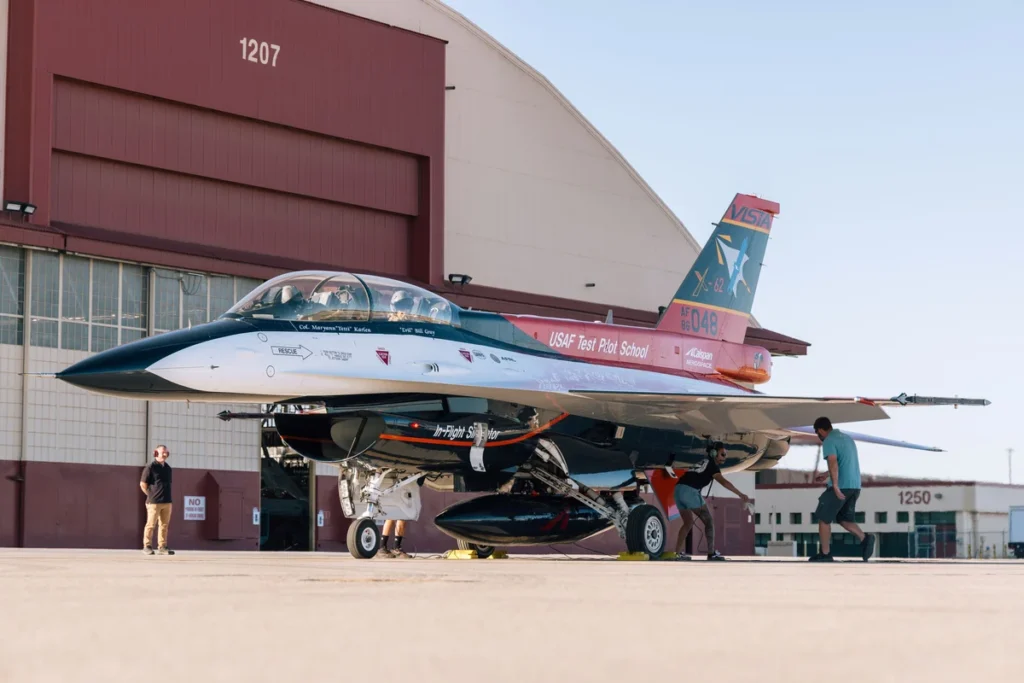
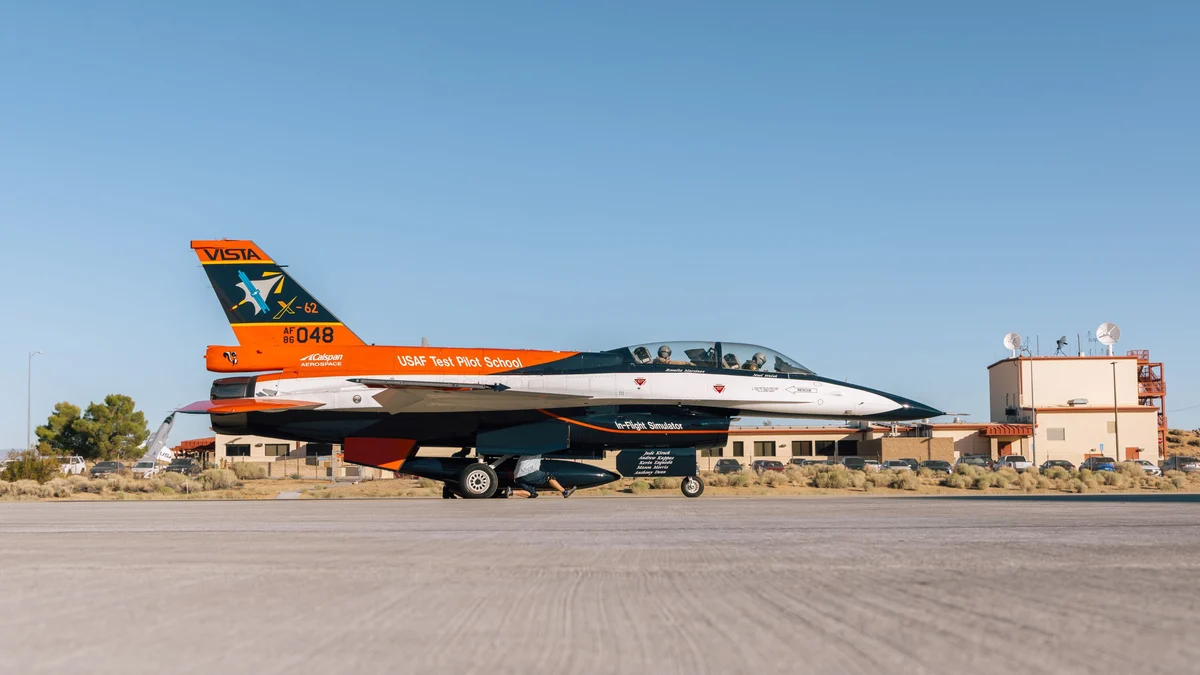
The project involved Skunk Works flying its tactical AI on the X-62 VISTA, a modified F-16 and open architecture test bed, for the first time. Working with the U.S. Air Force Test Pilot School, the team evaluated an F‑16 under missile attack to test whether an onboard AI agent could detect an incoming threat and autonomously execute an evasive maneuver within the jet’s limits, all without pilot intervention.
The pilots themselves named the effort “Have Remy,” after the rat in Ratatouille who secretly guides a human chef to extraordinary performance. They did more than christen it, though. They helped guide the project and ultimately drove its success. Sanchez said their feedback was “overwhelmingly positive,” largely because they were brought into the development cycle from the start. Instead of being handed a black box and told what the AI would do, they helped shape how it was trained, how it behaved and how it interacted with the aircraft’s autonomy stack. Giving operators visibility into how the “Remy” in the jet thinks has now become central to Skunk Works’ approach to tactical autonomy.
Under the hood, Have Remy was as much about process as performance. Skunk Works shifted from traditional CPU-based training to a GPU-driven, “Supermassive” data approach. This enabled billions of simulated engagements to run overnight, a training volume that once would have taken years.
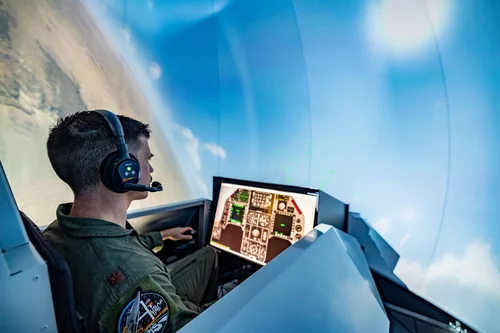
Engineers and pilots then iterated through a tight fly‑fix‑fly loop. First, they used Skunk Works’ simulator environment to run the AI agent through high‑fidelity missile‑evasion scenarios and refine its behavior before going airborne. Next, they moved into live flight on the X‑62, executing more than 100 test points in which the AI autonomously pulled just under 6 Gs, right at the aircraft’s limit, while maintaining minimum speed thresholds, all without requiring pilot intervention. After each batch of flights, the team reprogrammed and updated the autonomy stack almost overnight, then flew again the next day.
“That’s the kind of learning and training that we’re going to need,” Sanchez said. Missile evasion was just a proof point for a broader method of developing and validating tactical autonomy.
Crucially, he stressed that Have Remy is not just about crewed fighters. When asked whether this AI and its associated data would eventually inform uncrewed systems, he did not hesitate. “It absolutely is, and we absolutely will,” he said. In his view, jumping straight to highly autonomous collaborative combat aircraft without this kind of incremental training and cultural adaptation is “highly unlikely” to succeed. Instead, Skunk Works uses controlled environments like X‑62 VISTA to mature algorithms, build operator trust and generate training datasets that can later be ported to CCAs and other autonomous drones. “You could see that being applied in a fully pilotless drone,” Sanchez explained. The same missile‑evasion logic that kept an F‑16 and its pilot alive could one day help a Vectis‑class CCA survive in dense threat environments, or reduce workload in crewed cockpits by automating high‑stress defensive maneuvers.
Open Systems, Tactical AI and the Long-Range Kill Chain
From Sanchez’s perspective, hypersonics, open systems and advanced ISR all exist to push actionable information to the edge and give both human pilots and autonomous systems better options, faster. All of that rests on open system architectures (OSA), the “underpinning” for future tactical autonomy, which allow Skunk Works to move models and behaviors across labs, ranges and platforms without rewriting everything from scratch.
By embracing government reference architectures, containerizing code and using shared simulation environments, Skunk Works can virtualize and reuse threat models and software across its ecosystem. Work with the Joint Simulation Environment (JSE), where government‑provided code and threat models have been virtualized and containerized, is intended to ensure that what’s learned in a sim (whether on X‑62, a future CCA, or a classified platform) can migrate quickly into operationally relevant kill chain architectures. That approach builds on the earlier Auto GCAS breakthrough, the first Collier Trophy ever awarded for software, which automatically takes control of a fighter to prevent ground collisions. Have Remy is a more advanced extension of the same logic, now operating inside dynamic missile threat environments rather than simply guarding against terrain.
Skunk Works treats Ramstein Flag, Vectis, X‑62 VISTA and Have Remy less as isolated showcases and more as linked stepping stones toward integrated air combat and fielded capability. Connecting foreign F‑35s into secure kill chains, flying the X‑59 with NASA, running the first tactical AI on X‑62 and demonstrating robust sim‑to‑real transfer of missile‑evasion capability across more than 100 test points—all while engineers developed, debugged, and tested updates in hours and lessons learned were immediately integrated from live flight into the autonomy stack—are part of “burning down the miracles” required for long‑range kill chains. The effort also proved that autonomous agents can be safely monitored, understood and controlled in real time. If the vision holds, the same methods that taught a “Remy” in an F‑16 to dodge missiles will soon reliably guide autonomous drones through the most dangerous airspace on Earth, in tight formation with the human pilots who helped teach them how.