
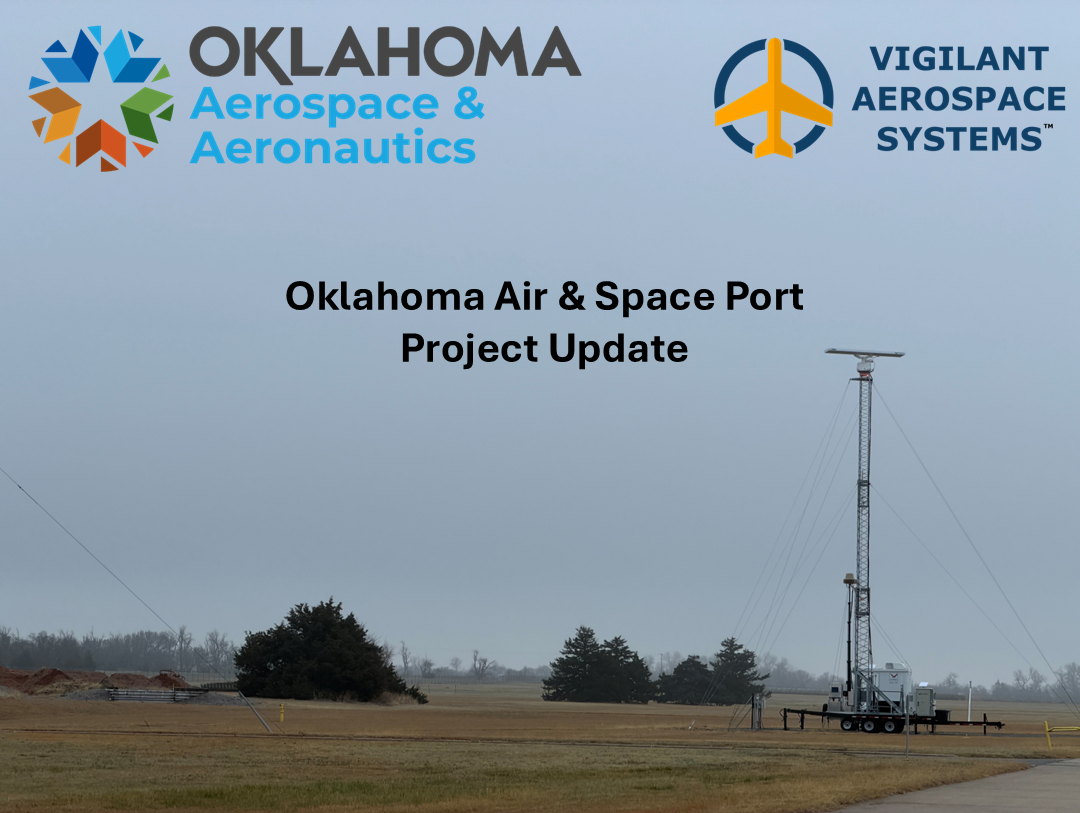
BURNS FLAT, OK March 31st, 2026 — Vigilant Aerospace has installed a FlightHorizon TEMPO airspace management system with multiple long-range radars and transponder receivers at the Oklahoma Air & Space Port in western Oklahoma as a part of its project for the Oklahoma Department of Aerospace and Aeronautics (ODAA) to develop a national testing site and operating launchpad for both military and civilian autonomous aircraft and spacecraft.
The updated system represents significant progress on the project, awarded in early 2025 as a multi-year agreement for Vigilant Aerospace to deploy its FlightHorizon system to support the development and testing of advanced uncrewed aircraft, autonomous spacecraft and operational flights.
The project includes integration and management of multiple mobile airspace surveillance radars to protect small aircraft and helicopters in the area without the need to fly chase planes to follow every drone. The system tracks aircraft for thousands of square kilometers around the airport during the flight of high-speed military drones and autonomous spacecraft expected to launch later this year. The system provides automatic detect-and-avoid collision avoidance services, real-time traffic display and detailed traffic logging and reporting.
The system is an important step in Oklahoma’s effort to advance the autonomous aircraft and spacecraft industry in the state and nationwide. Doug Wood, State Manager for Advanced Air Mobility at ODAA, described the development this way:
“This is a key milestone in building out the infrastructure required for a national proving ground for long-distance, autonomous flight testing. FlightHorizon provides the robust traffic management system required—a standards-based, multi-sensor-ready solution that can grow with future military, cargo UAS, and air taxi operations.”
FlightHorizon TEMPO gives ODAA a new tool to support advanced flight testing in Oklahoma including the Mk-II Aurora spaceplane, which is scheduled to begin flights from Clinton-Sherman in 2027 under an agreement with Dawn Aerospace announced in June 2025.
Kraettli L. Epperson, Chief Executive Officer of Vigilant Aerospace, emphasized the broader impact for the state from this project:
“This deployment creates new opportunities for advanced flight testing and operational validation. By combining standards-based detect-and-avoid and scalable surveillance infrastructure, Clinton-Sherman can support a wide range of current and future aerospace missions safely and efficiently with great cost-effectiveness and range availability compared to competing solutions.”
What This Project Delivers for Oklahoma
The project was funded by the Oklahoma Space Industry Development Authority (OSIDA) through the Preserving Rural Economic Prosperity (PREP) fund initiative to invest in UAS and AAM infrastructure. Since work began last year, Vigilant Aerospace has installed three DeTect air traffic surveillance radarssupporting the cloud-based FlightHorizon TEMPO system, with four additional radars awaiting setup.
FlightHorizon TEMPO provides broad airspace awareness around the air and space port and supports long-range and mid-altitude testing with one of the largest test areas in the country. The system allows airspace activity to be monitored electronically rather than relying on chase aircraft or large teams of ground observers.
This capability is intended to support beyond visual line of sight (BVLOS) testing and help demonstrate alignment with Federal Aviation Administration (FAA) expectations for integrated airspace operations.
Doug Wood noted the combination of factors that make Oklahoma attractive for aerospace companies:
“When you combine Oklahoma’s highly effective operating environment with its aerospace history, strong commercial development opportunities, available incentives, aerospace-focused legislative support, and a supportive regulatory climate, the state becomes very attractive for companies. That is further strengthened by direct recruitment efforts and the range of academic institutions, industry partners, and aerospace companies that have chosen to build and grow in Oklahoma.”
Progress Toward a Statewide Aerospace Test Corridor
With approximately 5,000 square kilometers of current coverage and plans to expand to roughly 10,000 square kilometers in the future, Clinton-Sherman Airport is becoming a central hub for advanced aerospace testing for the country. The scale of the operating area supports extended-duration and long-distance flights that require persistent airspace awareness.
Doug Wood noted that the state is working to connect assets and infrastucture across the state:
“Overall, we are working to leverage Oklahoma’s safe airspace and ground environment, along with its high number of flying days a year – 300 – to encourage companies to test their uncrewed systems not only at Burns Flat, but also by connecting this range to multiple test ranges throughout the state, making Oklahoma a viable, connected testing and operational environment.”
Potential Use for Disaster Response
Beyond flight testing, the FlightHorizon TEMPO system can support a range of missions where situational awareness is critical. The State could use the radar network and the mobile radars to support missions like search and rescue, disaster response, emergency management, infrastructure monitoring, and other public-interest activities.
How FlightHorizon TEMPO Works
FlightHorizon TEMPO is Vigilant Aerospace’s cloud-based Software-as-a-Service airspace management system that combines multiple sensors and data sources into a single operational view with automatic collision avoidance warnings and commands. It provides a live 3D display of air traffic, giving clear awareness of activity around the range. For this deployment, TEMPO integrates multiple data sources:
- Multiple air traffic surveillance radars, including multiple radar models
- Coverage spanning thousands of square kilometers
- Detection of both cooperative aircraft with ADS-B transponders and non-cooperative aircraft without transponders
- Track correlation across all data sources including ownship telemetry, radars and ADS-B tracks
- Real-time detect-and-avoid alerts and resolution advisories based on ACAS Xu
- Data logging for ownship telemetry, ADS-B, Remote ID, and radar to support review and reporting
About the Oklahoma Department of Aerospace and Aeronautics
The Oklahoma Department of Aerospace and Aeronautics (ODAA)is the state agency responsible for promoting and supporting aviation and aerospace activities across Oklahoma. The department works with public and private partners to support airport development, aerospace infrastructure, economic growth, workforce initiatives, and policies that strengthen the state’s aerospace sector. ODAA also helps promote Oklahoma as a location for advanced aviation, uncrewed aircraft systems, Advanced Air Mobility, and space-related operations by supporting projects, partnerships, and long-term planning that expand the state’s role in national aerospace development.
About Oklahoma Air and Space Port
The Oklahoma Air and Space Port, located at Clinton-Sherman Airport in Burns Flat, is a state-owned facility supporting aviation, uncrewed aircraft systems (UAS), and spaceflight operations. Operated by ODAA, the Clinton-Sherman Airport features one of the longest civilian use runways in North America, with a length over 13,500 feet. The airport previously was a Strategic Air Command base where B-52 Superfortress bombers were stationed during the Cold War. The base was decommissioned in 1969 and was sold to the City of Clinton in 1971. The facility holds a Federal Aviation Administration (FAA) horizontal launch spaceport license. The facility serves as a test and development location for advanced aerospace technologies, including long-range UAS operations, autonomous flight systems, and future commercial spaceflight programs, and plays a central role in Oklahoma’s efforts to expand aerospace infrastructure and industry partnerships.
About Vigilant Aerospace Systems
Vigilant Aerospace is the leading developer of multi-sensor detect-and-avoid and airspace management software for uncrewed aircraft systems (UAS or drones). The company’s product, FlightHorizon, is based on two NASA patents and uses data from multiple sources to display a real-time picture of the air traffic around a UAS and to provide automatic avoidance maneuvers to prevent collisions. The software is designed to meet industry technical standards, to provide automatic safety and to allow UAS to safely fly beyond the sight of the pilot. The software has won multiple industry awards and the company has had contracts and users at NASA, the FAA, the U.S. Department of Defense and with a variety of drone development programs. Visit our website at www.VigilantAerospace.com