
By: Dawn Zoldi
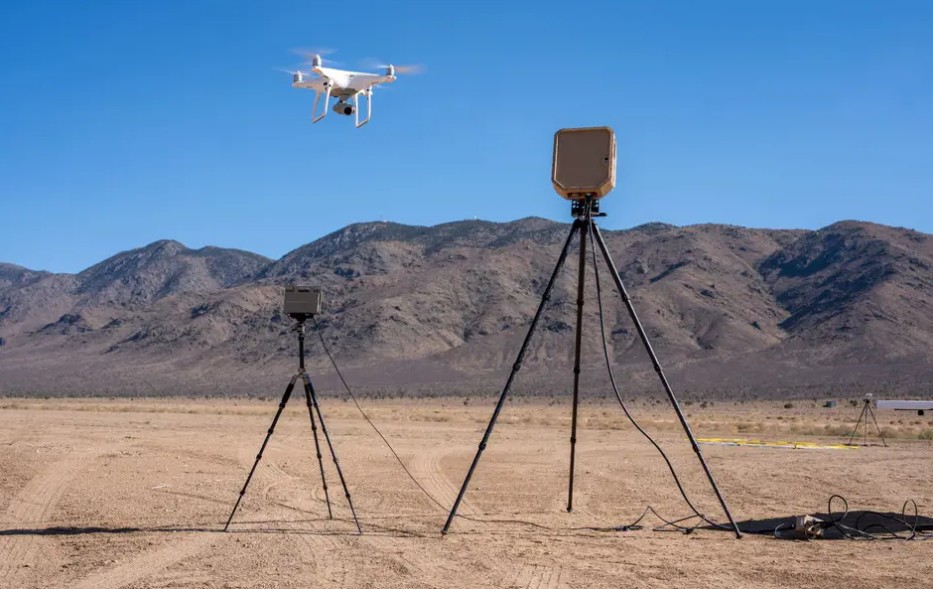
Drone as First Responder (DFR) programs have already changed how communities think about 911 response. Even so, most still operate inside a tight visual bubble around the pilot. As beyond visual line of sight (BVLOS) becomes the next step, EchoShield radar emerges as one of the key technologies that can make that step both safe and scalable for public safety agencies.
The Detect-and-Avoid Problem Every BVLOS Program Must Solve
For police departments, fire services and emergency managers, the attraction of BVLOS is straightforward. When a drone can legally and safely fly beyond an operator’s line of sight, it becomes a true networked asset, not a point solution tied to one launch location. BVLOS allows a single DFR hub to cover multiple beats, respond to incidents several miles away and maintain persistent overwatch during unfolding events, instead of hopping from scene to scene. In practice, that means faster incident assessment, better officer safety and more time to de-escalate because decision-makers see the scene before they step into it.
But BVLOS is also where the regulatory bar rises. The Federal Aviation Administration (FAA) expects BVLOS applicants to show how they will detect-and-avoid (DAA) both cooperative aircraft (those carrying transponders or ADS-B) and non-cooperative aircraft (flying VFR with no digital signature at all).
Many DFR programs start with a mix of cameras, ADS-B feeds, tablet-based airspace apps and acoustic sensors. While valuable tools, each has gaps:
- Cameras and electro-optical (EO) systems lose effectiveness in darkness, glare, fog or smoke
- Network feeds are only as good as the participation of surrounding aircraft
- Acoustic systems degrade quickly in dense, noisy urban environments.
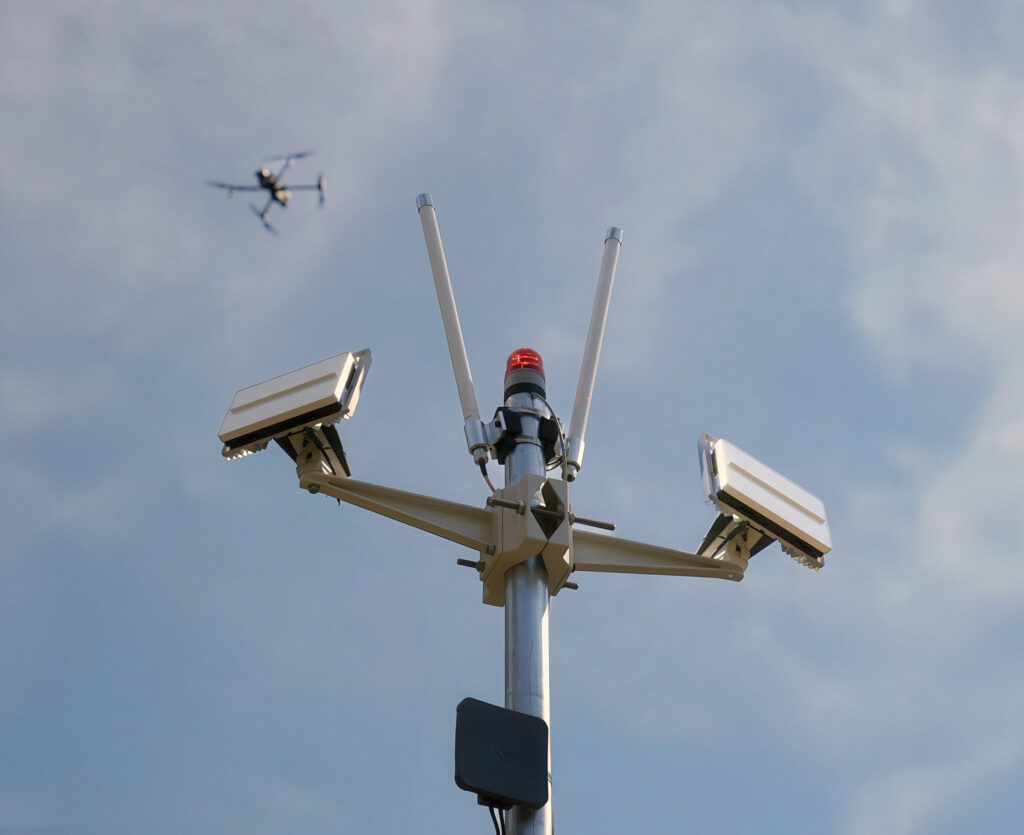
That is why radar has increasingly become the “trusted electronic observer” for BVLOS. Unlike human visual observers, radar does not squint into the sun, struggle with distance estimation or go off shift. Unlike optical sensors, a well-designed radar maintains performance through night, weather and clutter. And unlike purely cooperative tracking solutions, radar will return a hit on any target with a meaningful radar cross-section, regardless of whether the pilot has turned on a transponder. For DFR operators who have to worry about low-flying helicopters, small general aviation (GA) traffic, and other drones all flying in the same low-level airspace, that independence proves crucial. Echodyne responded to that exact challenge with EchoShield.
Inside EchoShield: Solid-State ESA Radar Built for Public Safety DFR
Built on the company’s MESA (Metamaterials Electronically Scanned Array) electronically scanned array architecture, EchoShield replaces mechanical scanning with software-directed beam steering in a solid-state package. With no moving parts to maintain, no heavy gimbals and no oversized radomes, it comes in a compact form factor: a panel that can be mounted on a mast, a rooftop, a vehicle or a DFR launch box. Because the array is electronically steered, EchoShield can dwell where it matters, track multiple objects simultaneously and update those tracks fast enough to support automated DAA logic.
From a public safety perspective, several attributes stand out. Echodyne designed EchoShield for all-weather, all-lighting operation to provide stable coverage in the exact conditions (think: night, haze, low ceilings) when air medical and law enforcement aviation activity may be highest. The company optimized it for low size-weight-and-power (SWaP), which makes it feasible to deploy multiple units around a jurisdiction and tie them into a common operating picture (COP). EchoShield also natively detects both cooperative and non-cooperative air traffic, as well as other moving objects in its field of view, giving DFR teams a more complete picture than ADS-B alone.
Building Stronger BVLOS Safety Cases with EchoShield Radar
While the Part 108 Rule remains pending, these technical choices have very practical consequences for BVLOS waivers. And when the rule comes to pass, they bolster safety margins for both safety and risk management.
FAA and NASA test campaigns have already relied on Echodyne radar for high-fidelity airspace data in complex environments. Echodyne’s systems are supporting public safety and federal users that must defend dense, low-altitude airspace every day. From a safety perspective, EchoShield’s track data, performance characteristics and integration options help demonstrate that the “see” function of “see and avoid” is being met with an independent, calibrated sensor. That matters, especially as regulators seek repeatable, scalable approaches rather than one-off experiments.
Echodyne took the opposite approach, building its best-in-class accuracy radar with the capability to stream data into systems that DFR agencies already use – drone command-and-control (C2), dispatch and live operations platforms alongside video, ADS-B and airspace advisories to create a unified air picture instead of yet another separate screen for pilots to manage. In integrations with DFR platforms, radar tracks can be used to trigger alerts, automatically ground or re-route drones and log events for after-action review and training. That kind of vital automation keeps workload manageable as agencies move from one or two aircraft to fleets of persistent response drones.
Scaling DFR from Pilot Projects to Persistent BVLOS Coverage
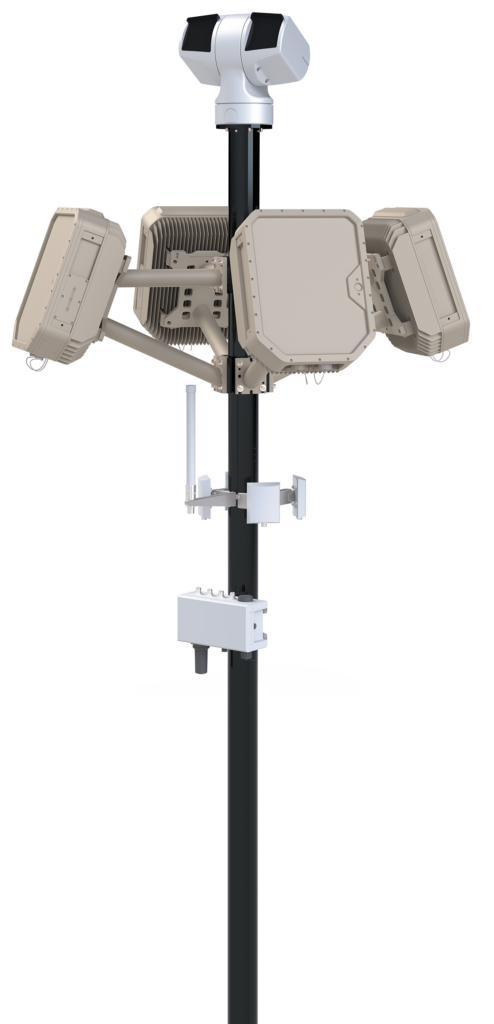
Any technology that joins the DFR stack must be rugged, quiet in the background and operationally intuitive. EchoShield’s solid-state, compact form factor and rapid setup align with those imperatives. Agencies can deploy it as a fixed sensor at a station, as a mobile capability for special events or wildfire seasons or as part of a hybrid architecture that covers both a city core and surrounding rural areas. Because radar does not capture personally identifiable information (PII) and does not interfere with wireless networks, it also avoids some of the community and privacy concerns that can accompany other sensors.
Once agencies can trust that this “electronic observer” layer will reliably detect traffic and obstacles, they can start to think differently about coverage models. Instead of a handful of VLOS pilots launching from a rooftop near headquarters, imagine distributed drone nests across a city, launching automatically when computer aided dispatch (CAD) codes match pre-approved mission types, and then remaining aloft as long as calls for service continue to arrive. EchoShield’s persistent airspace data is one of the ingredients that makes that vision operationally credible, rather than aspirational. This trajectory is already visible in the market.
EchoShield and the Future BVLOS Regulatory Landscape
Echodyne’s radar is integrated into purpose-built DFR solutions, including partnerships that marry MESA radar with turnkey DFR platforms. This allows agencies to pursue automated BVLOS operations without relying on visual observers. Those partnerships show regulators and city managers alike that BVLOS DFR can be fielded as a complete, safety-forward package, not a bespoke integration for each jurisdiction. For agencies still in pilot phases, that lowers the barrier to entry. For those preparing to scale citywide, it provides a roadmap to persistent coverage.
As rulemaking on BVLOS advances, the requirement for robust DAA will only grow more explicit. Public safety agencies that move now to incorporate radar into their DFR architectures will not just check a compliance box. An investment in this sensing backbone will support more automation, higher sortie rates and more complex missions in the years ahead. EchoShield’s combination of low SWaP design, high-fidelity tracking and public-safety-focused integration gives agencies a way to move from demonstration to durable capability.
For program managers, chiefs, emergency management leaders and regulators, the question is no longer whether radar belongs in DFR, but what kind of radar and deployment model will best support BVLOS at scale. EchoShield offers a clear answer. As a compact, solid-state ESA radar that sees what human observers and cameras can miss, it fits where public safety teams actually operate. More importantly, it gives 911 drones the airspace confidence they need to arrive first…and fly safely every time.