
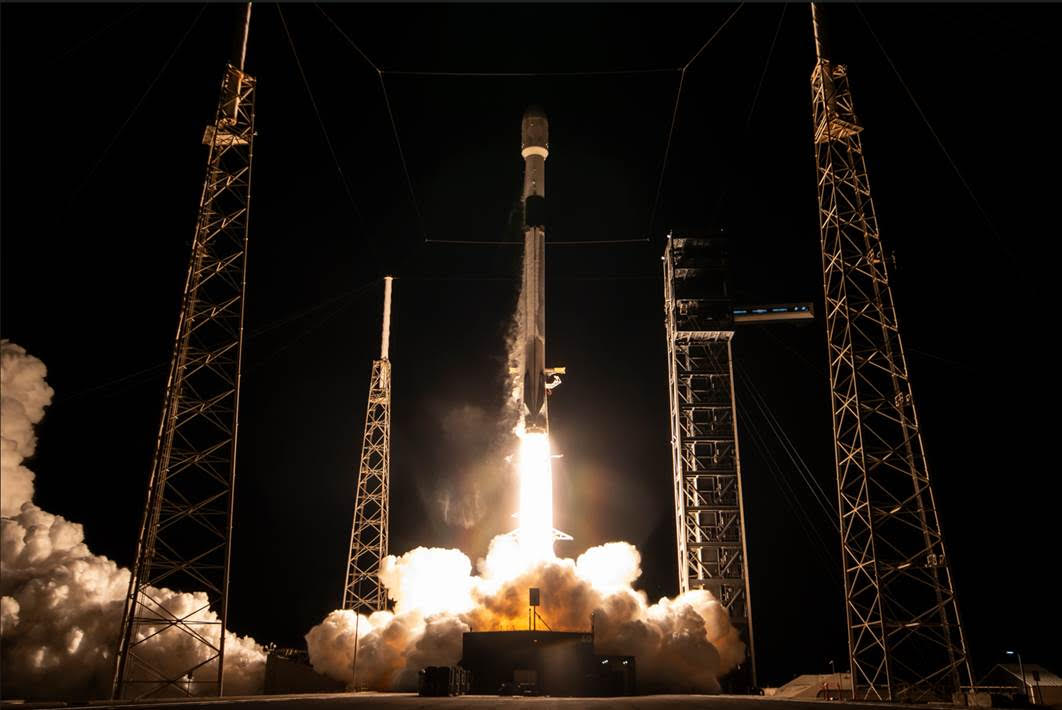
Summary: The Space Force launched a Lockheed Martin-built Global Positioning System (GPS) III satellite, named in honor of NASA astronaut Col. Ellison Onizuka, into orbit on a SpaceX Falcon 9 rocket from Cape Canaveral Space Force Station, Florida.
EL SEGUNDO, Calif. & COLORADO SPRINGS, Colo. – U.S. Space Force’s Space Systems Command (SSC) and Combat Forces Command (CFC) marked a critical step in enhancing global positioning capabilities with the successful launch of GPS III-9 Space Vehicle 09 (SV09) on Jan. 27 at 11:53 p.m. EST (8:53 p.m. PST) from Space Launch Complex (SLC)-40, Cape Canaveral Space Force Station, Florida, using a SpaceX Falcon 9 rocket. This significant mission also underscored the proven agility and responsiveness of the National Security Space Launch (NSSL) program.
Once operational, the Lockheed Martin-built SV09 adds another highly capable M-Code satellite to the constellation, increasing overall system functionalities in geolocation, navigation and system resilience. GPS III satellites have a three-fold increase in positional accuracy and an eight-fold improvement in jam resistance compared to prior versions. These advanced features enable the constellation to provide an across-the-board boost in effectiveness and lethality to weapon systems in every theater.
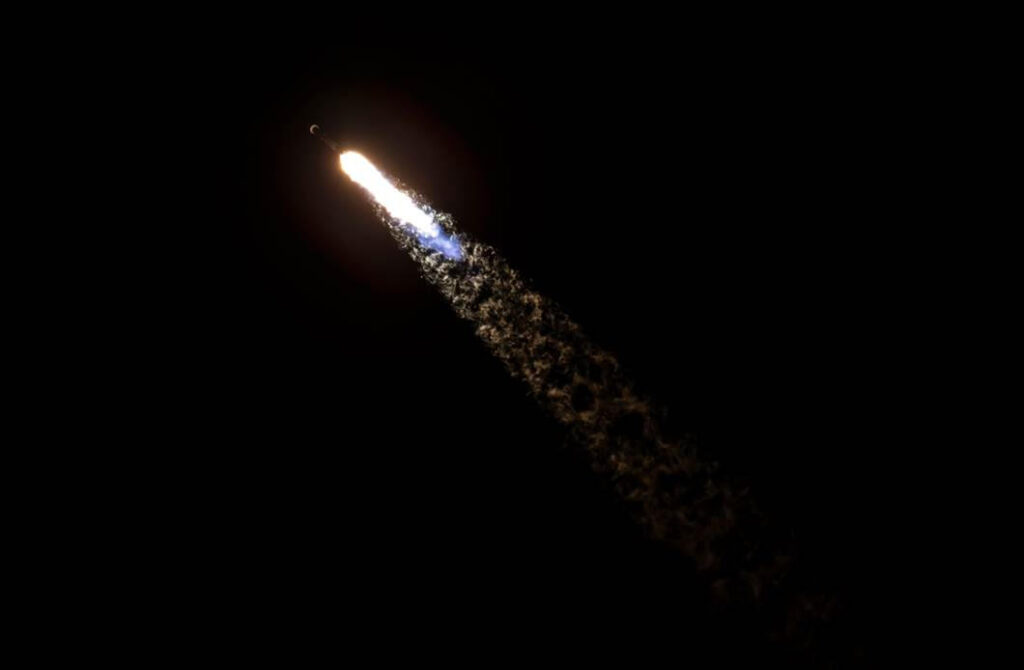
This GPS satellite is named in honor of Col. Ellison Onizuka, an accomplished U.S. Air Force flight test engineer, science and technology leader and astronaut from Kealakekua, Hawai’i who flew on the STS-51C space shuttle Discovery mission before perishing in the Jan. 28, 1986, space shuttle Challenger disaster 40 years ago.
The NSSL team led the rapid launch campaign shoulder-to-shoulder with the space vehicle team, Space Launch Delta 45 and SpaceX, who provided the launch service. This program ran on a swift timeline, following in the footsteps of the two most recent GPS missions, the Rapid Response Technology (RRT)-1 in December 2024 and GPS III-7 (SV08) in May 2025.
The GPS III-9 (SV09) launch, delivered through NSSL’s flexible and agile processes, demonstrates a commitment to rapidly deploying critical assets to the warfighter.
“When we combine the agility built into our contracting processes with the incredible teamwork between our launch and range teams, motivated space vehicle partners, and our seasoned launch service provider, we get outstanding results,” said USSF Col. Ryan Hiserote, SYD 80 commander, NSSL program manager, and mission director for this launch. “Going faster while maintaining precision and excellence is key as we head into the future of space as a warfighting domain.”
Speed in the national security launch business is a carefully orchestrated, all-hands activity. Technically, the effort began with a contract action that traded this mission from a ULA Vulcan launch to a SpaceX Falcon 9 launch, followed by a later trade in which a GPS IIIF (Follow-On) mission was moved from a Falcon Heavy to a Vulcan launch.
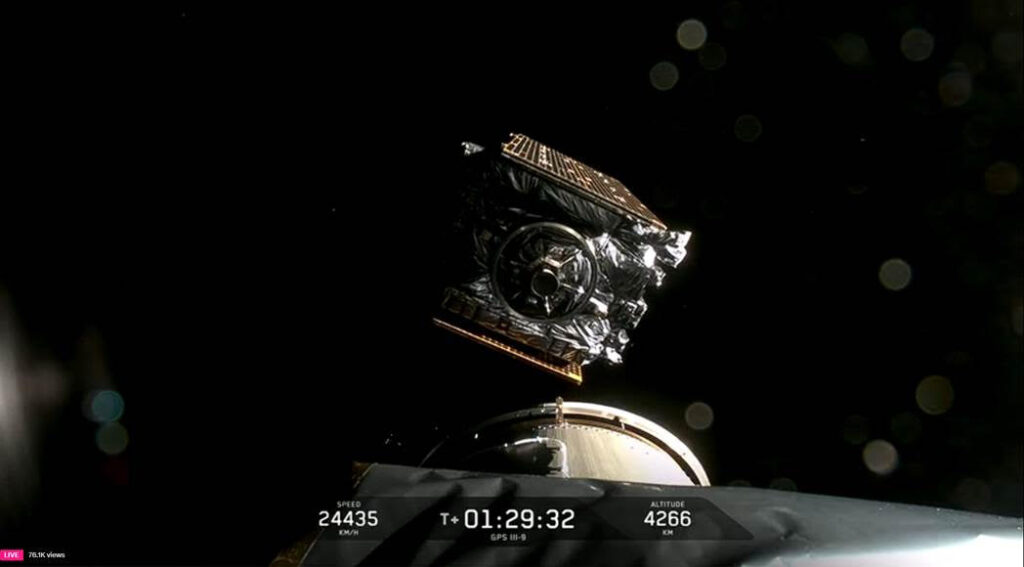
is successfully deployed over the Pacific Ocean west of Mexico one hour and 29 mins after liftoff on Jan. 27 at 11:53 p.m. EST (8:53 p.m. PST) from Space Launch Complex (SLC)-40, Cape Canaveral Space Force Station, Florida, using a SpaceX Falcon 9 rocket.
The launch campaign for GPS III-9 (SV09) was subsequently executed in only two months, reflecting highly polished processes for both the launch vehicle and space vehicle teams and showcasing the program’s unique ability to rapidly adapt the launch manifest to ensure a decisive advantage for the warfighter.
“What you’re seeing is an evolution of teamwork in process efficiency and focus. Continuing the work we started on RRT-1, we’re strengthening our base and gaining momentum,” said Dr. Walt Lauderdale, Falcon System program director and launch deputy mission director. “These achievements are not only time-saving and efficient, but they are also essential for our future. We’re tackling the challenge to not only sustain and build out present constellations but launch entirely new space capabilities.”
Within CFC’s Mission Delta 31, the space vehicle team accomplished their regimen of processing actions, preparing SV09 for the battery of tests, encapsulation and integration with the Falcon 9. Their schedule was likewise reduced, and the ground campaign was smoothly executed.
About SSC
Space Systems Command is the U.S. Space Force field command responsible for acquiring, developing, and delivering resilient capabilities to outpace emerging threats and protect our Nation’s strategic advantage in, from, and to space. SSC manages a $15.6 billion annual space acquisition budget for the Department of Defense, working with joint forces, industry partners, government agencies, academia, and allied nations. For more information, visit ssc.spaceforce.mil and follow @USSF-SSC on LinkedIn.
About SYD80
SYD 80 executes the U.S. Space Force’s core function of Space Access, performing space lift and range control missions in close partnership with the 30th and 45th Space Launch Deltas. Additionally, the delta develops resilient and ready launch and test infrastructure to expand U.S. economic, technological, and scientific leadership. Furthermore, SYD 80 delivers servicing, mobility, and logistics capabilities that operate in, from, and to the space domain.
About CFC
CFC is the service force provider, focused on generating and presenting improved combat-ready Space Forces, fortifying mission resiliency and advocating for combat-ready space power from future force to fielded force.
About Mission Delta 31
MD 31’s mission is to provide, operate, and sustain Satellite Control & Navigation Warfare to protect our Nation’s interests. And assure an unparalleled global unity. MD 31 is the world’s premiere provider of positioning, navigation, timing, and satellite control…for all users, in all places, at all times.