
By Arie Egozi, Autonomy Global – Ambassador for Israel
Israeli unmanned ground systems specialist Roboteam has expanded and reshaped its product line in the wake of the recent conflicts, introducing new platforms and architectures born from intense operational use of unmanned ground vehicles (UGVs) and multi‑domain autonomy. The Israel Defense Forces (IDF) and defense establishment describe its most recent two-year campaign as a “first robotics war,” marked by large‑scale deployment of ground robots for tunnel exploration, route clearing and close urban ISR with embedded AI for detection and tracking of adversary fighters.
Israeli forces used Roboteam’s Micro Tactical Ground Robot (MTGR) family and related platforms extensively for tunnel work, building clearing and stand‑off reconnaissance. The company now markets these systems as combat‑proven. Lessons from heavy operational employment now drive Roboteam’s roadmap toward more scalable autonomy, multi‑robot teaming and tighter integration between unmanned assets at platoon and company level.
One of the company’s most unique new concepts, the “Robot Container,” an integrated, deployable module, holds a mixed fleet of UGVs and a drone. The container allows infantry units to rapidly deploy multiple unmanned assets from a single module to hold perimeters and push robots forward instead of troops. This directly reflects lessons learned on the need for scalable unmanned capabilities in high‑risk approaches and urban strongholds.
Roboteam’s heavy Rook UGV, developed jointly with Elbit, was another platform that saw extensive action. Rook is a fully autonomous 6×6 UGV capable of carrying a 1,200 kg payload for logistics support, CASEVAC, ISR payloads, remote weapon stations and loitering munitions integrations.It is explicitly positioned to operate in swarms or as part of coordinated unmanned teams in dense, lethal environments.
Alongside Rook, Roboteam is expanding its MTGR and “Roni” portable robot families, both of which were used in combat and are now gaining fresh export interest. The MTGR/Roni line, which includes a roughly 200‑unit U.S. Marine Corps order with deliveries through Q1 2025, is marketed as battle‑tested and continuously upgraded rather than a static, one‑off design.
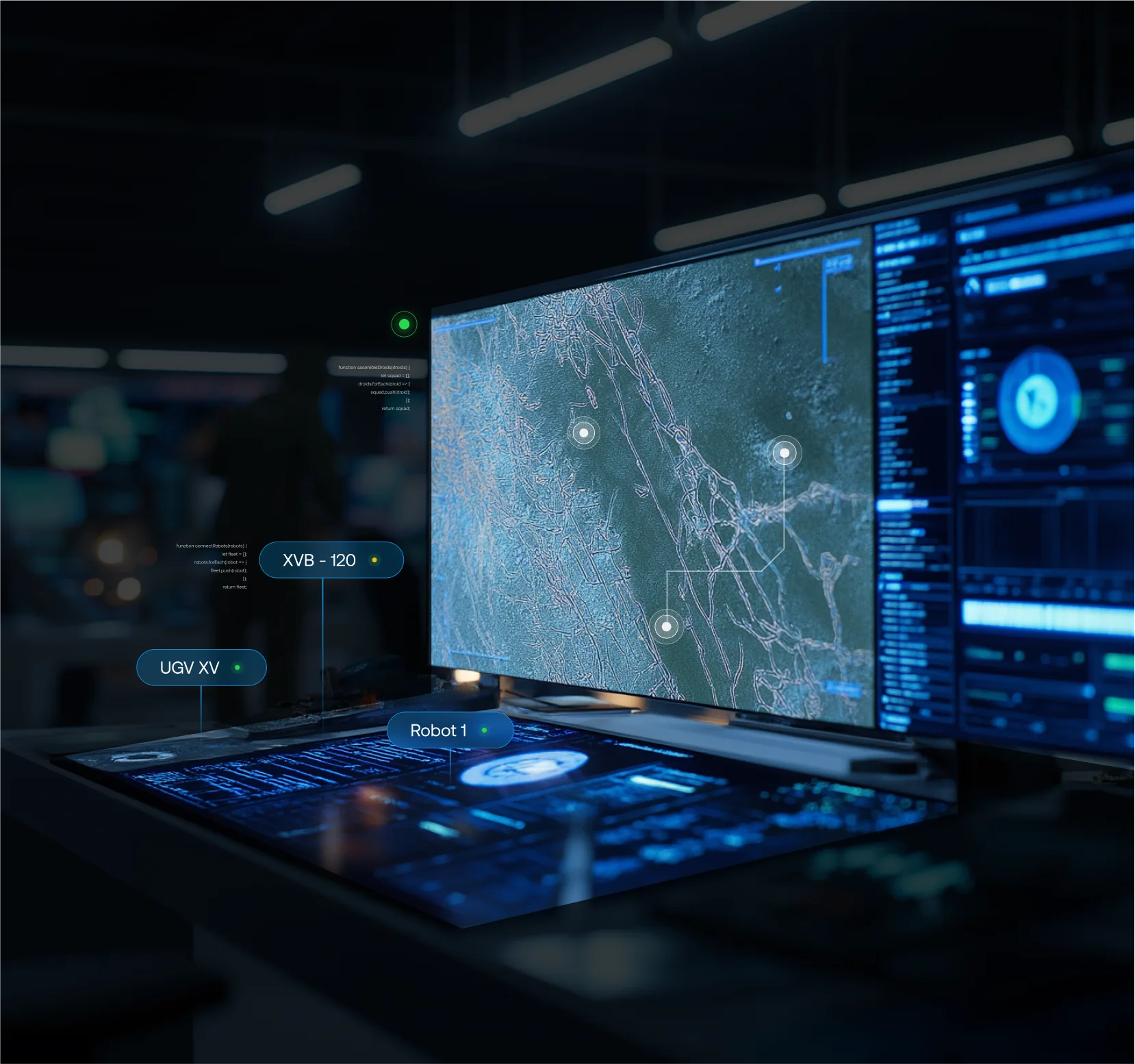
In 2025, Roboteam also announced Roboteam HUB, an AI‑enabled, platform‑agnostic command‑and‑control layer for managing heterogeneous fleets of unmanned systems across domains. HUB is already integrated across Roboteam’s UGV portfolio and is designed to control third‑party systems as well. It provides a unified, data‑driven operational picture and enables higher levels of autonomy for complex missions involving multiple robots and sensors.
Roboteam co‑founder and CEO Yossi Wolf told Autonomy Global that the company’s robotic systems have “saved a lot of lives.” “When the robot is the first to confront a Kalashnikov assault rifle or RPG anti‑armor rocket, soldiers are saved,” he said. He added that the IDF now views robotic systems, especially in dense areas, as an operational must and that Roboteam is working on new systems where AI will be a major part of the operational concept.