
By: Dawn Zoldi
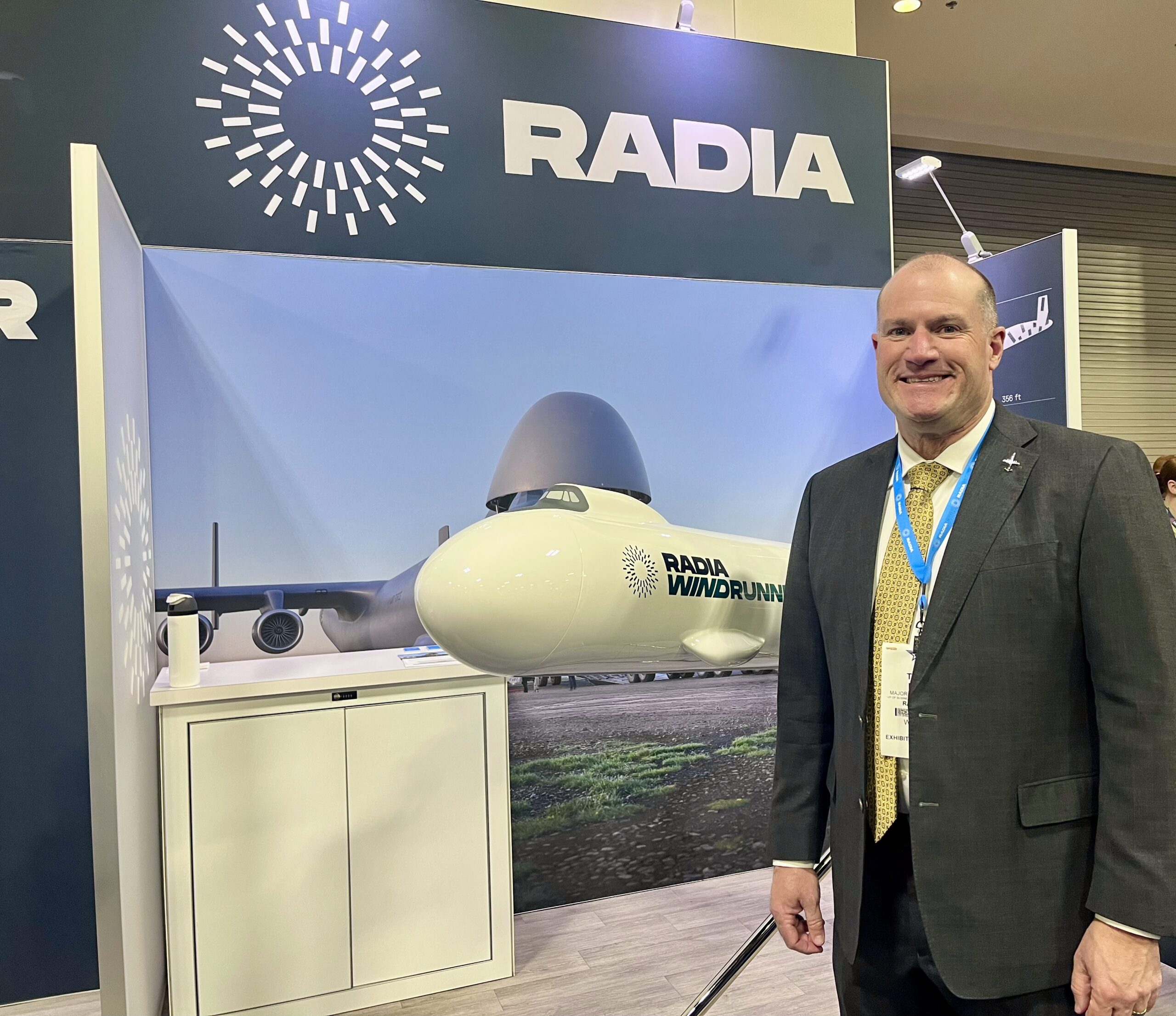
Radia used this week’s AFA Warfare Symposium in Aurora, Colorado to sharpen its pitch that WindRunner, the ultra-large cargo aircraft it bills as the world’s largest, is as much a defense asset as a renewable energy enabler.
At the show, Maj. Gen. (Ret.) Thad Bibb, Radia’s Vice President For Defense Business Development, traced WindRunner’s origins to a problem in offshore wind: how to move 105‑meter blades from coastal factories to inland wind farms that lack heavy infrastructure. “They looked at blimps and other options, but the idea was to build an airplane that could land on dirt strips at wind farms across the United States and around the world,” he said.
Bibb, a former 18th Air Force commander with roughly 5,000 flight hours (most of them in the C‑5 Galaxy) joined Radia after retiring from the Air Force last year. As the company refined its design around wind energy, leadership asked him whether the same platform could close emerging defense mobility gaps. “With my background with large cargo airplanes…(I knew) we never have enough airlift,” Bibb said. “What we’ve discovered is there’s a real gap in outsized airlift capability around the world globally.”
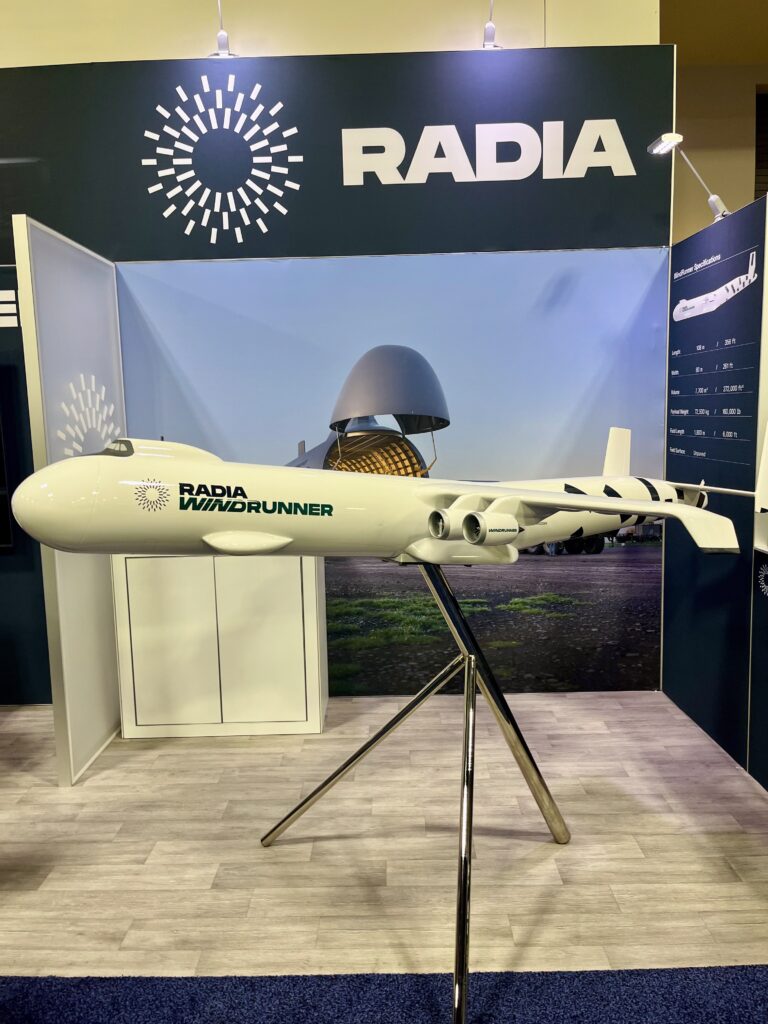
Unlike legacy airlifters optimized around tonnage, Radia is engineering WindRunner first and foremost for volume. Bibb noted that in real‑world operations his crews usually “cubed out before we massed out,” filling available volume before hitting weight limits. Radia quotes more than 6,800 cubic meters (more than 240,000 cubic feet) of usable cargo space, roughly seven times the volume of a C‑5 and up to 12 times a 747 freighter depending on configuration.
That volume enables mission loads that today require multiple sorties and extensive disassembly. A C‑17 can move one CH‑47 Chinook. WindRunner is designed to carry six Chinooks with rotor blades and gearboxes installed, roll‑on/roll‑off and mission‑ready. Radia also highlights capacity for four CV‑22 Ospreys for special operations direct delivery, and internally fitting four F‑16 or F‑35C fighters, configurations aimed at relieving stressed tanker fleets by reducing the need for ferry refueling.
While WindRunner itself is not being pitched as an uncrewed platform, Bibb argued that its relevance to future airpower lies in how it supports uncrewed systems at scale. He pointed to the U.S. Air Force’s Collaborative Combat Aircraft (CCA) vision, which will field large numbers of autonomous “loyal wingmen” with no pilots to ferry them into theater.
“We can carry a total of 44 autonomous fighters for the collaborative combat [mission],” he said, adding that realistic Pacific scenarios would probably see loads of 21–22 CCAs per sortie. The idea is to push large numbers of mission‑ready CCAs through contested logistics networks and disperse them at austere locations that currently lack outsized airlift options.
Despite its scale, 356 feet long with a 261‑foot wingspan, Radia designed the WindRunner to operate from semi‑prepared or unpaved strips as short as 1,800 meters. This opens up many airfields that are off‑limits to today’s widebody freighters. Bibb emphasized that this short‑field performance on unprepared surfaces is central to how defense planners see the aircraft enabling Agile Combat Employment and distributed basing concepts. “Aircraft this size to be able to go and use the same runways as a C‑130, as far as weight‑bearing capacity, really gives military planners all kinds of options,” he said.
To keep schedule and certification risk in check, Radia is deliberately avoiding unproven propulsion or flight‑control architectures on its first variant. The aircraft uses engines “flying over the United States today, some of the biggest in the world,” as well as composites, landing gear, and flight‑control systems similar to those certified on other aircraft, according to Bibb. “To have this aircraft available for military planners in 2030, we’re using all existing technology,” Bibb said.
Radia’s defense push is less than a year old, but Bibb said interest from U.S. and allied customers has been strong, including a letter of intent from NATO’s Strategic Airlift Interim Solution (SALIS) program.
The company initially planned to own and operate the entire fleet and sell capacity as a service, positioning WindRunner as part of the Civil Reserve Air Fleet‑like ecosystem that the U.S. Transportation Command could tap during crises. Some militaries, however, want to own the aircraft outright. “They said, ‘If we’re going to do this, we would really like to own and operate the fleet because we want to own the risk to be able to go into combat situations,’” Bibb explained. In response, Radia has added flexibility to its model to allow for either airlift services or direct sales for military and allied government operators as desired while still planning to offer commercial service for wind, aerospace and outsized cargo customers.
That dual‑use approach underpins three main lines of effort: wind energy, defense and outsized commercial cargo. Beyond turbines, Bibb cited demand signals around space launch vehicles that today move only by ship, hydroelectric infrastructure components, and heavy industrial hardware that must reach remote sites. He also called out humanitarian and disaster response, where access to 1,800‑meter runways could be critical even if operations don’t require true dirt strips.
Internally, WindRunner is now in what Bibb described as an integration phase with roughly 15 manufacturing partners around the world, each with experience designing and certifying major aircraft systems. Radia maintains headquarters in Boulder, Colorado and Rome, Italy. It has recently showcased the aircraft at events including the Singapore Airshow as it courts customers across Europe, the Middle East, and the Indo‑Pacific. Bibb said he is headed to Europe next to continue discussions with senior defense leaders, while the company fields multiple parallel conversations with NATO, Gulf, and Asia‑Pacific stakeholders.
For now, Radia is positioning WindRunner as a way to bridge the gap between aging C‑5/C‑17 fleets and whatever next‑generation airlift family of systems emerges, particularly for loads longer than 300 feet that current aircraft cannot accommodate. “WindRunner really enables us to move, in today’s environment, the hardest‑to‑move things to the hardest‑to‑reach places,” Bibb said.