
By Dawn M.K. Zoldi, Colonel (USAF, Ret.), Esq.
The FAA’s latest nationwide UAS security NOTAM, FDC 6/4375, significantly escalates how the federal government can manage drones near sensitive facilities, mobile assets and their “escorts” (undefined). It also raises serious First Amendment questions about news‑gathering, particularly around ICE raids and other high profile law‑enforcement operations that fall squarely in the public eye.
The First Amendment, in Plain English
The First Amendment commands that “Congress shall make no law…abridging the freedom of speech, or of the press.” That simple sentence undergirds modern protections for both expression and newsgathering. In this context, courts have interpreted the term “speech” broadly to include written and spoken words, images and even conduct or symbols intended to convey a message. Folks, speech includes aerial video documenting a law‑enforcement convoy or an ICE raid scene.
But the Constitution does not protect all expressive activity. Obscenity, fighting words (face‑to‑face threats), defamation and incitement to imminent lawless action fall outside the First Amendment’s shield. However, political speech and press activity, including documenting how government agents conduct immigration enforcement, protests oversight or arrests, sits at the very core of what the Founding Fathers designed the First Amendment to protect.
Content‑Neutral vs. Content‑Based Rules
When courts examine a restriction that affects speech, the first question is whether the government is targeting the message itself. Going back to black letter law, a rule is “content‑based” if it applies because of what is being said, who is saying it or the subject of the expression. Those types of laws are presumed unconstitutional and subject to “strict scrutiny.” Under strict scrutiny, the government must show a compelling government interest and prove it is using the least restrictive means to achieve that interest. Most laws cannot survive that standard of review.
By contrast, courts evaluate a genuinely content‑neutral rule that regulates only the time, place or manner of expression, such as a uniform stand‑off distance around critical infrastructure for safety reasons, under “intermediate scrutiny.” There, the government must just show an important or significant interest, narrow tailoring (not perfect tailoring, but no unnecessary burden on speech) and that ample alternative channels of communication remain.
Where the FAA’s NOTAM lands on this spectrum will decide its constitutional fate.
What NOTAM 6/4375 Actually Says
The new NOTAM, issued under 14 C.F.R. 99.7 and 49 U.S.C. 40103(b)(3), designates airspace near certain Department of Defense, Department of Energy and Department of Homeland Security facilities and mobile assets as “national defense airspace.” It applies to “vessels and ground vehicle convoys “AND THEIR ASSOCIATED ESCORTS, SUCH AS UNITED STATES COAST GUARD (USCG) OPERATED VESSELS,” and imposes a stand‑off distance of 3,000 feet laterally and 1,000 feet vertically within which all UAS operations are prohibited unless separately authorized.
The enforcement language is equally strong. The NOTAM warns that, “IN ADDITION, UAS PERATORS (sic) WHO ARE DEEMED TO POSE A CREDIBLE SAFETY OR SECURITY THREAT TO PROTECTED PERSONNEL, FAC (sic), OR ASSETS MAY BE MITIGATED…” It then goes on to reference authorities that permit interference with, interception of, seizure of, or even destruction of unmanned aircraft deemed threats (think: counter-uas mitigation). Notably, this language explicitly protects not just facilities or assets, but “personnel,” which can readily be read to include ICE agents, DHS officers and other federal law‑enforcement teams in the field.
Jonathan Rupprecht, an FAA-certificated commercial pilot with multiple ratings, contributor to Forbes.com covering aerospace and defense topics and attorney known for his keen attention to detail, had this to say about the NOTAM. “It appears to be rushed…” he said. “Notice someone deleted the Department of Justice up above (e.g., top of the document) but forgot DOJ was below” (in the mitigation section). He also opined that the document seems to have been written “without consideration of important First Amendment rights.”
On that note, for purposes of a First Amendment analysis, two features matter. First, the FAA failed to define the phrase “AND THEIR ASSOCIATED ESCORTS.” That ambiguity potentially sweeps in any law‑enforcement or contractor vehicles, and in the context of later language, people, moving with, ahead of or behind a DHS or ICE convoy, if loosely providing “escort” support…with no clear standards, public listing or map depiction.
Second, the FAA all but admits that, rather than using more tailored Special Security Instructions (SSI), it opted for this broad, roaming framework because specificity is kinda hard in many cases. As the NOTAM states:
“THE FAA APPLIES, TO THE MAXIMUM EXTENT PRACTICABLE, SPECIAL SECURITY INSTRUCTIONS (SSI) PURSUANT TO 14 C.F.R. SECTION 99.7 OR OTHER AIRSPACE MEASURES THAT RESTRICT UAS OPERATIONS IN PROXIMITY TO FACILITIES AND MOBILE ASSETS COVERED BY 6 U.S.C. SECTION 124N, 10 U.S.C. SECTION 130I, AND 50 U.S.C. SECTION 2661. HOWEVER, IMPLEMENTING ADVANCED SSI OR OTHER AIRSPACE MEASURES MAY NOT BE FEASIBLE FOR ALL COVERED ASSETS AND MOBILE ASSET OPERATIONS.”
Translated: Because it is operationally difficult to be specific, the agency created a broad, mobile exclusion zone instead. That choice may very well be front and center in any challenge.
ICE Raids, Escorts and Moving “No‑Drone Zones”

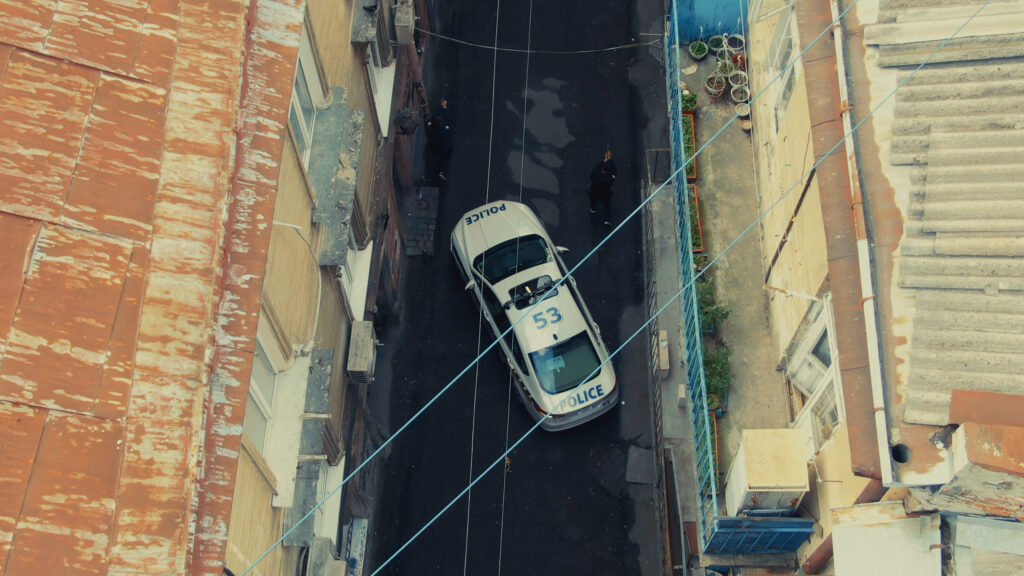
Now view this NOTAM through the lens of the real world of ICE raids and immigration enforcement. Many such operations unfold as multi‑vehicle events: transport buses, tactical units, local police partners, private security and additional support vehicles. Any of these could be characterized as “associated escorts,” even if that designation is never publicly announced or is decided after the fact.
Because “AND THEIR ASSOCIATED ESCORTS” remains undefined, the practical effect is a roving, invisible and potentially retroactive bubble of “national defense airspace” around any operation that DHS or its partners decide to treat as sensitive.
Add in the mitigation language referencing “PROTECTED PERSONNEL,” and the government now has both a broad trigger and powerful tools to push media drones away from documenting how those personnel perform their mission. From a First Amendment standpoint, that combination creates two dangers:
- It chills newsgathering, because risk‑averse journalists may avoid flying anywhere near suspected enforcement activity rather than risk being deemed a “credible…security threat” to protected personnel and mitigated.
- It invites selective enforcement, where similar drone flights are tolerated in routine contexts but aggressively targeted when they are capturing politically charged events such as ICE raids, protest crackdowns or controversial operations.
That second danger is precisely what can convert a facially content‑neutral rule into a content‑based one in practice.
Applying the First Amendment Tests
On its face, NOTAM 6/4375 looks like a content-neutral time‑place‑manner restriction. It applies to “all unmanned aircraft” within a defined distance of certain facilities, convoys and escorts, without explicitly distinguishing by purpose, content or speaker. The government interest of protecting critical national security missions, sensitive assets and personnel from potentially hostile UAS is undoubtedly important, and arguably compelling.
The constitutional stress point lies in narrow tailoring and alternative channels. A 3,000‑foot lateral and 1,000‑foot vertical stand‑off around any covered convoy plus undefined “escorts” can be overbroad in dense urban environments, where those distances can effectively erase the ability to obtain meaningful aerial footage of what is happening on the ground. Ground‑based footage may not be an adequate substitute when lines of sight are blocked, events move rapidly or law‑enforcement perimeters are themselves large and fluid.
Courts applying intermediate scrutiny will likely focus on:
- Whether the rule is enforced uniformly, regardless of whether the operator is a journalist, activist, commercial operator or hobbyist.
- Whether there are workable, timely mechanisms for media to obtain coordinated access or waivers when covering fast‑moving events like ICE raids.
- Whether undefined terms like “ASSOCIATED ESCORTS” and the broad “credible…security threat” language to “PROTECTED PERSONNEL” are being used to selectively suppress disfavored coverage.
If patterns of enforcement show that the government invokes this NOTAM most aggressively when drones are used to document controversial DHS operations, protests or immigration enforcement, and not, for example, when hobbyists or commercial operators fly near similar vehicles, the rule’s application will begin to look content‑ and viewpoint‑based. At that point, courts may reframe the dispute under strict scrutiny, where the government would have to justify why such broad, vague and roving restrictions are the least restrictive means of protecting assets and personnel, and not just a convenient way to keep cameras away.
Will the NOTAM Survive?
On paper, the FAA has structured NOTAM 6/4375 to resemble a content‑neutral safety buffer around national‑security‑related facilities, convoys and escorts. Its language about “all unmanned aircraft” and public‑interest coordination channels gives the agency a plausible argument that any impact on press drones is incidental, not intentional.
In practice, however, the undefined “AND THEIR ASSOCIATED ESCORTS” clause, the explicit reference to “PROTECTED PERSONNEL,” and the candid admission that more precise SSIs are often “not…feasible” collectively push the NOTAM toward overbreadth and vagueness. Those features increase the risk of chilling core press activity and enabling selective enforcement in precisely the kinds of high‑stakes events (think: ICE raids, immigration crackdowns, protest responses) where First Amendment protections are normally viewed as strongest.
According to Jennifer Ambrose, the Founder of Aviation Aerospace Law, PLLC who previously worked for the FAA for over 18 years in the Office of the Chief Counsel in various roles, whether the NOTAM violates the First amendment will likely depend on how the government applies it. “On the surface, the courts have found that restrictions on flight over critical infrastructure or sensitive areas do not inherently restrict freedom of speech.”
Ambrose pointed to the Fifth Circuit ruling in National Press v McCraw (No. 22-50337). In that case, she explained, the court found Texas’ Chapter 423 restrictions on drone flights did not violate the First Amendment because they were solely restrictions on flight, rather than restrictions on recording or speech. “However, even in that decision, the circuit court acknowledged that the First Amendment does protect the right to record the police in the course of their public duties as a way of keeping government officials accountable,” she continued.
“Because the NOTAM is so sweeping in its language, it could become a de facto ban on drone recording, which could be a bigger problem when coupled with other government actions designed to keep press away from government activity,” Ambrose warned.
Legalisms aside, Ambrose also noted that, “On a practical level, the NOTAM isn’t written in a way that operators will be able to follow it. Operators are unlikely to be able to follow a TFR that is constantly in motion because they won’t know which direction the TFR might move to.”
So perhaps if federal agencies implement this NOTAM with transparently neutral, consistently applied criteria and create credible, rapid processes for media access, the rule might stand a reasonable chance of surviving under intermediate scrutiny. If, instead, it becomes a tool to push news drones out of the sky whenever coverage becomes uncomfortable, expect litigation. In that case, courts will explore whether 6/4375 truly regulates safety…or whether it has been wielded as a shield to drone pilot-journalists and a content‑based barrier to the public’s right to know.