
By: Charlton Evans, AG Certification Ambassador
The future of aviation control could someday come down to a single swipe. At the 2025 NBAA-BACE conference, Skyryse’s Jonahs Ruiz described his company’s mission as controlling aircraft skillfully and safely, a mission as old as flight itself.
The company’s solution, called SkyOS is a universal fly by wire control system, and aims to bring a common interface and architecture to aircraft of all types, from helicopters and fixed-wing planes to potentially multi-rotor designs. “We set out to create a system that could serve as the standardization of flight controls across all aircraft platforms,” Ruiz explained during the session. In essence, it’s about making flying simpler, safer and more consistent, without removing the pilot from the equation.
Skyryse’s approach involves a triply redundant, dissimilar system architecture. Three independent flight control computers (FCCs) work in parallel. If one fails, the others maintain function seamlessly. As Ruiz put it, “If one goes down, the other two are still operating fully functionally. Two go down, the system tells you to land.” This level of redundancy, combined with a patented array of electromechanical actuators that replace traditional hydraulic systems, positions their platform to meet rigorous FAA certification standards under DO-178C, DO-254, and ARP 4754 validation.
The system is as adaptable as it is robust. Built to be aircraft-agnostic, it can theoretically fit anything from a Robinson R66 helicopter to a Black Hawk. The company has expanded development to a Cirrus SR22. Each integration involves the careful balance of trading out mechanical systems for smart electronics, while maintaining or even reducing weight. The team noted that on the R66, for instance, “we came out net neutral in terms of weight.” This was a critical milestone for any retrofit program navigating certification scrutiny.
Other companies have tried piecemeal approaches, such as integrating existing autopilots with fly-by-wire systems, bolting on sensor suites and layering over proprietary interfaces. Still others, especially in Silicon Valley’s advanced air mobility (AAM) sector, have sought to keep everything “vertically integrated,” and build entire ecosystems in-house. Charlton noted, “We’ve been exposed to most of the eVTOL companies and a lot of the [mid sized unmanned systems]… and they’re all seeking solutions.” Many have realized that building proprietary flight systems in-house strains both budgets and timelines. Skyryse’s position is all-in. “We can’t create a universal platform if we don’t take on all of the hard work ourselves,” Jonas commented. Skyryse seeks to provide as comprehensive a solution as possible. A testament to that vision, the company now holds a moat of intellectual property (IP): more than 50 patents across its flight control computer (FCCs) and actuation systems.
None of this has been easy. The Skyryse team was candid about the grind behind the headlines. “A lot of blood, sweat, and tears,” Jonas said, “We knew we’d be breaking a lot of spirits and hopes and dreams. But hey, we’re here now.” That “here” represents years of methodical development, from electromechanical actuator design through triple redundancy testing, software qualification and full-stack integration. all under the scrutiny of regulators and OEM partners.
Unlike many flashy prototypes that debut at air shows but rarely reach certification, Skyryse’s focus is compliance-first. By designing within frameworks like DO-160 environmental testing and ARP 4754 safety assessment, the company has proven its seriousness about scaling safe adoption. The company’s first Supplemental Type Certificate (STC) path with the FAA for the R66, for example, while demanding, will establish a replicable roadmap for integration into future airframes, from small general aviation planes to heavy rotorcraft.
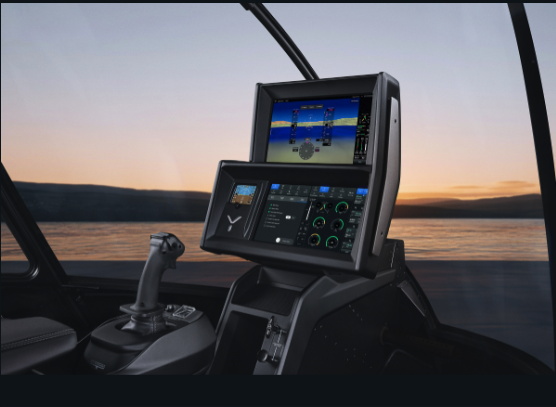
IIn addition to Skyryse’s technical prowess, its vision of making flight intuitive was even more impressive. “You can start your engine with a swipe of a finger and initiate a hover by swiping,” Jonas said. This merging of touchscreen simplicity with advanced avionics reframes aircraft operation as something more fluid and human-friendly. Flying with “one hand on the control stick and the other out the window,” (as the speaker joked) may not yet be regulation-approved, but certainly captures the spirit of intuitive autonomy Skyryse hopes to achieve. The achievement of many previously complex tasks are combined into outputs from the simplest of inputs. Anyone who has flown a highly automated multicopter has experienced this type of control interface.
So why is this tech so important? For a few reasons. Skyryse’s team emphasized that their mission isn’t about removing the pilot. It’s about rethinking how control is expressed. The difference between a “swipe to hover” and a fully autonomous takeoff lies in design philosophy. One focuses on intuitive human-machine interaction, the other trends toward full automation. Skyryse sits squarely in the former camp.
As the engineer noted, the goal was never to hand over control but to reduce workload. The integrated autopilot is “essentially always on,” but the human remains at the loop’s center, equipped to intervene or command effortlessly. For pilots, that means reducing cockpit management from dozens of switches and levers to a unified, logical touch interface, without losing situational awareness.
To do this, Skyryse’s system design focuses on a human-rated foundation. The company built its control system so that any aircraft using it could later operate either manually or optionally piloted. “If you wanted to go optionally pilot [the same aircraft], you’d be good to go,” Jonas explained. “Whereas if the drones are being certified, you can never put a human on board.” In other words, Skyryse designed for both sides of the autonomy equation, today’s human pilots and tomorrow’s unmanned systems to ensure the transition won’t require a technological reboot.
This flexibility distinguishes Skyryse from other advanced air mobility (AAM) startups that often start drone-first. By anchoring their system in pilot-in-command architecture, where automation supports rather than replaces, the company has tapped directly into regulatory comfort zones while keeping optional autonomy on the table.
Skyryse’s name might soon become synonymous with a new kind of cockpit simplicity. But the company’s deeper vision lies beyond any one aircraft. If the flight control logic goal of being ubiquitous across the majority of platforms becomes a reality, it could enable software updates, modular certifications, and cross-airframe maintenance models previously unimaginable in aviation. Beyond everyday flight operations, Skyryse’s system opens new doors for public aircraft and special missions. The company is already in partnership with CAL FIRE, where automated precision could one day mean safer aerial firefighting. As Jonas explained, instead of “judging when to drop the water based on…the orientation out the bubble window,” a pilot could geotag a location, press a single button and perform a perfect drop sequence. These automation layers could dramatically enhance efficiency and reduce pilot workload in demanding conditions. Another case where more automation is better.
For the U.S. military’s Black Hawk and potential other rotorcraft applications, the platform doesn’t depend on FAA certification criteria, which enables Skyryse to address the current defense and disaster response market through public aircraft operations.
While the company isn’t yet active in multi-rotors, it’s receiving “inquiries from players in the game.” Its universal platform that could quietly govern everything from large firefighting helicopters to small fixed wing general aviation planes and many more products beyond those categories. A universal language for flight control, long theorized and often dismissed as too complex, may finally be within reach.