

By: Abby Smith, Autonomy Global Ambassador – Airspace Awareness
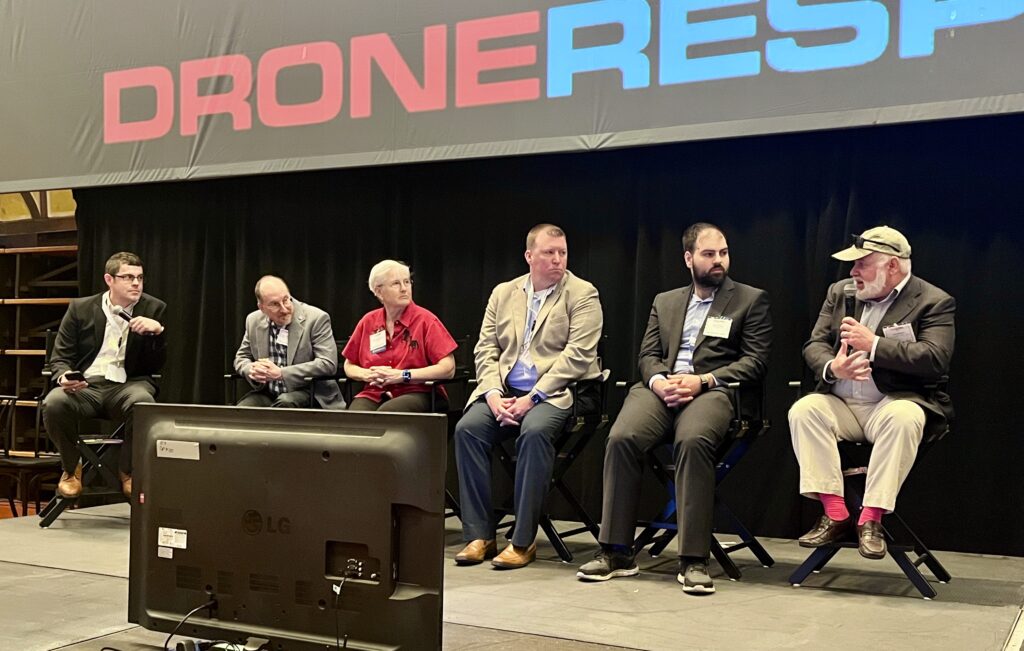
Airspace has increasingly become a contested, crowded and data-rich domain where public safety, national security and commercial opportunity all converge. For the panelists gathered at the recent DRONERESPONDERS NACON, a critical conversation unfolded around “airspace awareness” and how it remains the key prerequisite to safely integrate drones, advanced air mobility (AAM) and critical public safety missions into the national airspace system (NAS). Here’s the recap.
Defining Airspace Awareness In A Low‑Altitude World
The moderator opened by borrowing a 2018 U.S. Department of Homeland Security definition of air domain awareness: “effective understanding of information, threats and anything associated with the air domain that can impact security, safety, or the economy of the United States.” That broad framing matters in a low-altitude environment where traditional tools like long-range radar and ADS‑B no longer give a complete picture of what is flying, where and why.
NASA’s Jay Ely, an RF and radar systems engineer who leads technical work at NASA Langley’s SMART center, boiled it down even further. At low altitudes, he said, “we don’t really have a good way to know what’s in our airspace.” Solving that gap requires both cooperative and non‑cooperative means of detection, from RF monitoring to radar, optical and acoustic systems. The goal is a usable operational picture, not just raw detections.
NASA researcher Robert McSwain, whose work spans UTM, detect‑and‑avoid (DAA) and the Advanced Air Mobility Pathfinder, defined airspace awareness as “having complete information about what’s in your airspace so that you can make actionable decisions off of it.” His team’s research has focused on sensor fusion that blends radar, optical and RF sources into a common operating picture (COP) that a decision-maker can actually trust.
State‑Level Digital Infrastructure: Virginia To Multi‑State Corridors
John Eberhart, managing director of aviation and one of the architects of the Virginia Flight Information Exchange (FIX), brought the discussion down to the state and regional level. With more than 25 years managing scientists and engineers across aviation, defense, healthcare and security, Eberhart has helped turn Virginia’s FIX platform into an FAA‑onboarded UAS service supplier (USS) for land and sea operations.
His core mission is to give states and regions the digital infrastructure to perform “inherently governmental functions” such as navigation aids and airspace awareness data., without trying to replace commercial UAS service providers. In practice, that looks like:
- Allowing cities and counties to publish safety‑critical information (think: prisons, reservoirs, sensitive facilities) directly to drone pilots via UAS tools, so operators know where they can and cannot fly.
- Integrating public safety dispatch systems so anonymized advisories can be pushed to pilots during incident responses, helping them avoid interfering with first responders.
- Exposing public sensor networks that detect both crewed and uncrewed aircraft as a shared asset for agencies across the state.
Virginia is not alone. Eberhart noted similar FIX deployments in Pennsylvania, Oklahoma, New Jersey, West Virginia, Ohio and California, with roughly “10 or 12 states” engaged at various levels. A particularly important development, he said, is a regional collaboration that includes Virginia, North Carolina, West Virginia, Pennsylvania, New Jersey, Maryland and Delaware, a step toward multi‑state corridors where public safety agencies can access data across borders.
The catch is governance and funding. Not every state has a FIX, and those that do must commit resources to engage cities, counties and other subdivisions and to resolve thorny data governance issues.
NASA’s Sensor Toolbox: No Silver Bullet, Many Layers
Ely’s biography at NASA Langley reads like a catalog of the technologies now being pointed at the low-altitude problem: aerospace communications, navigation, RF and radar, electromagnetic compatibility and spectrum management. In his view, airspace awareness breaks into two broad approaches, cooperative and non‑cooperative. Both are needed.
He pointed out that ADS‑B, widely used in higher‑altitude operations, simply “doesn’t work on drones” in a scalable way because of power, frequency and spectrum constraints. That limitation has driven a wave of experimentation with:
- Networked and standalone radars tuned to low-altitude, small radar‑cross‑section targets.
- Optical and acoustic systems that can detect and classify drones amid clutter, birds and background noise.
- RF monitoring systems capable of sensing control links and other emissions.
Each sensor, Ely cautioned, has “disadvantages, clutter [and] false alarms.” No single system works in every case. The challenge is choosing the right combination of systems for a given mission profile and then managing cost, coverage and false positives in a way that agencies can actually sustain.
McSwain extended this point with a concrete example from NASA testing that involved radar returns filled with birds. Whether that is noise or a signal depends entirely on the mission. Wildlife management might welcome those detections, while a counter‑UAS operator may not. His central argument is that defining the mission first is essential. Sensor configurations, detection thresholds and even what counts as “relevant” all flow from that decision.
UTM As A Filter, Not A Panacea
If sensors form one layer of airspace awareness, digital traffic management forms another. Mary Carol “MC” Chruscicki introduced herself as co‑owner of AX Enterprise, a New York State‑certified woman‑owned small business that has spent decades building distributed information and communication systems for government and industry. She also serves as deputy director of the FAA‑designated New York UAS Test Site at Griffiss International Airport, where she has watched UTM evolve from concept to operational tool.
AX Enterprise, she explained, first dove into UTM when the Department of Defense and Department of Homeland Security asked what would happen if “the Googles and Amazons of this world” took over the low‑altitude airspace. Building UTM capabilities quickly revealed that its true value extends beyond cooperative drone management: by correlating known, trusted operations, UTM helps decision‑makers “separate the wheat from the chaff.” In an incident, that means:
- Identifying drones and operators who are filing flight intents, broadcasting Remote ID and following the rules.
- Highlighting unknown or non‑cooperative aircraft as higher‑priority targets for investigation.
She emphasized that today’s Remote ID rules do not yet guarantee “trusted” identity. True Trusted Remote ID is still aspirational, but even imperfect tools free public safety officials to focus on aircraft that “don’t look right.”
The glaring problem is access. Chruscicki’s team has supported high‑end operations, from Air Force bases to the National Capital Region during a presidential inauguration, where sensors stream data into cloud services that can be accessed via APIs. However, she admitted that UTM has been “very slow” to reach state and local agencies because of resource constraints and the cost of building out sensors and communications infrastructure.
New York is exploring a different model: shared infrastructure. Under that concept:
- Public safety agencies use the sensor and communications network for training, exercises and real‑world response.
- Commercial players including upstate medical delivery services, logistics companies, major retailers pay to leverage the same infrastructure for revenue‑generating operations.
- Priority rules govern who gets bandwidth and data access first when something goes wrong.
The economic logic is straightforward. Few agencies can afford to build and sustain their own stovepiped networks, but a shared backbone can spread cost while enabling more consistent coverage.
Turning Sensor Data Into Usable Information
While Ely and McSwain focus on the hardware and physics of detection, NASA computer scientist Byron Retter approaches airspace awareness from the software side. With degrees in computer engineering and computer science and eight years supporting UAS integration and testing projects, Retter has spent much of his career figuring out how to move sensor data into cloud platforms where operators can actually see and act on it.
He argued that modern operations are simply too complex and geographically dispersed to manage without digital tools. As requirements get “replaced by sensors,” the task is to ingest those streams into a “usable space” so that tools like UTM and other decision-support systems can make sense of them.
One promising avenue, he suggested, is treating airspace awareness as an Internet of Things problem. In that model:
- Sensors become data access points feeding a common messaging protocol.
- Data can be pre‑processed at the edge, then shared through standardized interfaces into national or regional systems.
- Agencies subscribe to the feeds and views they need, rather than struggling to integrate proprietary, one‑off interfaces.
Sharing information “from the national perspective,” Retter said, is a critical piece of the puzzle. Data must move from sensor to user in a timely, predictable way if it is going to make a difference in the field.
Mission First, Money Second, Tech Third
Asked what the single biggest challenge in airspace awareness is, Eberhart didn’t point to a sensor gap or a missing data standard. “The number one challenge is figuring out what you want to do,” he said. There is “no silver bullet” and “no magic beam.” Agencies must start by defining their mission and use cases before buying anything. He laid out the required hierarchy:

- Understand the mission and the outcomes you care about. That determines what data you must have to prioritize and mitigate risk correctly.
- Build a realistic sustainment model that covers acquisition, maintenance and lifecycle, not just a one‑time grant purchase.
- Only then start matching technology to those mission needs.
McSwain agreed, noting that many sensors can be “programmed and configured” for different targets (think: small UAS, low‑altitude surveillance, or something else) but only if end users articulate those requirements upfront. NASA’s research now includes defining sensor specifications in terms that decision‑makers can understand, such as probabilities of detection and false alarm rates for specific use cases.
Chruscicki added a financial reality check. “Everyone is right, it’s expensive,” she said. The full suite of sensors and infrastructure most agencies want is not affordable to build and sustain independently. That insight is driving New York’s shared infrastructure strategy and its effort to avoid deeper stovepipes between organizations.
Ely, for his part, framed the public safety community as both early adopter and primary beneficiary of the digital infrastructure now being built. Virginia’s aviation partnerships, he noted, are already using public safety, fire and law enforcement as “highly compelling use cases” to justify investment in digital infrastructure. In parallel, the state is exploring drone‑based delivery of blood products and organs to trauma centers along its coastal and regional medical hubs. Those operations will absolutely require robust airspace awareness to execute safely.
Accelerating Progress: Communication Over Technology
In the session’s rapid‑fire closing round, the panelists were asked what will most accelerate airspace awareness. Their answers focused on people and process.
Ely pointed to “communication” across federal, state and local levels so stakeholders can align on funding, roles and responsibilities. Conferences like the one hosting this panel, McSwain added, are where those relationships and strategies are hammered out.
Eberhart urged agencies to “start where you can with what you can,” bring stakeholders to the table at state and county levels and “spend your money wisely.” That means piloting realistic use cases, documenting lessons learned and incrementally scaling, rather than waiting for a perfect, national‑level solution that may never arrive.
For Chruscicki, the path forward runs through shared infrastructure and prioritization. Build systems that can serve law enforcement, tribal authorities, medical delivery providers and commercial operators, then enforce clear rules on who gets access to data and services during high‑stakes events. If done well, she argued, this approach can reduce stovepipes instead of deepening them, and make airspace awareness both operationally effective and economically sustainable.
As drones, air taxis and networked sensors proliferate, airspace awareness will determine whether communities harness those capabilities for public good or spend the next decade reacting to risk. The experts gathered on this panel agreed on one thing: the technology is largely here, but aligning missions, money and governance will decide how quickly the United States can see, and safely manage, what’s in its skies.