

By: Dawn Zoldi
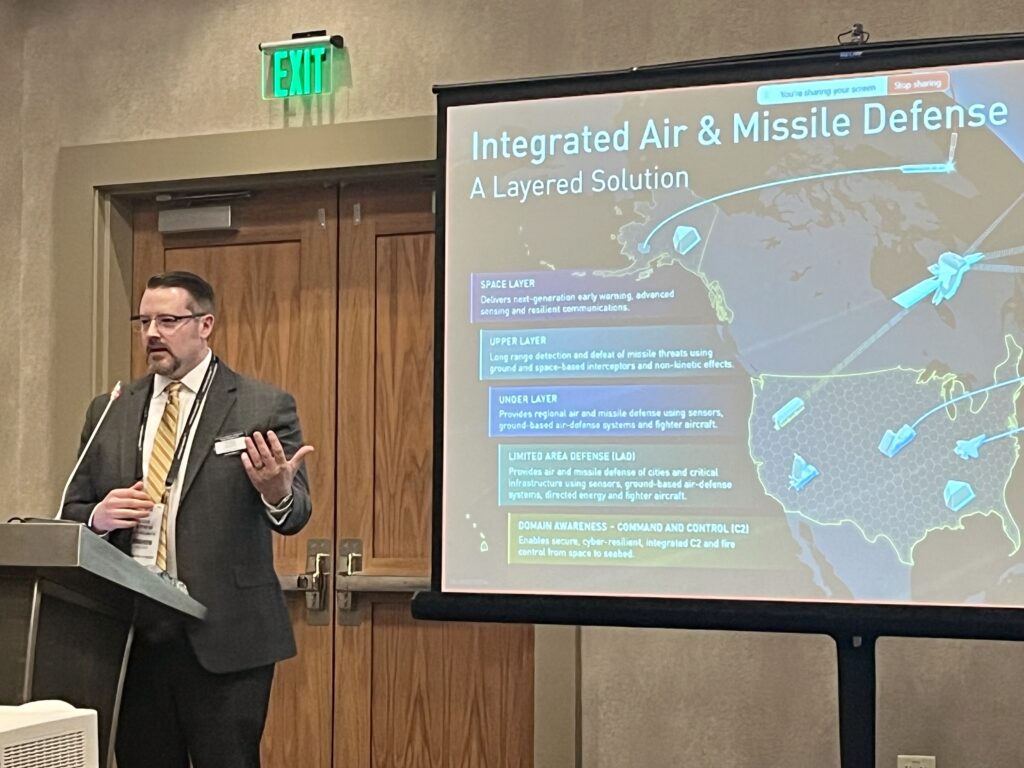
Now that the U.S. is at war, Iran’s missile barrages and drone swarms overseas have turned integrated air and missile defense (IAMD) into a homeland emergency. Lockheed Martin has positioned its layered, highly networked defense as a viable way to keep pace with that threat. In a recent AFA Warfare Symposium briefing, Todd Stevens, the company’s Vice President for Mission Strategy, outlined a roadmap that treats space sensing, upper‑tier interceptors, regional air defense and command‑and‑control (C2) as a single, scalable system, rather than a collection of disconnected programs.
From Niche Mission To National Survival
Stevens framed(IAMD as a “layered business” stretching from space to undersea, and stressed that it must be treated as a nationwide enterprise, not a single‑program problem. That message lands as Iran’s campaign of long‑range missiles and one‑way attack drones against U.S. forces and partners in the Middle East has exposed how easily dense salvos can saturate isolated batteries…and how thin U.S. homeland defenses remain away from a handful of high‑value sites.
Defending the homeland and forward bases against such campaigns, he argued, demands tight integration of space sensors, upper‑tier interceptors, regional air‑defense systems, fighter aircraft and C2 architectures into one coherent kill web. That vision mirrors the operational reality in the current combat zone, where U.S. and allied forces are already blending ground‑based interceptors, airborne shooters and theater sensors to blunt Iranian attacks. Yet they still face capacity and coverage gaps.
Layered Architecture: From LEO to Limited‑Area Defense
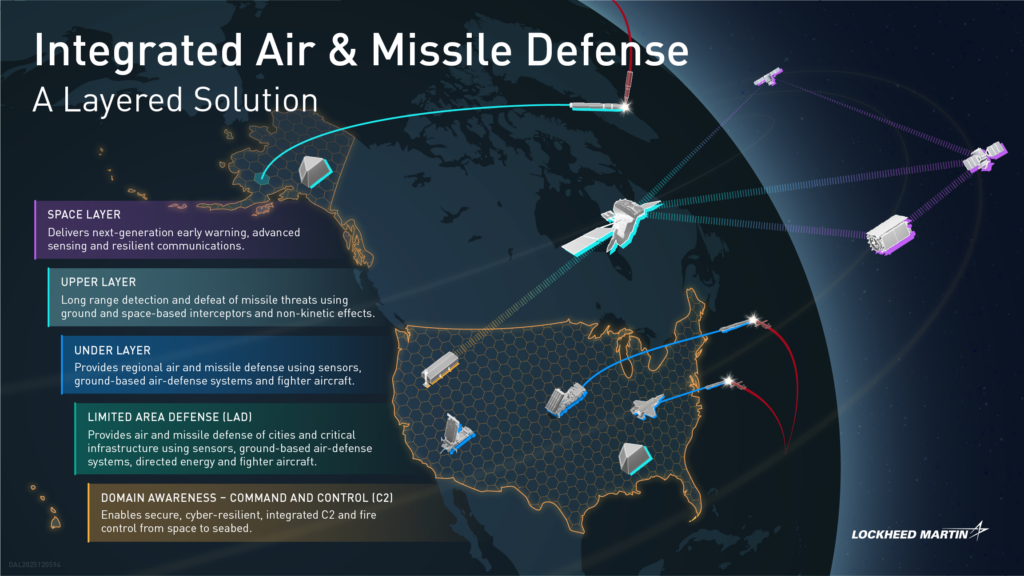
Lockheed Martin breaks the IAMD problem into several interlocking layers that together create a continuous sensing and engagement chain from “left of launch” to terminal defense.
Space
At the top, the space layer provides global early warning, missile tracking and resilient data transport, with proliferated low Earth orbit (LEO) constellations such as the Space Development Agency’s (SDA) tracking and transport layers that feeds cues and tracks custody to terrestrial shooters. In parallel, Next‑Generation Overhead Persistent Infrared Geosynchronous Earth Orbit (OPIR GEO, or NGG) augments Space Based Infrared System (SBIRS) to deliver higher‑resolution mid‑latitude coverage. This tightens timelines against launches from states such as Iran.
Upper Layer
The upper layer focuses on long‑range defeat of ballistic and emerging hypersonic threats using ground‑ and sea‑based systems like Terminal High Altitude Area Defense (THAAD) and the future Next‑Generation Interceptor (NGI) to push engagements as far downrange as possible.
Under Layer / Limited Area Defense
The under layer and Limited Area Defense (LAD) tiers rely on Patriot Advanced Capability‑3 interceptor (PAC‑3), Aegis‑equipped ships, regional sensors, directed‑energy prototypes and fighter aircraft to handle saturation raids, low‑altitude cruise missiles and massed UAVs over cities, bases and critical infrastructure.
Domain-Wide C2
Across all layers, a domain‑wide C2 architecture, anchored in systems such as Command and Control, Battle Management and Communications (C2BMC) and emerging battle‑management frameworks, provides threat evaluation, weapon assignment, fire‑control quality tracks and a common operating picture (COP) that links F‑35 sensors, long‑range discriminating radars and multiple interceptor families.
This is where the technical and operational threads converge. Kill webs that span space, air, land, sea and undersea, with data exchanged fast enough to matter against complex Iranian‑style salvos.
Industrial Base as Part of the Weapon System
Stevens emphasized that building this layered architecture is no longer just a technology‑demonstration problem. It is an industrial‑capacity fight. Over the past decade, Lockheed Martin has invested roughly 7 billion dollars in munitions acceleration, including about 2 billion dedicated to PAC‑3 and THAAD to drive production rates from legacy levels into the salvos‑per‑night regime seen in Ukraine, and now in Iranian operations.
Those investments translate into concrete capacity. PAC‑3 output is planned to grow from 620 to 2,000 interceptors annually, while THAAD production will rise from 96 to 400 per year. Camden, Arkansas has become an advanced munitions hub under a multi‑billion‑dollar investment as Lockheed Martin works across a 13,000‑plus‑supplier ecosystem, most of it U.S.‑based, to scale production. In the Iran context, where months of missile and UAV strikes can drain magazines quickly, industrial throughput becomes a performance parameter as critical as interceptor kinematics.
On the homeland side of the strategic deterrent, Lockheed Martin’s Alabama footprint acts as a dedicated Next Generation Interceptor (NGI) and hypersonic hub. The company designed its Courtland Missile Assembly Building 5, an 85,000‑square‑foot facility on a 650‑plus‑acre campus, for high‑rate NGI assembly, integration and test for the Missile Defense Agency (MDA). Huntsville’s Missile System Integration Lab adds a 25,000‑square‑foot digital testbed where kill vehicles and interceptors are integrated electrically and in software before flight hardware is built. This compresses risk‑reduction timelines and allows rapid configuration updates as threat signatures evolve.
Space-Enabled Sensing and Transport For Missile Defense
The space segment of this architecture blends proliferated sensing, high‑rate manufacturing and resilient data transport into a single kill‑web enabler. Stevens highlighted Lockheed’s Colorado small‑satellite “speed center” built around flow‑line production techniques that can deliver individual LEO satellites in about a week, with throughput capacity of up to 180 spacecraft per year. Those vehicles populate a significant share of the Proliferated Warfighter Space Architecture tracking and transport layers, including Tranche 1 Transport Layer planes already on orbit. Additional launches are due this year.
On the geosynchronous side, NGG introduces more capable imaging payloads to the missile‑warning mission. They improve sensitivity and angular resolution over mid‑latitudes where both Iranian launch areas and U.S. and allied targets reside. The first NGG space vehicle has completed its test campaign and is expected to launch this year, with a second in production. These will augment six SBIRS spacecraft already in service.
In parallel, ongoing GPS III and GPS IIIF production adds hardened positioning, navigation and timing with stronger anti‑jam capabilities, regional military‑protection spot beams and upgraded nuclear‑detection payloads, reinforcing the PNT backbone that missile‑defense and air‑defense operations depend on under electronic‑warfare conditions. (See prior AG coverage of GPS III / IIIF).
Network‑Centric C2 and Kill‑Web Integration
At the integration layer, the focus is on secure, cyber‑resilient C2 and fire‑control architectures that can ingest heterogeneous data streams and drive engagement decisions at salvo scale. C2BMC, paired with sensors such as Long Range Discrimination Radar (LRDR) like TPY‑4 and TPY‑6 acts as a global backbone for track correlation, threat evaluation and weapon‑system tasking, while emerging architectures connect these systems to Army Integrated Battle Command System (IBCS) and naval combat systems. F‑35s contribute forward, multi‑spectral sensing and track refinement, with their data fused into ground C2 nodes that can cue PAC‑3, THAAD, Aegis and eventually NGI and directed‑energy assets.
From an autonomy and systems‑engineering standpoint, the hard problems are data‑fusion fidelity, track custody across domains and automated resource management under stress. Engagement managers must resolve track conflicts, assign the optimal shooter based on kinematics, inventory and defended‑asset priority, and do so under communications degradation and cyberattack. Those same architectures have to incorporate counter‑UAS and soft‑kill options like electronic attack, spoofing and directed‑energy into weapon‑assignment logic, especially against mixed salvos where expending a high‑end interceptor on a low‑cost drone is operationally and politically problematic when defending U.S. cities.

Lessons From Ukraine Applied To Iran
Stevens pointed to Ukraine as a live laboratory for IAMD under fire. There, Russian adaptations in long‑range missile profiles and UAV tactics have forced continuous defensive updates. Without naming specific systems, he described a feedback loop in which operational sensor data from the field is captured, analyzed and used to refine models and system parameters, with updates then pushed back to deployed units on compressed timelines.
That observe‑adjust‑redeploy cycle maps directly onto what U.S. and partner forces now face against Iran’s evolving playbook of trajectory shaping, coordinated timing, decoys and terrain‑hugging cruise missiles. It signals a future in which missile‑defense architectures behave more like continuously updated software ecosystems than static hardware programs, with the kill web tuned against live threat data rather than test‑range surrogates.
What It Means for Homeland Defense and Autonomy
Stevens stressed that no single company can deliver a resilient, layered defense of the U.S. homeland. It is a national effort that must harness primes, non‑traditional defense‑tech firms and regional partners looking to build munitions closer to home. Ukrainian calls to co‑produce air‑defense systems in Europe, and similar conversations emerging from partners under Iranian fire, point toward a more distributed industrial model that could also strengthen U.S. depth.
The overarching takeaway is that integrated air and missile defense is becoming an all‑domain, software‑rich mission where space sensing, networked aircraft, ground‑based interceptors and digital C2 stacks must be co‑designed to protect both forward forces and the homeland from state‑level missile and drone campaigns.
The Iran war will likely accelerate that convergence, and turn speed, integration and industrial resilience into the decisive variables that determine whether the United States can credibly defend its own cities and critical infrastructure from the kind of complex salvos now seen nightly overseas.