
By: Dawn Zoldi
When the world tunes into the 2026 FIFA World Cup, the spectacle on the pitch will hide an unprecedented collaboration in airspace security playing out overhead. From federal agents to city cops, fire rescue and FIFA’s own tiny airspace team, counter‑UAS (cUAS) operations around the tournament will surely redefine how the U.S. will manage low‑altitude risk long after the final whistle blows.
From Stadium Showpiece To 600‑Site Airspace Puzzle
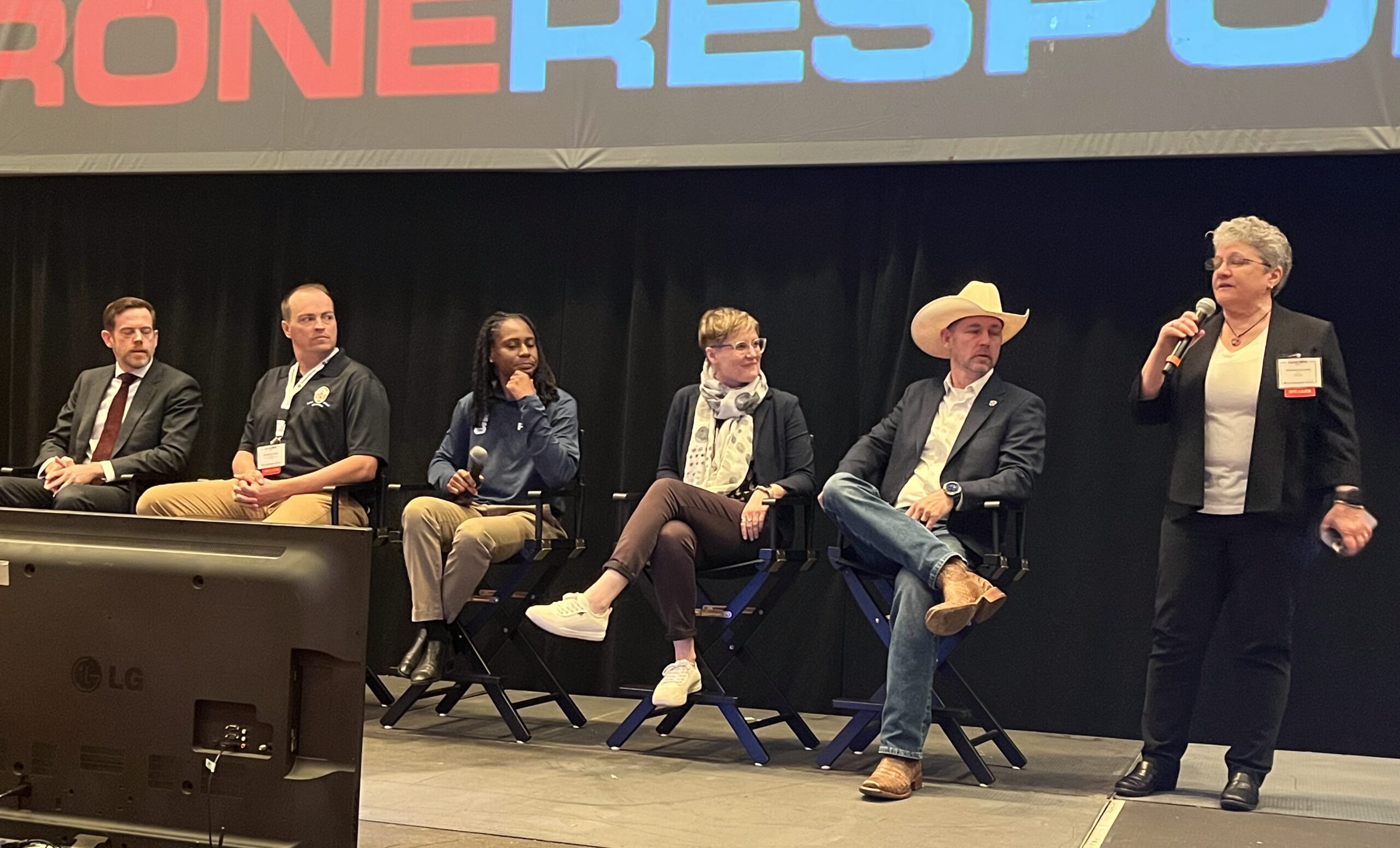
Moderator Michelle Duquette kicked off the panel with some high level implications. This isn’t just about protecting 11 stadiums, she explained. It’s about managing risk across roughly 600 associated sites that includes fan zones, practice fields, hotels, training bases and more. Each venue sits in a different jurisdiction, with a different mix of laws, capabilities and constraints. All are connected, however, by the same imperative to keep drones from turning a global celebration into a catastrophe.
The FBI’s Mike Torphy described the World Cup as a “no‑fail initiative” and “the biggest sporting event in the history of ever.” He noted that on his watch, his goal is that the public won’t need to “even think about drones” at all. That standard drives an aggressive blend of airspace planning, layered detection and a new model for deputizing local officers under federal authority to help mitigate threats.
The Federal Playbook: Detection First, Mitigation Rarely
Torphy’s team has spent seven years building and refining a counter‑UAS model now being packaged and “operationalized” for agencies that don’t do this full‑time. At its core is a simple principle: tactical kinetic or electronic mitigation is the last resort, not the starting point. He broke mitigation into two categories:
- Tactical mitigation: the highly regulated act of physically or electronically stopping a drone, tightly limited by law.
- “Soft” mitigation: the broader 80 percent solution (detection, identification, communication and enforcement) built on tools like cameras, radar, RF, Remote ID and human observers.
Out of more than 1,400 illegal drones detected at major events in recent years, the FBI has only executed technical mitigation about 175 times. The rest were handled through detection, contact teams on the ground, and increasingly, air intercept “overwatch” drones flown as part of counter‑UAS operations.
At the Super Bowl, for example, that “overwatch” model allowed agents to get eyes on suspected operators within about 60 seconds and rapidly distinguish between a clueless hobbyist filming a sunset and someone conducting hostile reconnaissance on stadium defenses. Similar concepts will be adapted for World Cup venues in Los Angeles, Miami and New Jersey, where the FBI will provide organic c-UAS teams while DHS covers eight other U.S. stadiums.
The legal framework complicates everything. cUAS operations remain constrained even for federal actors. Even the FBI must file special government interest (SGI) requests and obtain approvals to fly within the very same temporary flight restrictions (TFRs) it asked for.
State and Local: Force Multipliers, Not Spectators
For state and local public safety agencies, the World Cup is about becoming a force multiplier. Sergeant Chris Bees from the Irvine Police Department explained that his agency runs both a drone program and a cUAS course, with a core role to carry out the ground contacts and detentions federal teams legally can’t take on alone.
In California, where pre‑SAFER Skies Act authority to act pre‑incident was limited, most encounters were “consensual contacts” with careless or clueless operators. Now, under new partnerships and deputization concepts, those same teams can act with federal backing and real enforcement teeth, turning repeated warnings into tickets, confiscations and, if needed, criminal charges. (See prior AG coverage of how SAFER Skies is being implemented).
That enforcement matters. Title 49 violations now carry a one‑year misdemeanor for a first offense and a five‑year felony for subsequent violations, plus fines, even if nobody expects a hobbyist cameraman to serve five years for a bad decision near a stadium. Torphy said every contact at the most recent Super Bowl resulted in a federal ticket. He urged localities to adopt complementary ordinances so they can process cases swiftly under state or municipal law.
The bigger operational challenge isn’t just tech, it’s getting to people in time. Massive crowds and traffic can leave drone response teams stuck while operators pack up and disappear. To close that gap, Irvine has built dedicated contact teams supported by drones with loudspeakers, pushing georeferenced pins, video and images out to officers so they can home in on operators and even speak to them in real time.
Most of Irvine’s “mitigation” to date has been detect‑contact‑educate, not shoot‑down. Pre‑event messaging around “no drones in the TFR” has cut the number of repeat offenders. The department has learned that over‑assigning contact officers to multiple primary duties makes the entire cUAS plan meaningless.
Interoperability: TAK, Data and The Missing National Picture
Interoperability kept surfacing across the panel. Duquette emphasized that TAK (Team Awareness Kit) has become the backbone for many public safety agencies. When deciding which platforms to purchase or software services to subscribe to, “it doesn’t matter what you have” as long as systems can talk to each other.
Jason Day, deputy director of training and a leader in both TAK deployment and the DRONERESPONDERS community, described how Texas has built a statewide TAK “single pane of glass” connecting more than 186 agencies and federating with federal servers. That environment integrates boots‑on‑the‑ground tracking, drone operations, radar and RF detection feeds, industry inputs and more into real‑time common operating pictures (COP).
But that success highlights a national gap. Day said one of the most frequent questions he gets is, “What do we do when we detect a threatening drone?” His answer is that you can’t know if it’s truly threatening without context. Today, there is no single national system where drone detection data from multiple cities and events can be stored, normalized and analyzed to show patterns or repeat behavior.
In an ideal future, a detection in Arlington, Texas would automatically flag if the same drone had been seen near five other stadiums that week. That would prompt a very different response than a one‑off $200 toy. The data exists. What’s missing is a central repository and a standard for ingesting and sharing it in ways public safety operators can actually use.
Irvine’s experience underscores the uneven adoption of TAK and similar tools. In California, TAK had not been widely used at first, forcing the department to integrate its own tools with federal TAK servers and workflows. Persistent joint exercises, monthly meetings and shared lessons learned are gradually closing those gaps, but they highlight why the World Cup is being treated as a proving ground for interoperability as much as for c-UAS technology.
FIFA’s Tiny Airspace Cell At The Center Of The Storm
Perhaps the most revealing perspective came from FIFA’s rep, Tiara Brown, a former U.S. Army helicopter pilot and Shadow UAS operator who now serves on the organization’s aerospace operations team. That team is just two people: herself and a veteran of more than 40 years at the FAA, Tyler Haley.
She stumbled into this role as an intern for FIFA, when a club wanted to fly a drone over a team practice during the FIFA Club World Cup and no one knew who could say yes. What began as a part‑time legal internship quickly turned into a full‑time job managing airspace for more than 600 sites across three countries, touching everything from broadcast drones and helicopters to national military flyovers and halftime performances.
FIFA’s job is not to approve or deny flights. That authority still rests with entities like the FAA, NavCanada and Transport Canada. FIFA serves as a central “listening source” and white‑listing hub for every aircraft that wants to operate in the vicinity of a venue. Broadcasters, teams, entertainment vendors and even foreign militaries must pass through FIFA’s process, where the airspace team walks them through the rules and then connects them with regulators.
One broadcaster learned the hard way that the old “I have my Part 107, I’m fine” mindset no longer applies. The team showed up to a stadium expecting business as usual. Instead, their credentials were revoked and they were escorted out after attempting to operate without going through proper channels.
FIFA has set up public and separate protected online forms for state and local public safety agencies to submit their air operations for inclusion on the white list, backed by a simple security email: SDC.IR@MWC2026.org. For law enforcement and first responders, getting on that list is essential to distinguish friendly aircraft from unknowns in c-UAS systems.
Just as important, FIFA is leaning on its airspace role to force collaboration between jurisdictions that have historically bought equipment and built protocols in silos. A new airspace working group is “trilateral” and brings together authorities from all three host nations. It also breaks into smaller calls with stadium police and local agencies to ask basic questions: What is your drone response protocol? Do you have one at all? When a site doesn’t, FIFA connects them with a jurisdiction that does.
The World Cup may end in July, but organizations like DRONERESPONDERS and local agencies will remain. She urged public safety teams not to operate in isolation and to treat this period as unprecedented by taking careful notes and sharing them widely.
Policy, Industry and The Money Problem
On the policy side, speakers from the Commercial Drone Alliance (CDA) and state‑level organizations see the World Cup as a forcing function for both funding and regulatory evolution. An Executive Order and the SAFER Skies Act spurred the creation of the FBI’s National Counter‑UAS Training Center in June and gave the federal government less than a year to translate new authority into operational reality.

Federal budgeting, they noted, is strained even in good times. Money hasn’t flowed as quickly as many state and local stakeholders hoped. No one is going to magically deliver perfectly structured templates and standards in time for kickoff. That reality is driving calls for more “organic communication” at the state and regional level rather than waiting for answers from Washington.
Industry sits squarely in this mix. From the technology side, vendors should build interoperable systems or risk being sidelined. Just as public safety agencies now buy different drones for indoor versus outdoor work, they will need multiple c-UAS solutions tailored to specific environments (stadiums, fan fests, fixed sites, marathon routes) and those solutions must work together.
Vendors are increasingly partnering to combine complementary capabilities into integrated packages so agencies can buy “one thing one time” rather than stitching together three to five separate systems. At the same time, Torphy cautioned public safety leaders to be careful with grant‑funded buying decisions, treat equipment as perishable and plan for license renewals and technology refresh cycles.
Despite the resource constraints, DHS grants are already putting more money and gear into local hands than some federal c-UAS teams have been able to field themselves, a fact Torphy welcomed, but warned could lead to missteps if agencies chase silver bullets.
Why This World Cup Will Outlast Itself
Duquette and the other panelists see the 2026 World Cup less as a one‑off mega‑event than as a catalyst that will reshape how public safety manages low‑altitude airspace in daily operations. After months of furious coordination, new laws and experimental partnerships, the hope is that many long‑standing pain points (authority gaps, funding ambiguity, data silos) will be reduced, if not eliminated.
The panel closed with a plea to the public safety community: stay present, keep learning, and collaborate relentlessly. Save every after‑action note, email, map and TAK screenshot and push them into communities of practice like DRONERESPONDERS, where people like Day can synthesize experiences into lessons that will shape how America handles drones over every future parade, protest, wildfire and championship.
In other words, if the World Cup’s counter‑UAS effort succeeds, most fans will only remember the goals. But for the people managing the skies above the games, 2026 may be remembered as the year U.S. public safety finally learned to treat the low‑altitude air domain as seriously, and as collaboratively, as everything happening on the ground.