
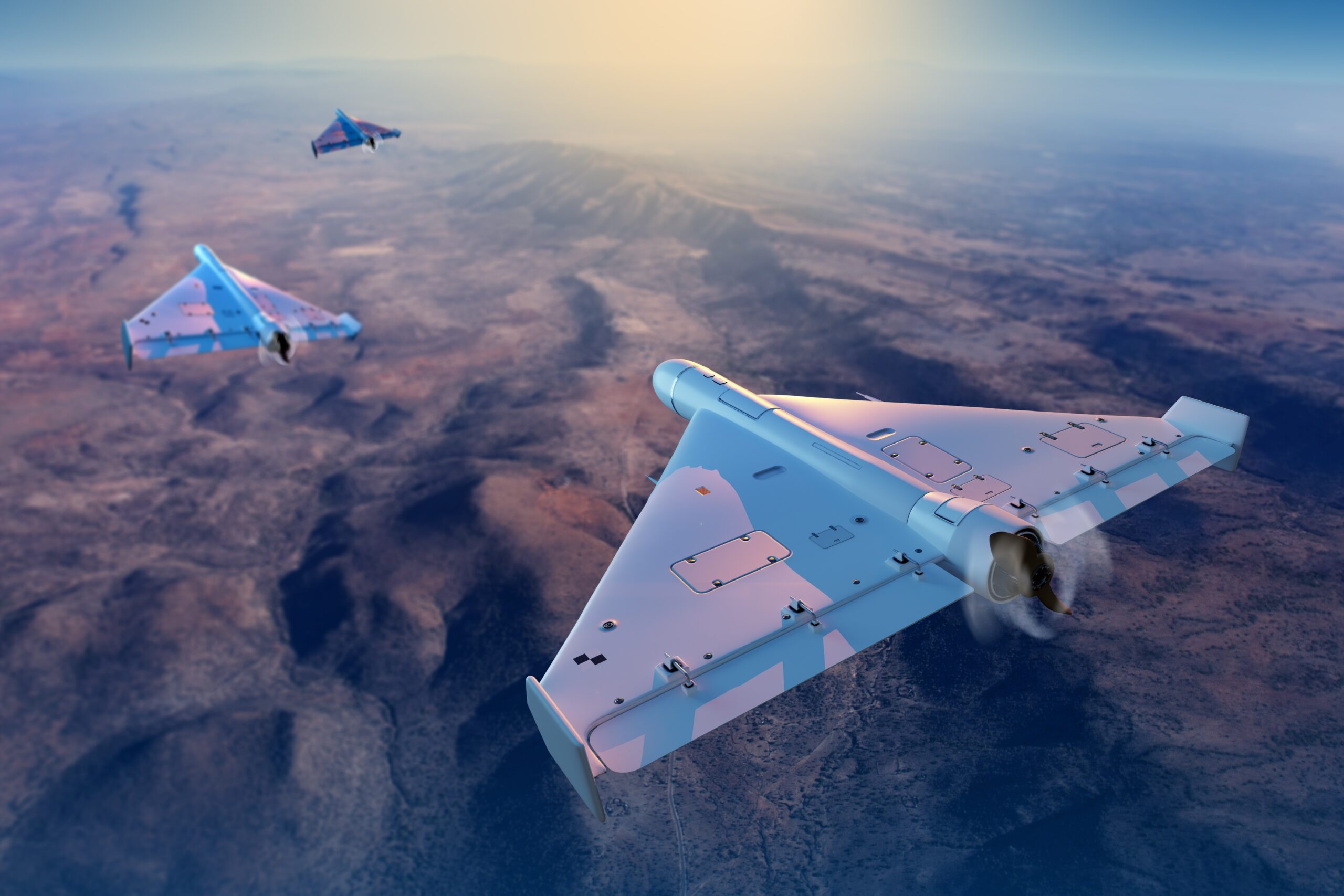
From Ukraine’s deep‑strike “Operation Spider Web” to Iran‑backed FPV drones blowing up U.S. assets around Baghdad, the modern drone threat has become normalized across Eurasia in just a few years. As “Operation Epic Fury” unfolds against Iran, coordinated swarms probe America’s nuclear bomber base. Has the “away game” already started to bleed into the homeland? What happens over there can absolutely happen over here. If recent incursions are any indication, perhaps our adversaries have already started rehearsing on U.S. soil.
Operation Spider Web: Blueprint for Strategic Disruption
Public reporting now frames Operation Spider Web, a coordinated strike in which Ukraine used scores of one‑way attack drones hidden in ordinary trucks to hit multiple Russian long‑range aviation bases across thousands of kilometers, as one of the most significant air campaigns of the war. Open‑source estimates say Ukraine smuggled more than 100 drones inside Russia and damaged or destroyed dozens of bombers across five airfields. (See prior AG coverage of Operation Spiderweb). The Crew focused on a few Spider Web lessons that should keep American planners up at night.
Precision Through Intelligence
Retired Maj Gen James Poss, a former U.S. Air Force (USAF) intelligence leader called the strike “a masterful intelligence operation” that used Russian shipping firms to move containerized drones inside Russia, then launched them against long‑range bombers from local truck parks. Each drone had both a human pilot and AI trained on a Tu‑95 airframe in a Ukrainian museum, reporting back over Russia’s own cellphone network and masking telemetry as normal GPS trucking data. The result, according to Poss: “They took out 14% of the Russians’ long range aviation force in one fell swoop,” with the Russians’ idea of protection literally being “to stick a bunch of spare tires on the top of them.”

Poss translated that into a template any capable adversary could adapt. Instead of dramatic “launch salvos” from across borders, attackers exploited Russian logistics against Russia itself: “They had them shipped by a Russian shipping firm… the Russian version of UPS delivered these containers to an area close to these Russian long range aviation bombers.” The drones used AI trained on a static bomber airframe to identify weak points, then rode the local cellular network home for battle damage assessment and command and control (C2).
Building on this, Brig Gen Houston Cantwell (Ret), a current Fellow at the Mitchell Institute for Aerospace Studies and prior fighter and drone pilot, “With good intelligence of where to hit a bomber with just a few pounds of explosives, they were able to take down those strategic bombers with just a very small payload.” For an F‑16 pilot who used to think in “2,000‑pound‑bomb” increments, the idea that a few kilos of explosives, well‑placed, can have strategic effects constitutes a profound shift.
Creative Communications
Leveraging commercial networks for beyond‑line‑of‑sight control means you can’t just jam one bespoke link and call it a day. He also warned that the same connectivity that lets us remotely manage refrigerators and alarm systems can turn into a global fire control network for attackers. The same ingenious architecture that linked a Ukrainian ops center to drones deep inside Russian airspace could, in principle, be replicated through U.S. 5G or other Internet of Things (IoT) pathways such as “using a Wi‑Fi network at Starbucks” to “become a drone with a weapon on it.”
Hard Targets, Now Soft
Lt Col Michael Twining (Ret), a career USAF Security Forces officer now at DroneShield, connected Spider Web directly to America’s current posture. “We’ve got the same vulnerabilities here that Russia has. We’ve got wide open borders, a big market for drone parts, and tons of soft targets scattered across the country,” he emphasized. If Russia’s long‑range aviation could be degraded by cheap drones on commercial trucks, he argued, U.S. bomber and tanker fleets parked in predictable clusters at a handful of stateside bases are just as exposed. The only difference is whether we choose to act before we see our own “14%” headline.
The uncomfortable follow‑on question from Poss: “Correct me if I’m wrong, we are at possibly even below zero readiness for this type of thing in the United States.” He has little trouble imagining Special Operations teams or proxies moving containerized drones through U.S. commerce: “Who knows? Maybe DoorDash is going to deliver a drone to Barksdale next time that could be used in an attack.” (More on Barksdale below…)
Baghdad’s FPV Strike and Tower 22: Firsts, Not Lasts
If Spider Web demonstrated what determined state actors can do with long‑range, semi‑autonomous systems, the recent first‑person‑view (FPV) drone strike at Baghdad’s Victory Base Complex shows how little it takes to blind and bleed a modern airfield. In late March, an Iran‑backed militia used low‑cost FPV drones to hit an HH‑60M medevac Black Hawk and an AN/MPQ‑64 Sentinel air defense radar parked near Baghdad International Airport. Open‑source assessments emphasized the asymmetry. A craft that costs hundreds of dollars destroyed a helicopter and radar package worth tens of millions, with no visible defensive response.
Air Bases Flying Blind

Poss narrated the reality. “There’s the radar, the eyes of the entire airfield. That’s…blown up. So now the base can’t see anything. And they’re going to go in and at their leisure, taking out this medevac helicopter. They know what they’re doing.” The use of separate drones as “cameramen” for propaganda footage, he noted, has also become routine for these groups.
Exploiting the Seams
For Twining, this is what worried him the most as a security forces commander at Ramstein Air Base. “This very scenario is literally what kept me up at night,” he admitted. Low‑cost drones hitting radars and aircraft are “a preview,” he said, of what future attacks on U.S. bases will look like. He pointed out that active radars are conspicuous on the spectrum, while passive detection is harder to target but has its own limitations. Either way, the attackers in Baghdad proved they know how to exploit seams.
Human Limitations
Cantwell linked Baghdad to an earlier and even more tragic “first,” the January 2024 drone attack on Jordan’s Tower 22 outpost, where U.S. personnel were killed by a one‑way drone that slipped through layered defenses. “In Tower 22 the breakdown was with the human interface,” he explained. “It’s hard to monitor a screen for hours at a time looking for threats. And that’s where the breakdown was.” For him, Tower 22 represents “Exhibit A” in why counter‑UAS missions demand automation and AI, not to replace defenders, but to keep them from missing the one blip in eight hours that might matter the most.
The experts were unanimous that the problem also encompasses mindsets and systems. Poss described “a pretty massive fight between the Services” over who is responsible for air base defense. He noted that the Army is nominally charged with protecting Air Force airfields but is “woefully underinvested” even for its own facilities. Inside the Air Force, he says, security forces are often the only ones who truly feel the urgency, but they are “not the loudest voice at the table when it comes to… spending money.”
Cantwell agreed, but pointed out there has been progress. He cited the new Joint Counter‑UAS University and improved pre‑deployment training, while also calling hard questions after a string of downrange losses. “How did those drones or missiles make it all the way into a strategic location and take out very precisely those very important strategic assets?” he asked. Were they detected? If so, why were no effective actions taken? His answer is that the Air Force must treat this as a top‑tier priority, resource accordingly and “change the mindset” back to generating aircraft under constant threat, not sanctuary.
Twining, for his part, was blunt about what he has heard in the halls of government and industry. He opined, “Unfortunately, it’s probably going to take an attack to make some movement and to make a difference and get that attention. And it pains me to say that, but I really, truly believe that’s true.”
Barksdale’s Swarms: The “Mother of All Wake‑Up Calls”
All of those fears came to fruition over Louisiana in mid‑March, when Barksdale Air Force Base, a core node of America’s nuclear bomber enterprise, reported “multiple waves” of 12–15 drones flying over sensitive areas for nearly a week. According to documents cited by ABC News and other outlets, the aircraft displayed non‑commercial signal characteristics, long‑range control links, resistance to jamming and appeared to use unusual lighting that suggested operators were testing security responses. The incursions triggered at least one shelter‑in‑place order and multiple interagency responses.
Just A Matter of Time?
When asked if this “was a big deal,” Cantwell flipped the question back: “Why has it not happened yet?” He said he remains “so surprised,” given similar activity at Langley AFB two years earlier that was never fully attributed. Now, seeing the same pattern at a strategic nuclear base on the heels of Operation Epic Fury in Iran, he asked, “What are we doing?” as he listed ongoing gaps in awareness, authorities and clear division of responsibilities among federal, state and local actors.
Poss zoomed out to the geopolitical context. Iran has both motive and means to hit U.S. targets at home. He noted, “We know they’ve got sleeper cells everywhere, and we know that they’re good with drones.” At the same time, Russia has every incentive to help after losing a chunk of its bomber force in Spider Web and the U.S.’ general support to Ukraine. The coordinated nature of the Barksdale swarm, the non‑commercial links and the clear probing behavior all point, in his mind, away from hobbyists and toward a sophisticated state or proxy test.
“If this isn’t the mother of all wake‑up calls, I don’t know what is,” Poss said. His fear is not just the test itself, but what comes next. If attackers replicate Spider Web’s effects against U.S. bombers at Barksdale, “things can get out of hand really quickly,” especially if a sitting president is forced to respond to the sudden loss of a double‑digit percentage of the strategic fleet.
More Kits, Interoperability
Twining was equally unsparing about current defenses. In response to the Barksdale incident, U.S. Northern Command fielded its single “fly‑away kit” for domestic counter‑UAS deployments. He characterized this as fundamentally reactive. “You’ve got something that happens, and then we react to it. It’s way too late,” he said. Every installation, in his view, should at least have radio frequency (RF) detection and jamming, backed by radar and other sensors in a fused picture, and, critically, autonomy to reduce human reaction time. This is where he sees companies like DroneShield.
Interoperability for drone detection and defeat tools from different vendors will allow operators to share tracks and automate responses. “It’s going to take all of us working together, in concert, to get these capabilities into the hands of our warfighters,” Twining said. This is where he sees companies like DroneShield, EchoDyne and others playing a crucial role. Radar, RF, electro‑optical (EO), passive and active systems all have to be layered and integrated, he argued, as “there’s no one silver bullet.”
Poss and Cantwell both insisted that authorities and governance are just as broken as the current status of much-needed hardware. Poss noted that tens of thousands of state, local, tribal and territorial (SLTT) law enforcement officers “really can’t do anything about drones” beyond trying to arrest an operator after the fact, despite the SAFER Skies Act and related counter‑UAS provisions Congress recently passed. (See prior AG coverage of SAFER Skies). He pointed out that training, funding, rulemaking and certifications have lagged badly. In one telling anecdote, he described an Army‑loaned laser system used by DHS near El Paso to experiment on cartel drones. Because the Army, DHS and FAA had not worked out basic procedures despite being ordered to do so years ago, a test shot that downed a party balloon triggered an FAA retaliation in the form of a months‑long temporary flight restriction.
Three Clear Messages to Congress, the Services, Industry
In their “last word” moments, each expert turned from analysis to a direct call for action aimed at a different center of gravity in Washington and beyond.
Poss to Congress

Gen Poss argued that lawmakers can no longer treat counter‑UAS as a boutique technical issue. They must recognize it as a core homeland defense mission and fund it accordingly, from base protection to special event security. That means not just passing authorities like the SAFER Skies Act, but resourcing the training, rulemaking and certification regimes that would let state, local and tribal partners actually use them.
It also means putting the National Guard at the heart of domestic air defense. “Put the Guard in charge.” Just as National Guard units support counter‑drug operations and border missions under tailored Title 32 authorities, he argued, Guard air defense units should be funded and empowered to protect both military bases and critical civilian infrastructure and special events like the 250th anniversary celebration, the FIFA World Cup and the LA Olympics. “The only way that we’re going to get ourselves out of this in the short term and the long term is to put real professionals in charge,” he said.
For Poss, Spider Web, Tower 22, Baghdad and Barksdale are not edge cases. They are the briefing slides Congress will be judged against when the inevitable after‑action report is written.
Cantwell to the Services
Cantwell addressed the Armed Services and their senior leaders. He urged each service to stop assuming some future “joint” solution will save them. “It’s the Services that have to take the lead on each one of these,” he said, calling counter‑UAS “an imminent and very important threat” that must be resourced, exercised and normalized across home‑station and deployed operations. Layered sensing, layered effectors and a return to generating aircraft under threat are, in his view, the new minimum standard.
Counter‑UAS is now inseparable from the ability to generate combat power, he said. Services must change their mindset to treat air base defense as a primary mission set rather than a supporting function. That starts with embracing layered sensing and layered effects, from RF and radar to passive systems, and pushing automation and AI into the loop so Airmen, Soldiers, Sailors, Marines and Guardians are not asked to stare at screens for hours hoping to catch a fleeting threat. It also means re‑normalizing operations under threat, from parking plans and dispersal to revetments and hardening, so that a handful of low‑end drones cannot sideline high‑end fleets.
Twining to Industry
Twining believes Spider Web, Tower 22, Baghdad’s FPV footage and the Barksdale swarms should be read not as isolated anomalies, but as previews. He spoke directly to industry. Despite improved constructs like the new joint interagency task force he praised, “we’re actually going to get stuff in the airmen’s hands” only if industry works together, authorities catch up and Congress chooses to fund in proportion to risk.
He rejected the notion that any one contractor will “own” the counter‑UAS market. He argued instead for open architectures, genuine interoperability and sensor‑fusion ecosystems that can evolve as fast as the threat. Radar, RF, optical, acoustic and effectors must work together, he said, and AI has to shoulder the cognitive load so operators are cued to act instead of drowning in raw data. “It’s going to take all of us working together, in concert, to get these capabilities into the hands of our warfighters,” he emphasized. Turf battles and closed systems will simply buy adversaries the time they need to turn today’s tests into tomorrow’s successful strikes.