
By: Arie Egozi, AG Ambassador, Israel
Israeli company Cognata uses artificial intelligence (AI) to power advanced simulation technology as a key enabler for Israel’s autonomous ground combat vehicle programs. The company’s platforms support the Israeli Ministry of Defense, Israel Aerospace Industries (IAI) and the Israeli Defense Forces (IDF) in developing, training and validating autonomous systems for demanding battlefield conditions.
Cognata’s AI Simulation Platform
Cognata has built an AI-driven simulation platform that combines deep learning, computer vision and supervised generative AI with high‑fidelity 3D rendering. The platform creates realistic virtual environments for testing autonomous vehicles and advanced driver-assistance systems.
The technology dramatically accelerates AI/ML training and validation. It enables rapid, repeatable testing of complex driving and mission scenarios that would be slow, costly or unsafe to reproduce in the real world. By shifting much of the validation workload into synthetic but highly accurate environments, Cognata helps customers cut both development time and field test expenses.
Military-Grade Autonomous Vehicle Testing
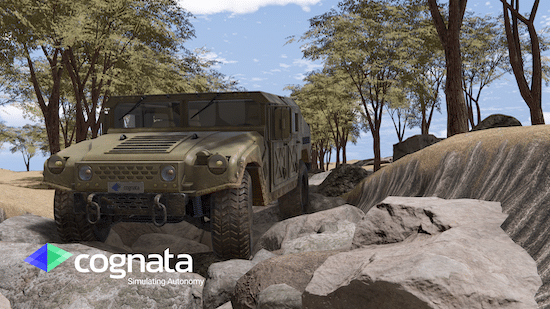
Cognata’s solutions are used by the Israeli Defense Ministry and IDF to support algorithm development and safety validation for autonomous ground vehicles in difficult and off-road terrain. The company designed the platform to demonstrate that autonomous vehicles can operate safely across a broad range of potential operational and environmental conditions.
This is particularly important as autonomous vehicle technologies have been increasingly integrated into defense ground platforms for missions such as logistics, reconnaissance and combat support. Military users rely on simulation not only to test safety and reliability, but also to model and refine operational “behavior” and tactics before deployment.
Why Simulation Beats Physical-Only Testing
Rapid advances in electronics, computing, sensors and communications have enabled sophisticated autonomous vehicle capabilities. But they also introduce new safety and reliability concerns. Issues such as system failures, collision ris, and the high cost of accidents drive the need for exhaustive scenario testing before vehicles are released to operate among people or in complex environments.
Physical testing with real vehicles provides essential data, but can be constrained by regulation, hardware costs and the time required to run large numbers of trials. Cognata’s simulation environment allows engineers to model thousands of edge cases and stress conditions virtually, which significantly reduces the reliance on expensive, time-consuming field campaigns.
Digital Twin of the Battlefield and Road
At the core of Cognata’s approach is a “digital twin” of the real world. Built from high‑definition maps, aerial imagery and additional geo-intelligence layers that increase realism, this digital twin serves as a high‑accuracy testbed where sensors, autonomy stacks, and decision‑making algorithms can be evaluated and iterated at scale.
By mirroring real-world roads, urban areas and combat zones inside the simulator, the platform helps bridge the gap between lab testing and operational deployment. For defense and commercial customers alike, this provides a crucial step toward certifying that autonomous vehicles can meet strict safety and performance requirements under almost any foreseeable condition.