
By: Dawn Zoldi
Today “public safety tech” ranges from drone‑as‑first‑responder (DFR) to AI‑driven analytics dashboards. Agencies now face the hard question as to which tools will actually help incident commanders make better decisions when seconds count…and which will simply add noise. CNA, a not‑for‑profit research organization that has spent decades embedded with operators on the front lines, tackles that problem head on. Through rigorous analysis, field‑based experimentation and a deep understanding of how responders work under pressure, Dr. Steve Habicht and his team focus on turning emerging technologies into resilient, trustworthy systems that improve situational awareness, coordination and outcomes when lives are on the line.
Ground Truth, Not Hype: CNA’s Mission in Public Safety
CNA is a not‑for‑profit research and analysis organization that has supported the U.S. government for more than 80 years by sending analysts and engineers into the field to work directly with operators. About 30 years ago, CNA extended that model into the broader public sector, embedding with public safety and emergency response agencies to help them solve complex frontline challenges. (See prior AG coverage of CNA).
Dr. Steve Habicht, director of CNA’s Center for Enterprise Systems Modernization, explained his important work. “I started my journey solving complex problems in the lab… Over time my lab became the front line, working with these different folks and trying to solve these complex problems.” For him, the common thread involves “using data and rigorous analysis to make complex systems behave the way people want to see them operate in the real world.”
That real‑world emphasis defines CNA’s public safety line of effort. Rather than evaluating “public safety tech” in sanitized demo environments, Habicht’s teams test new tools in the type of noisy, chaotic conditions where emergency decisions actually happen.
Designing Systems for Decisions Under Pressure
Public safety and emergency response are “very fast‑paced, driven environments” where decisions must be made quickly, and can literally be a matter of life and death. Agencies increasingly rely on drones, artificial intelligence (AI) and advanced analytics to help operators “see more, decide faster, coordinate better under pressure,” but that promise depends on how well these tools are integrated and presented to users.
Habicht’s center helps agencies design, evaluate and test systems that support missions such as emergency management, resilience and security. His team starts by unpacking core requirements, including how systems need to function day‑to‑day, what data matters and how operators will actually use information in the field. They then prototype and “right‑size” potential solutions, perform operational assessments and identify what must be hardened for real‑world deployment.
He cautions that when agencies adopt technology without proper analysis or testing, the tools often overlap, fail to meet their intended purpose or create data silos. “If they’re going in without clearly defined roles for how these technologies are going to be applied to the situation, then you get to the front line…they really can just add more friction to the crisis than they do help,” Habicht noted.
FRAME and Port Security: Fusing Data into Actionable Awareness
CNA’s emerging technology challenges team, which Habicht also leads, brings together analysts, engineers and industry partners around specific government challenges that often take the form of competitions. These events pose real operational problems and ask the “best and brightest” to build and test concepts or prototypes quickly using internal investment.
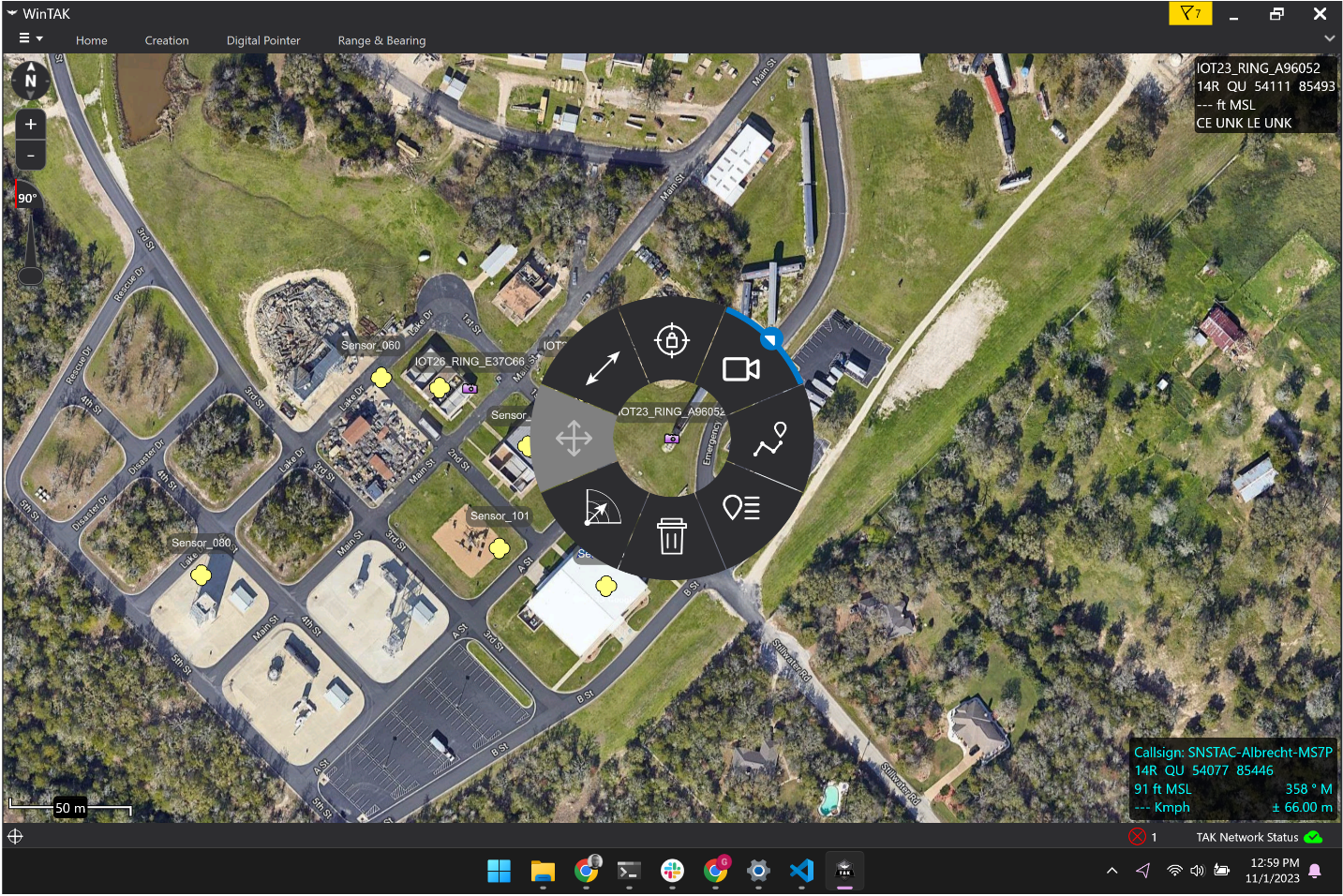
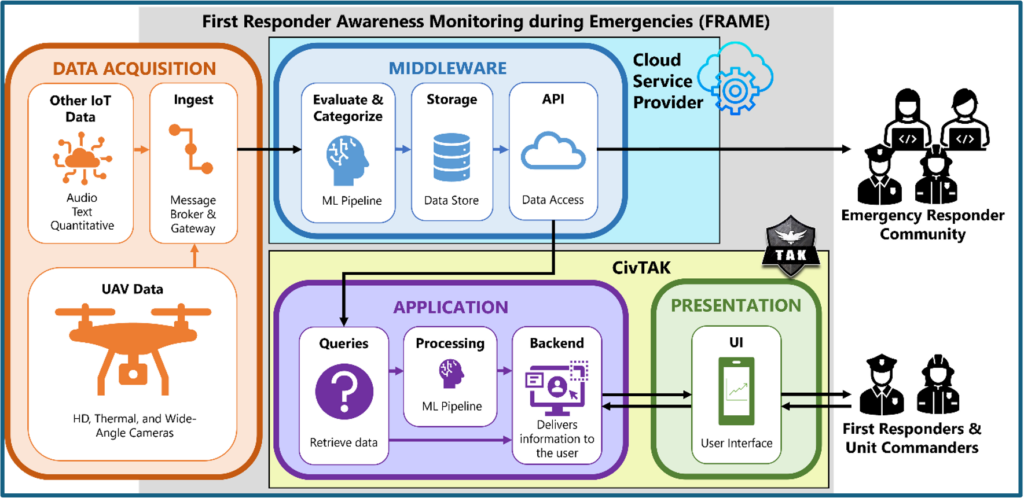
One notable effort involved FRAME, or “First Responders Awareness and Monitoring for Emergencies,” a prototype system developed with partner RIIS. FRAME uses a machine learning engine to process data from a variety of Internet‑of‑Things (IoT) sensors and other feeds that operations might encounter during an emergency, such as drone video, temperature sensors and gas line monitors. It pulls together disparate formats and conventions, then visually displays processed outputs through a geospatial interface designed for incident commanders.
In a government challenge built around a mock disaster, CNA’s team had to show up “like a first responder” without knowing in advance what data would be available. FRAME ingested the provided feeds on the fly, and produced a real‑time common operating picture (COP) that helped commanders see emerging patterns, recognize changes as the incident evolved and prioritize actions when time and attention were limited. AI and GIS, thoughtfully combined, turned raw data into operational awareness. The solution won first prize. (See prior AG coverage of FRAME)
CNA applied the same systems approach to the “Port Security and Emergency Response Using UXS” project, conducted in and around the Port of Virginia. Ports are complex environments where every hour of downtime from a public safety incident can cost millions of dollars, and where metal infrastructure and dense container stacks create a challenging communications landscape.
In this project, CNA leveraged commercially available uncrewed air, ground and maritime systems, connected them via a meshed network to mitigate interference and line‑of‑sight issues, and fused their data into a COP. The integrated system was especially valuable for hazmat response, where uncrewed vehicles with specialized sensors could identify the source of a leak, track its spread and guide responders much faster than traditional “suit up and search” approaches.
Habicht emphasized that this was not just a concept but a blueprint. “We were leveraging commercial technologies to explore these use cases… a blueprint for how port operators could really procure, integrate and field these technologies in their operations.” CNA supported this work with a detailed report and an interactive story map that lets users explore the port environment, vehicle paths and GIS layers.
Hardening Drone Fleets: Cybersecurity as Operational Safety
CNA also tackles cyber risk in public safety technology, in recognition that connected tools can become liabilities if not properly hardened. Through a National Institute of Standards and Technology (NIST) challenge focused on public safety drone cybersecurity, Habicht’s emerging tech team developed the BFDI‑AP countermeasure system, an automated cyber‑hardening tool for UAS fleets.
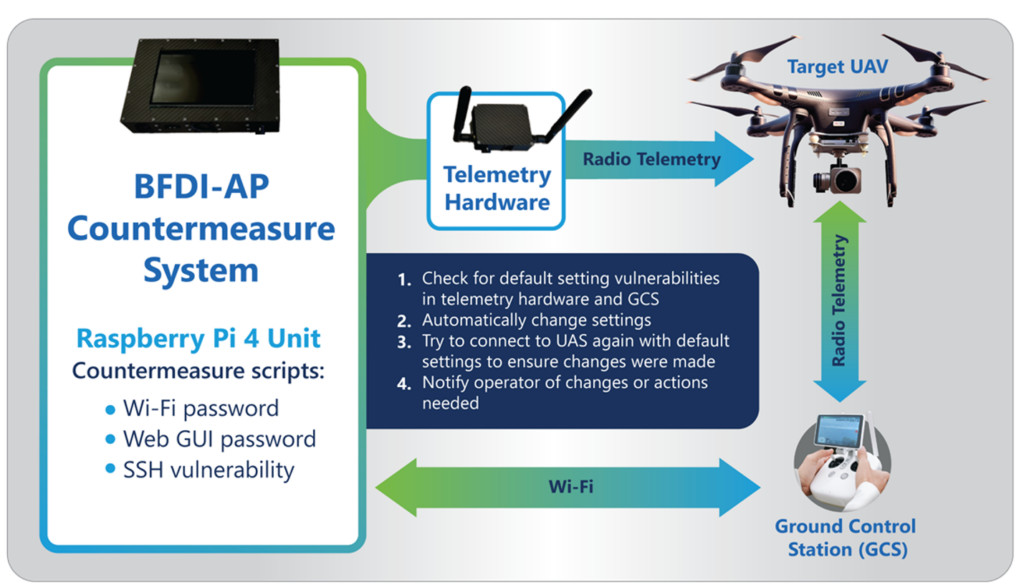
BFDI‑AP is a computer interface equipped with radios and connections that allow it to tie into various UAS components, including the aircraft, ground control station (GCS) and telemetry links. It “ties in first,” scans the full system for default settings and common misconfigurations, and then automatically applies more secure configurations across the board. The system also generates a report for operators detailing the changes it made.
Habicht drew a parallel to basic home‑network hygiene. Just as users are told to change the default password on a router, public safety agencies must eliminate default configurations that adversaries can easily discover. He notes that as drones become more ubiquitous, especially with potential logistics and package delivery operations, malicious actors could simply observe recurring models, obtain their default settings and hijack them as they fly routine routes or support law enforcement missions.
“This system really protects UAS fleets from that kind of brute‑force attack,” Habicht explained. He called it the “first level” of security needed to harden fleets against easy exploitation. It addresses the low‑hanging fruit so agencies can focus on more sophisticated threats. (See prior AG coverage of other CNA projects involving cyber protection for drones).
AI, GIS and Wildfire Risk Along Critical Routes
Habicht’s emerging technology challenges team also turned its attention to wildfires, which have placed growing strain on public safety agencies worldwide. In a competition focused on reducing wildfire risk, the challenge asked how advanced tools, particularly geospatial analytics, could help.
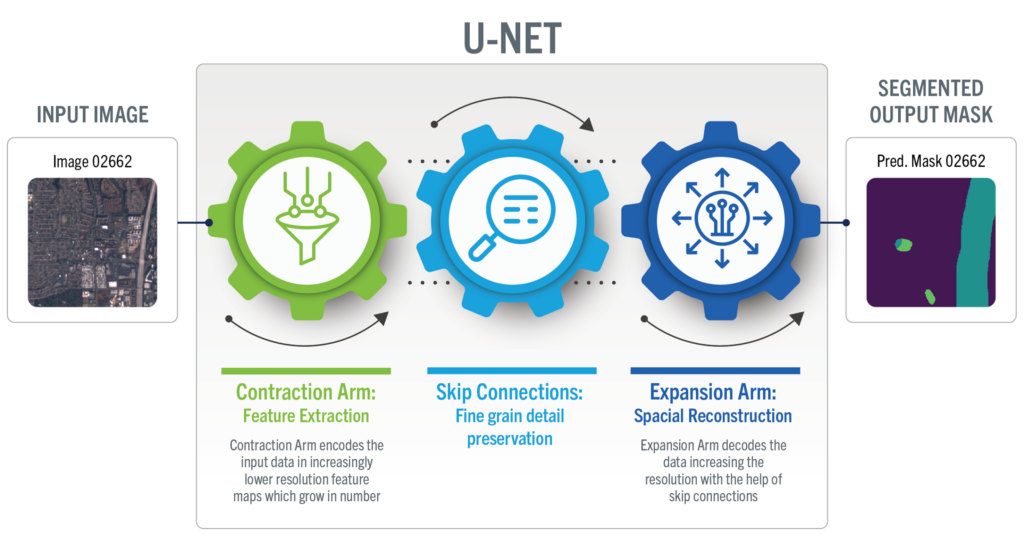
CNA’s approach leveraged the explosion of available geospatial data such as detailed satellite imagery, granular fire‑risk datasets in high‑risk regions and transportation network information. The team built an AI‑driven model, U-NET, that used this data to assess wildfire threat along transportation routes by generating a “mask” that highlighted the most vulnerable segments of highways, rail lines or other corridors.
The concept enabled planners and public safety officials to shift from reactive response to proactive mitigation. With AI‑generated risk maps, they can now prioritize vegetation management, plan alternate evacuation and supply routes and pre‑position resources where they are most likely to be needed during fire season.
Lessons for Public Safety Leaders: Start with the Mission
Across these projects, Habicht returned to the central principle to start with the mission and the operational environment, not the technology. He said he sees a recurring pattern where agencies purchase commercial off‑the‑shelf (COTS) products under the assumption that they are “ready to go,” only to discover integration challenges, overlapping functions and workflows that do not match field reality.
Habicht stressed the importance of clearly defined roles for each technology, rigorous test and evaluation (T&E) in realistic conditions and a system‑thinking mindset that treats integration as its own engineering problem. He also pointed out that technologies may arrive at a high Technology Readiness Level (TRL) from the vendor, but the overall system, how those tools interact with existing platforms, data flows and human procedures, must also be evaluated with the same rigor.
For public safety leaders, CNA offers a practical model:
- Bring analysts and engineers into the field with operators.
- Prototype and test against real mission scenarios.
- Use data and rigorous analysis to identify what truly improves situational awareness, coordination and decision‑making under pressure.
From FRAME and port security to BFDI‑AP and wildfire analytics, CNA shows how public safety agencies can leverage emerging technologies as trustworthy tools that help them prepare for and manage crises.
To learn more about CNA visit https://www.cna.org/ or Contact Steven Habicht athabichts@cna.org.
Watch Dr. Steven Habicht on Episode 112 of the Dawn of Autonomy.