
By: Tom Adams, DroneShield and Autonomy Global Contributor*
State and local officers finally have a legal path to put hands on rogue drones, but only if they can “break the law within the confines of the law.” The SAFER SKIES Act and the FBI’s new National Counter‑UAS Training Center (NCUTC) turn that catchphrase into a concrete implementation roadmap, especially for teams securing ad hoc events rather than fixed facilities.[ppl-ai-file-upload.s3.amazonaws]hstoday+2
From Federal Monopoly to Shared Authority
For years, only a handful of federal agencies could legally detect and defeat drones using tools that decoded or decrypted radio‑frequency signals. That changed on December 18, 2025, when President Donald Trump signed the FY26 National Defense Authorization Act, which folded the SAFER SKIES Act into law.hstoday+2[ppl-ai-file-upload.s3.amazonaws]
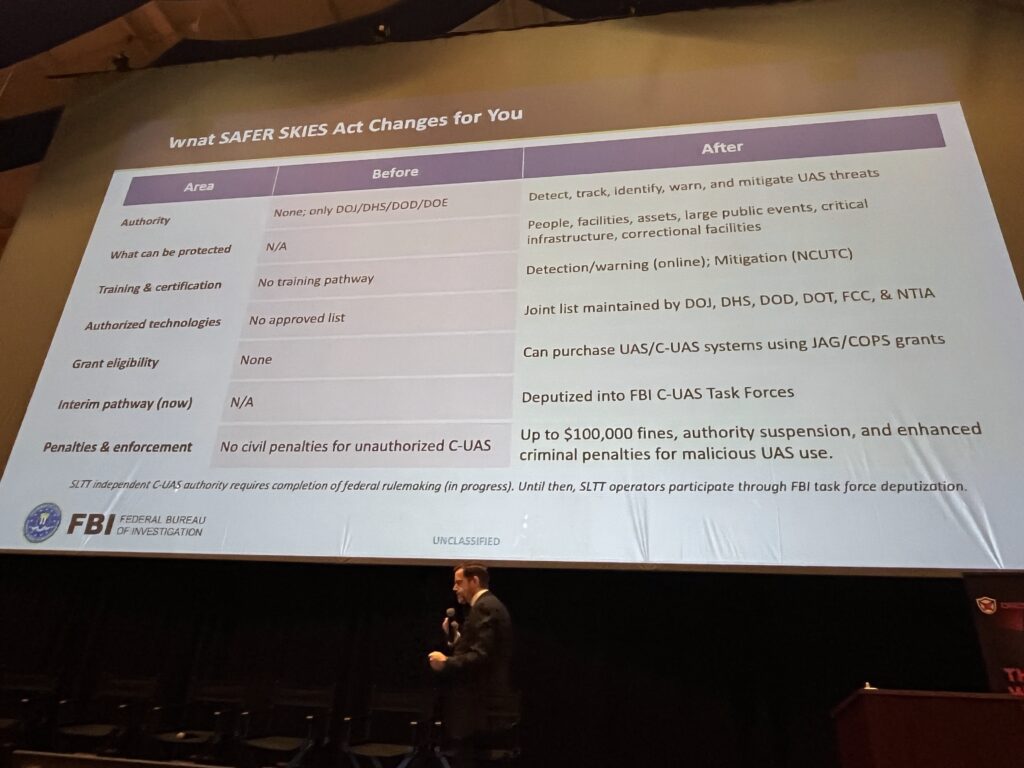
SAFER SKIES substantially expands counter‑UAS authority to state, local, tribal and territorial (SLTT) law enforcement and certain correctional officers, allowing them—after training and certification—to “take actions necessary to mitigate a credible threat” posed by drones over people, facilities, assets, large public events, critical infrastructure and correctional facilities. This is one of the rare times Congress has granted broad criminal‑law relief to non‑federal entities so they can lawfully use tools that would otherwise violate wiretap and other statutes.jdsupra+2[ppl-ai-file-upload.s3.amazonaws]
NCUTC: The FBI’s C‑UAS Schoolhouse
To turn statute into operational capability, the FBI stood up the National Counter‑UAS Training Center at Redstone Arsenal in Huntsville, Alabama, modeled on the Bureau’s long‑standing Hazardous Devices School for public safety bomb technicians. NCUTC is now the sole federal certifying authority for SLTT and correctional law enforcement personnel who will conduct mitigation under SAFER SKIES.x+2[ppl-ai-file-upload.s3.amazonaws]
Drawing on over seven years of FBI counter‑UAS experience at dozens of high-profile events such as numerous Super Bowls—the Center has distilled best practices into a planner‑and‑operator‑focused course aimed squarely at law enforcement teams protecting time‑limited, ad hoc events. This is not a static‑site security program; it is built for the reality of rolling into a venue, setting up gear, troubleshooting networks and making real‑time judgments on whether, when and how to neutralize a drone.[ppl-ai-file-upload.s3.amazonaws]
Training Tiers
SAFER SKIES implementation relies on two tiers of training.[auvsi][ppl-ai-file-upload.s3.amazonaws]
- Tier 1 – Detection‑only:
- Envisioned as a short, likely one‑hour, virtual academy‑style module covering ethics, legal boundaries, data retention and dissemination rules for using detection tools that implicate wiretap authorities.[auvsi][ppl-ai-file-upload.s3.amazonaws]
- Officers complete an online test, receive a certificate and operate under an agency policy that governs how they deploy detection technologies and handle data, including privacy and civil liberties safeguards.[ppl-ai-file-upload.s3.amazonaws][auvsi]
- Envisioned as a short, likely one‑hour, virtual academy‑style module covering ethics, legal boundaries, data retention and dissemination rules for using detection tools that implicate wiretap authorities.[auvsi][ppl-ai-file-upload.s3.amazonaws]
- Tier 2 – Mitigation:
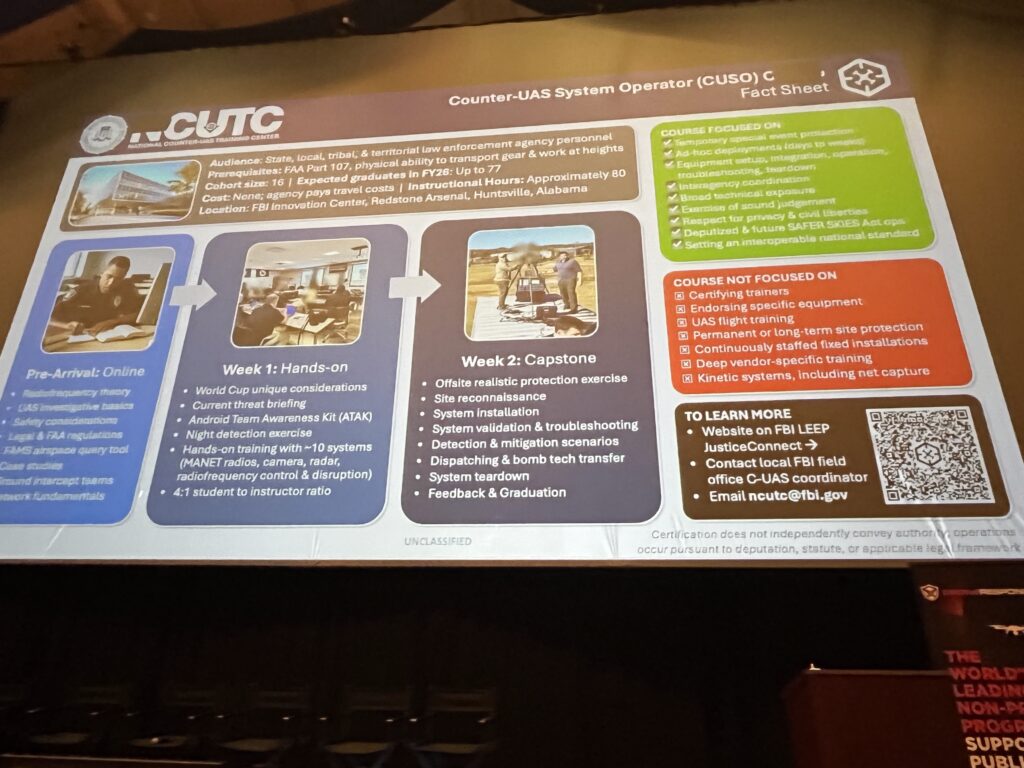
- A two‑week resident course at NCUTC (originally designed as three weeks but compressed by pushing foundational content online), focused on planners and operators who will actually execute mitigation during events.[256today][ppl-ai-file-upload.s3.amazonaws]
- Graduates learn to plan operations, configure and network systems, troubleshoot under pressure and make threat‑versus‑risk calls before taking kinetic or non‑kinetic action against a drone.[ppl-ai-file-upload.s3.amazonaws]
- A two‑week resident course at NCUTC (originally designed as three weeks but compressed by pushing foundational content online), focused on planners and operators who will actually execute mitigation during events.[256today][ppl-ai-file-upload.s3.amazonaws]
By the time major event seasons like the 2026 FIFA World Cup ramp up, the FBI expects to have dozens of SLTT officers trained, deputized and conducting missions under FBI authority while the broader SAFER SKIES rulemaking process plays out.unmannedairspace+1[ppl-ai-file-upload.s3.amazonaws]
“Breaking the Law Within the Law”
SAFER SKIES does not change the fact that certain counter‑UAS actions—such as decoding or decrypting RF signals—would ordinarily violate existing federal criminal statutes. What it changes is who can be relieved from those statutes under tightly controlled conditions.jdsupra+1[ppl-ai-file-upload.s3.amazonaws]
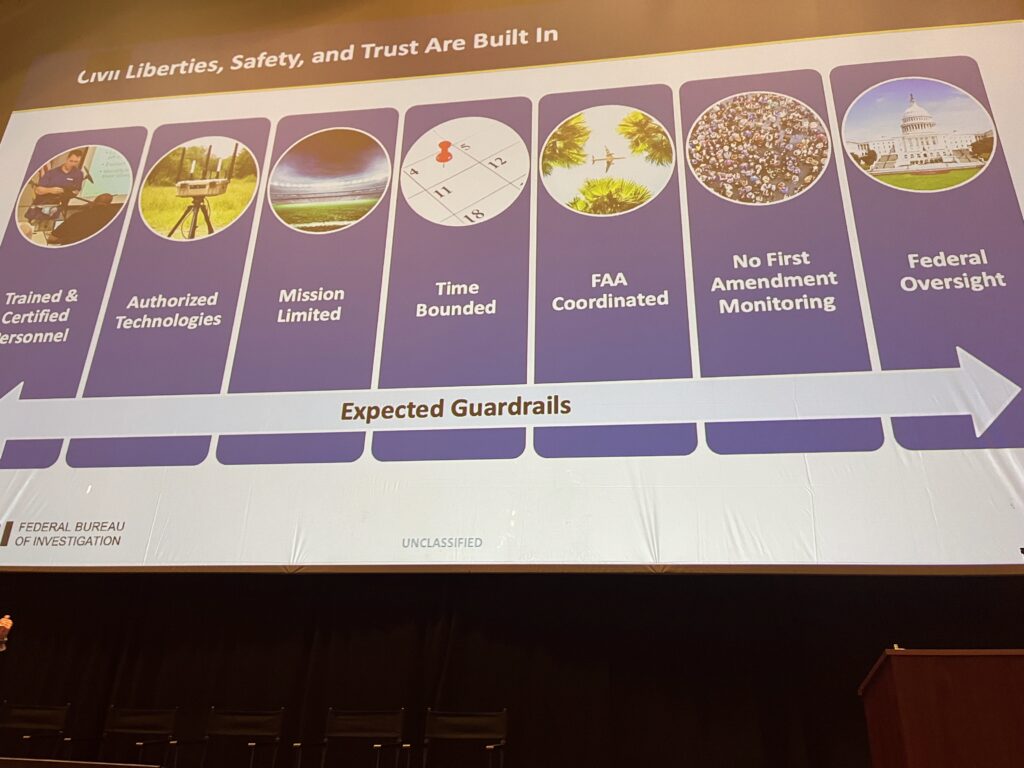
Torphy frames the core mindset as “you are breaking the law, you’re just being allowed to break the law, so you have to do it within the confines of code, because Congress told us to.” For law enforcement, that means three big guardrails:[ppl-ai-file-upload.s3.amazonaws]
- Mission and time limits: Mitigation authority must be tied to specific missions and time‑bounded events, not blanket, open‑ended operations.[auvsi][ppl-ai-file-upload.s3.amazonaws]
- Authorized technology: Agencies must use only radio‑frequency detection and mitigation tools, such as RF detection, RF jamming and RF “takeover” technologies, that appear on an authorized technology list managed by a federal interagency.[auvsi][ppl-ai-file-upload.s3.amazonaws]
- Oversight and auditing: Federal oversight, compliance checks and recertification (on a three‑year model for mitigation) ensure programs stay within statutory and policy lines.[auvsi][ppl-ai-file-upload.s3.amazonaws]
Civil penalties of up to 100,000 dollars and potential authority suspension now attach to unauthorized counter‑UAS activities—another signal that Congress intends this power to be used, but only inside a defined legal box.unmannedairspace+1[ppl-ai-file-upload.s3.amazonaws]
A Practical Checklist for Ad Hoc Events
For law enforcement planners and operators, Torphy’s remarks function as a de facto checklist for standing up and running a SAFER SKIES‑compliant C‑UAS program for ad hoc events.hstoday+1[ppl-ai-file-upload.s3.amazonaws]
1. Confirm you are eligible
- Verify that your agency qualifies as a law enforcement entity or a department with a law‑enforcement component, including potentially some public safety or fire agencies where personnel have duties to protect life and public safety.[ppl-ai-file-upload.s3.amazonaws][auvsi]
- Identify which officers and employees will fill detection‑only roles versus mitigation roles, noting that the statute is not strictly limited to sworn officers.[auvsi][ppl-ai-file-upload.s3.amazonaws]
2. Build the policy backbone
Before you touch a single antenna:
- Draft or update agency policies on RF detection and mitigation, data collection, retention and dissemination, with explicit privacy and civil liberties safeguards.[ppl-ai-file-upload.s3.amazonaws][auvsi]
- Define internal approval chains for event‑based missions, and establish record‑keeping practices to document each deployment, including technology used, locations, time windows and actions taken.[auvsi][ppl-ai-file-upload.s3.amazonaws]
These policies will anchor both your online detection training and your mitigation certification, and they will be scrutinized during federal oversight reviews.[ppl-ai-file-upload.s3.amazonaws][auvsi]
3. Put your people through the right training
- Enroll relevant personnel in the online detection course as soon as it becomes available, ensuring they understand that any decoding or decrypting of RF signals triggers heightened legal responsibilities.jdsupra+1[ppl-ai-file-upload.s3.amazonaws]
- Work with your FBI field office’s counter‑UAS coordinator to nominate planners and operators for the two‑week NCUTC mitigation course in Huntsville, using the Bureau’s law enforcement portal and contact guidance provided by the Center.strong.house+1[ppl-ai-file-upload.s3.amazonaws]
Graduates may also be deputized to conduct missions under the FBI flag for nationally significant events, bridging federal and local capabilities.x+1[ppl-ai-file-upload.s3.amazonaws]
4. Align your gear with the authorized list
Initially, the federal government will maintain an authorized technology list rather than a fully granular “authorized equipment list.” Expect it to cover categories like:[auvsi][ppl-ai-file-upload.s3.amazonaws]
- RF detection systems
- RF jamming mitigation technology
- RF cyber-takeover tools (for controlled landings)
As the regime matures, that list may evolve into an authorized equipment list with specific makes, models and major firmware versions, requiring more precise configuration and fleet management. Agencies should plan procurement around these categories and avoid buying “orphan” systems that may never qualify.[ppl-ai-file-upload.s3.amazonaws][auvsi]
5. Secure funding early
SAFER SKIES implementation opens new funding channels, including Department of Justice Justice Assistance Grants and Community Oriented Policing grants that can be used to buy drones and counter‑drone technologies. FEMA’s Counter‑UAS Grant Program and related DHS opportunities further expand the pool, helping ensure that authority is matched with means as high‑profile events approach.phelps+3[ppl-ai-file-upload.s3.amazonaws]
For many departments, building C‑UAS into their broader UAS and public safety technology roadmaps—and tying grant applications to specific, high‑risk events—will significantly improve their chances of approval.hstoday+1
6. Design your mission packages
When you move beyond detection and into mitigation, SAFER SKIES requires that operations be mission‑ and time‑bound. Practically, that means:[auvsi][ppl-ai-file-upload.s3.amazonaws]
- Filing event‑specific paperwork (envisioned as a short, fill‑in‑the‑blank package) that outlines the who, what, where, when and why of the mission.[ppl-ai-file-upload.s3.amazonaws]
- Coordinating with the FAA for airspace permissions and the FCC for spectrum‑related approvals, even though the FBI will not act as a formal approver.[route-fifty][ppl-ai-file-upload.s3.amazonaws]
- Notifying the FBI of your planned operations so the Bureau can deconflict missions and help avoid interference with federal activities.[hstoday][ppl-ai-file-upload.s3.amazonaws]
The goal is to give local agencies autonomy to protect their interests while preserving aviation safety and national‑level situational awareness.route-fifty+1[ppl-ai-file-upload.s3.amazonaws]
7. Train for judgment, not just joystick skills
NCUTC’s curriculum emphasizes that mitigation is not a default response; it is an option that must be weighed against the risk to public safety. Operators are trained to answer:[ppl-ai-file-upload.s3.amazonaws]
- Is this drone a credible threat, or an unaware hobbyist?
- Will mitigation actions—jamming, takeover, forced landing—introduce greater risk to crowds, aircraft or first responders?
- Are there viable warn‑and‑divert options before taking hard action?
Federal policy also requires that counter‑UAS operations respect First Amendment activity and embed privacy protections in every part of the workflow, from collection through retention and sharing.[auvsi][ppl-ai-file-upload.s3.amazonaws]
8. Prepare for audits and recertification
Finally, agencies should assume their C‑UAS programs will be subject to periodic audits, compliance checks and technology reviews, with mitigation certifications on a three‑year cycle. Keeping tight records—from training logs and equipment inventories to mission reports and after‑action reviews—will make those audits routine rather than disruptive.[auvsi][ppl-ai-file-upload.s3.amazonaws]
Why It Matters Now
The SAFER SKIES Act arrives just as the United States gears up for the 2026 World Cup, the 250th anniversary of the Declaration of Independence and other mass‑gathering events that dramatically increase the risk profile for malicious or reckless drone operations. At the same time, federal agencies are taking a harder line on unsafe UAS flights generally, routing more cases into legal enforcement rather than education‑first approaches.autonomyglobal+4
In that environment, NCUTC and SAFER SKIES aren’t just legal and training developments; they are the new operating baseline for law enforcement that wants to keep crowds safe and stay on the right side of federal law. For agencies with active drone and first‑responder UAS programs, Torphy’s message is clear: you have proven you can handle this responsibility—now it is time to formalize it, train for it and document it.
*This article was based on a presentation by Mike Torphy, FBI at the 2026 DRONERESPONDERS NACON.