
By Arie Egozi, Autonomy Global – Ambassador for Israel
Rafael’s SPICE 250 air-dropped munition strikes critical targets with very low collateral damage thanks to integrated artificial intelligence (AI) and deep-learning capabilities. The combat-proven system now anchors an expanded SPICE family that includes an extended-range turbojet variant aimed at high-volume precision strike in contested, GPS-denied environments.
Rafael Advanced Defense Systems has upgraded the SPICE 250 with Automatic Target Recognition (ATR). This enables the weapon to autonomously learn and classify specific target characteristics before a mission. Using electro-optic (EO) scene-matching and AI-driven deep-learning algorithms, the munition can detect and identify both moving and stationary targets, and continue operating effectively when GPS signals are degraded or denied.
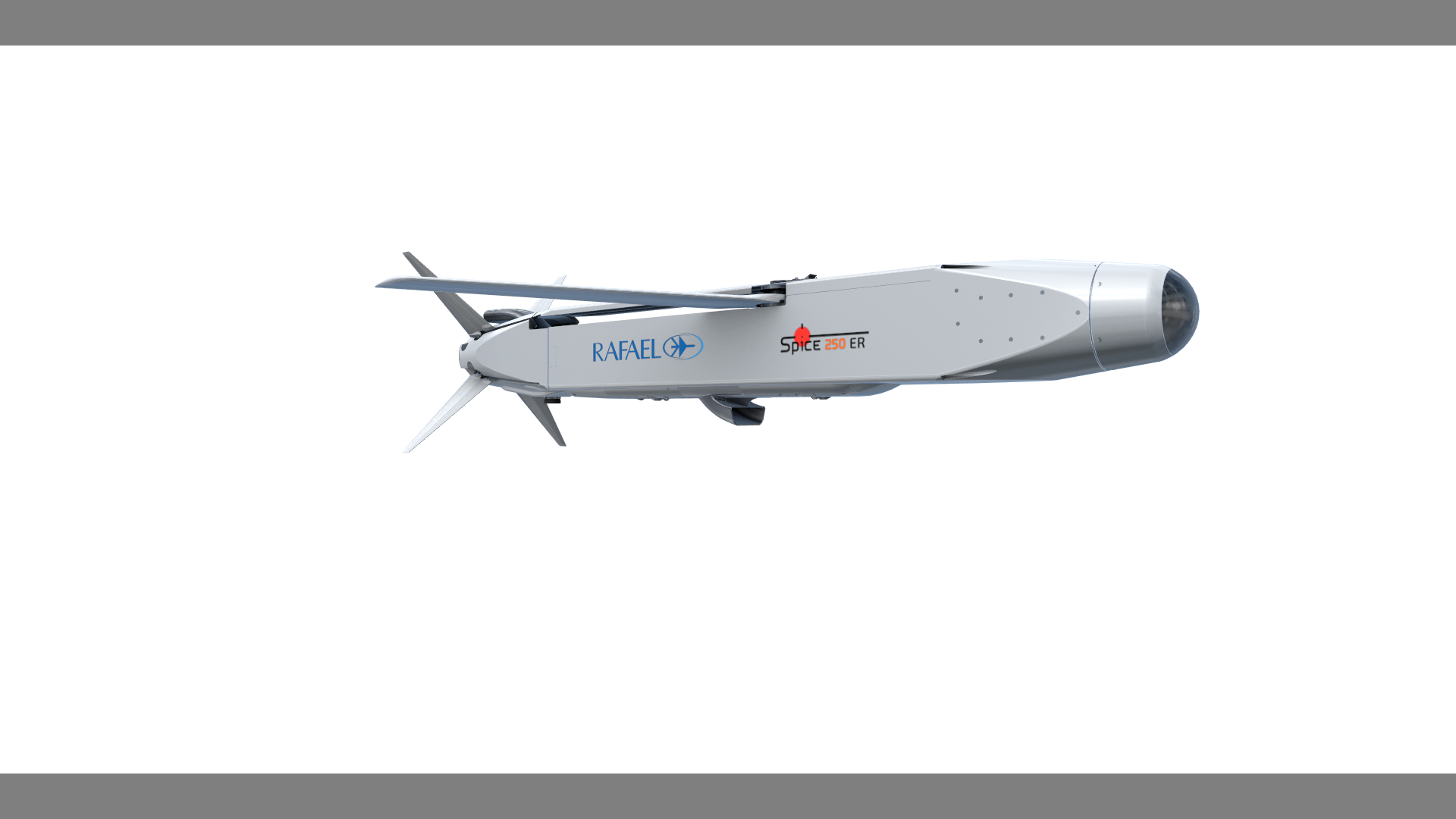
The newest member of the family, the SPICE 250 ER (Extended Range), builds on the smallest SPICE variant, which sits alongside the SPICE 1000 and SPICE 2000 guidance kits. SPICE is designed as a stand-off, autonomous, air-to-surface weapon system that delivers pinpoint accuracy and high attack volumes using its EO, AI-based scene-matching guidance rather than satellite navigation.
To achieve extended reach, SPICE 250 ER adds a miniature turbojet engine and an internal JP‑8/10 fuel system, which pushes its stand-off range to at least 150 km while preserving the same mission-planning tools, aircraft interfaces and cockpit workflows as the baseline weapon. This commonality is intended to reduce integration burden and training costs for operators fielding both gliding and powered variants.[
SPICE 250 employs a common aircraft interface and a Smart Quad Rack (SQR) that simplifies carriage and wiring. It allows four weapons per rack for high load-outs. Owing to its compact size and light weight, the weapon can also be directly mounted on light attack aircraft stations without major structural modifications.
The ER variant retains the same external form factor as the gliding SPICE 250. This allows forces to use existing SQRs and aircraft interfaces with no change in load-out or stores management. It also preserves the full software-defined feature set of the original weapon, including ATR, Automatic Target Acquisition (ATA) and Moving Target Detection homing modes.
Rafael presents the ATR function as a key technological breakthrough because it allows SPICE 250 ER to “pre-learn” target signatures using AI and deep-learning before launch. Prior to or during flight, operators can define target type, location and strike parameters for each weapon either via automated mission-planning tools or manually from the cockpit.
In flight, the weapons initially navigate using their inertial navigation systems toward the designated target area. As they close in, ATA and ATR modes take over to detect, recognize and refine the aim point, with each munition homing on its assigned target either autonomously or under human-in-the-loop supervision supported by the ATR algorithms.
Rafael positions the combination of dense load-outs, multiple homing modes and extended range as a way to deliver high-volume, autonomous precision strikes against diverse target sets while maintaining strict limits on collateral damage. The company also emphasizes the system’s cost-effectiveness and notes that SPICE is already in operational service with several international customers.