

GeoAI and robotics have been rewriting how the world sees, maps and manages physical infrastructure. Pittsburgh has positioned itself as one of the places where that transformation has already become real.
By: Dawn Zoldi
Pittsburgh has already begun its next industrial revolution. The story is being written in pixels, point clouds and precise coordinates, as geo-enabled robots and autonomous systems move from research labs into streets, factories and critical infrastructure. The city’s GeoAI ecosystem is emerging as both the test bed and the blueprint for what comes next.
Pittsburgh’s GeoAI Moment
Pittsburgh has already evolved from a steel town to a robotics powerhouse, anchored by Carnegie Mellon University, the University of Pittsburgh, and a dense cluster of startups, scale-ups, and global firms. Now that ecosystem sits squarely at the intersection of geospatial technology, automation and spatial computing, with GeoAI providing the common language between maps, machines and markets.
At GeoBuiz 2026, the GeoAI, Robotics, and Autonomous Operations Executive Leadership Roundtable panels described GeoAI as “the connective tissue” linking geospatial data producers to the robotics community that increasingly relies on that data to operate safely and at scale. That framing puts Pittsburgh at the center of a much larger conversation about how to commercialize geo-enabled autonomy across infrastructure, defense, urban planning and logistics.
GeoAI: The Nervous System for Robots That Fuels Markets

GeoAI, broadly defined, fuses location-aware data with advanced analytics so autonomous platforms know where they are, what surrounds them and how environments change over time. In practice, that means better routing, higher-fidelity digital representations of critical assets, and faster, more defensible decisions for asset owners, public agencies and operators in the field.
Roundtable speakers stressed that the technology is no longer the bottleneck. “The question is not whether GeoAI works,” one leader noted, “it’s whether we can line up capital, customers, and standards fast enough to keep up with what the technology is already capable of doing.” That shift from “if” to “how fast” drives new urgency around standards, data governance, workforce readiness and cross-sector partnerships.
Nowhere is that urgency more visible than in Pittsburgh’s commercialization engine. Carnegie Mellon’s Robotics Institute and Pitt’s Intelligent Systems programs anchor a broader innovation hub that includes the Pittsburgh Robotics Network, the Pittsburgh Technology Council, Innovation Works and a growing mix of homegrown startups and global companies. This network gives founders working on mapping, sensing and autonomy an immediate on-ramp to customers, mentors and investors.
At Innovation Works’ Robotics Factory, for example, early-stage companies are trying to turn advanced sensing, mapping and autonomy capabilities into sustainable businesses, not just pilots. University of Pittsburgh’s business and innovation programs, panelist Chris Barlow emphasized, are not only training future talent but “building bridges between researchers, entrepreneurs, and investors” so promising GeoAI concepts do not stall at the prototype phase. Together, these efforts are turning Pittsburgh into what one participant called “a living lab for geo-enabled robotics.”
Real-World Missions With Real Stakes, High Impacts

The roundtable kept circling back to deployment: what it takes to move from bespoke demonstrations to repeatable, revenue-generating operations in high-consequence environments. Examples ranged from automated inspections of runways and bridges to persistent mapping for defense installations and complex urban corridors.
Speakers highlighted how high-resolution 3D models and change detection algorithms can replace manual “windshield surveys” for infrastructure, allowing authorities to spot hairline pavement cracks, structural distress or encroaching vegetation long before they become safety issues. In defense and public safety contexts, geo-enabled robotic systems offer something similar: persistent, sharable situational awareness that can be fed into command centers, mobile devices and autonomous platforms without re-creating the same base maps over and over again. As one participant observed, “Once you get the data, it’s great—but what matters is how fast you can get it to where it needs to be.” Success is less about any single robot or sensor and more about the pipelines that move trustworthy data from edge to enterprise.
With more sensors, cameras, robots and vehicles instrumenting the physical world, the roundtable also tackled public trust and governance head-on. Several speakers warned that data-rich environments can quickly feel dystopian if agencies and companies fail to explain what they are collecting, why it matters and how it is protected. “If you can help me get through security faster, monitor me all you want,” one participant quipped, “just don’t use images of me in ways I never agreed to.”
Those concerns are amplified by national security debates over foreign-made components, cloud dependencies and the potential for sensitive infrastructure data to end up in the wrong hands. “It’s not just what the sensor sees,” a panelist with a legal background noted. “It’s where that data goes besides where you think it’s going.” For Pittsburgh’s ecosystem, that means grappling with procurement rules, data localization requirements and “made in USA” preferences at the same time that startups are trying to scale quickly.
The panelists agreed that narrative work is just as critical as technical work. Communicating tangible benefits such as fewer lane closures, safer bridges, faster emergency response and more resilient utilities, helps move the public conversation from fear of being “the product” toward an understanding of shared value.
Setting the Stage for June 2026
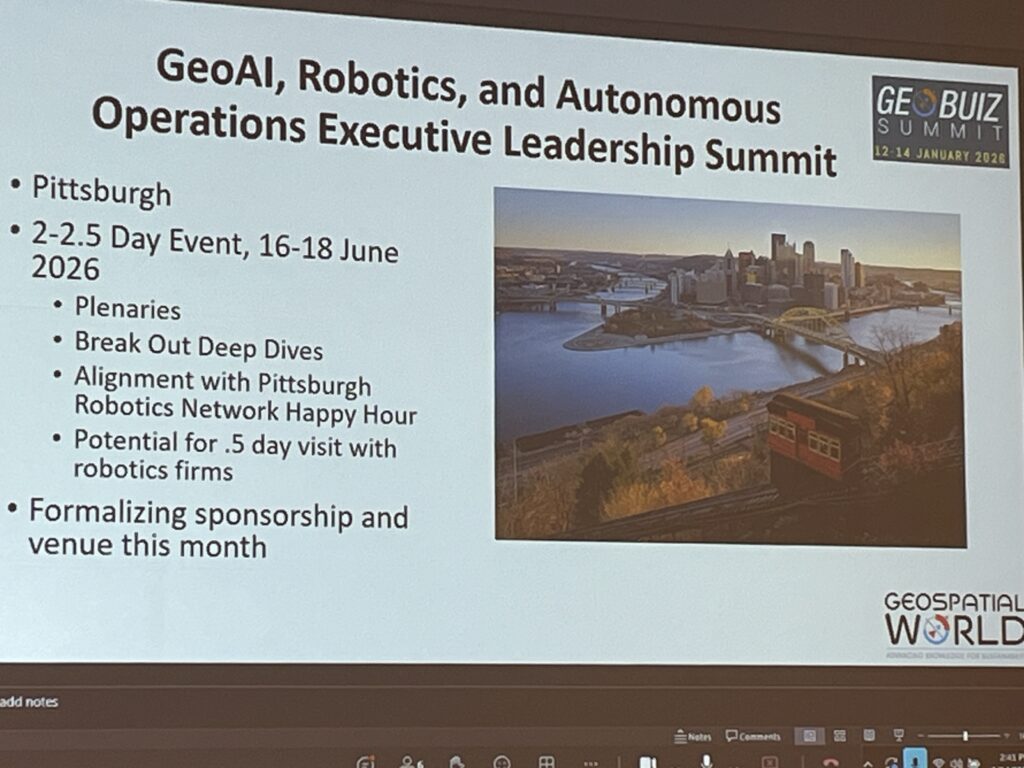
The conversation in Denver was only the beginning. Those themes will carry directly into the GeoAI, Robotics, and Autonomous Operations Leadership Summit, scheduled for June 16–18, 2026, at a Pittsburgh conference venue, with a welcome reception on June 15 that doubles as a showcase for the city’s robotics ecosystem. Rather than a series of slide decks, the roundtable emphasized candid dialogue among leaders from academia, startups, established industry and government on commercialization pathways, standards, ethics and communications. Those same themes will shape the Pittsburgh summit, on a bigger stage, and where the next chapter of geo-enabled autonomy starts to be written.
Planned keynotes from CMU, Pitt, NVIDIA and regional robotics companies, combined with site visits, will highlight how laboratories, investors and public agencies are already collaborating on geo-enabled robotics, and how that model can be replicated elsewhere. “If Pittsburgh’s next act is to lead on geo-enabled autonomy,” one participant remarked, “these conversations are where that script is being written.”
Pittsburgh is not just another tech hub. It has become a reference architecture for how GeoAI, robotics,and autonomous operations can move from promising prototypes to market-ready, mission-critical solutions. If Pittsburgh’s next act is to lead on geo-enabled autonomy, these conversations are where that script is being written.
Learn more about the GeoAI, Robotics, and Autonomous Operations Leadership Summit.