

By: Dahlia Kopycienski
At the world’s busiest gateways, behind the scenes, high‑fidelity geospatial data, live sensor feeds and drone‑enabled 3D models have evolved airports and ports into deeply digital operating environments. Spatial intelligence, rather than gut instinct, informs every passenger journey, cargo move and maintenance decision. Here’s how.
A New Operating System for Global Gateways
Airports and seaports have become highly instrumented, constantly evolving digital systems. At Denver International Airport (DEN), at major U.S. hubs like the Dallas Fort-Worth area (DFW) and across research programs in Michigan and Europe, geospatial platforms, real‑time sensing and high‑fidelity 3D models define critical infrastructure planning, maintenance and security. Operations teams rely on this type of usable “digital campus” everyday, from shaving minutes off passenger journeys and spotting hairline cracks before a runway fails to understanding how drones, air taxis and counter‑UAS systems fit into an already crowded air and maritime picture.
Inside Denver’s “Digital Airport Campus”
At Denver International Airport, geospatial data has moved from a back‑office reference layer to a frontline operational system. Chelsea Seiter‑Weatherford, the Geospatial Supervisor at DEN, explained how her team maintains the authoritative geodatabase for the airfield, from runways and taxiways to complex airspace surface models that guide planners and pilots in what can be built and where.

Rather than chasing a single monolithic “digital twin,” DEN is building a federated digital airport campus. Indoor mapping platforms aggregate architectural and space data to give planners and operations a shared spatial view of the terminal environment. Enterprise integrations link GIS with systems like Genetec (cameras), Maximo (asset management), and Velocity (airfield inspections) turn maps into live operational canvases instead of static viewers. Airspace surface analysis is fully digitized, with each of DEN’s 12 runways and six planned future runways modeled across about 30 regulatory surfaces and exposed through interactive maps to internal and external stakeholders.
“We’re not trying to build one digital twin,” Seiter‑Weatherford explained. “It’s multiple different systems that show a digital environment of the airport that helps certain teams and departments do the work they need to do, whether it’s operations, finance, space planning or wayfinding.”
That environment is increasingly “real time.” For example, sensors and lidar equipped cameras track how long it takes a passenger to drop a bag, clear TSA, board the train and reach a concourse to inform staff about whether a 50‑minute journey signals a design or flow failure. On the landside, DEN also instruments Peña Boulevard, the airport’s only major access artery, to distinguish true airport traffic from local through‑traffic and feed that situational picture into planners’ and executives’ geospatial tools.
Drones as a New Spatial Layer
Panelist Dawn Zoldi, CEO of P3 Tech Consulting and Publisher at Autonomy Global, noted that whereas traditional GIS “comes from space,” drones have become a new contextual layer that connects airside, landside and regional operations. At airports like DFW, drone‑enabled mapping and inspection missions generate 3D models and orthomosaics of flight lines, flight paths and critical infrastructure, which are then fused into GIS to support responders, engineers and planners. (See prior AG coverage of GIS at DFW).
Those same aircraft are also stress testing the next generation of low‑altitude traffic management. Around DFW, an industry‑led ecosystem, spanning Wing and other drone delivery companies, public safety agencies and airport stakeholders, has been running full‑scale operational evaluations of drone deliveries and other beyond visual line of sight (BVLOS) missions for roughly two years.
Because conventional air traffic control systems cannot scale to “hundreds of thousands” of low‑altitude drone flights, this ecosystem is piloting Uncrewed Traffic Management (UTM), shared digital services where operators exchange airspace intent, constraints and tactical updates below traditional controlled altitudes. “They’ve already created a mini [UTM] out there in the Dallas–Fort Worth area,” Zoldi said, “and they are communicating with each other, the DFW airport and using all this data.”
Looking ahead to mega‑events like the 2028 Los Angeles Olympics, the same convergence of GIS, drones and low‑altitude traffic management will collide with heightened security demands. Zoldi pointed out that substantial federal funding is already being steered toward digital infrastructure, especially counter‑UAS capabilities and UTM‑like services. (See prior AG coverage relating to emerging digital infrastructure needs).
Digital Twins That Find Cracks Before Failure
If airports are cities, they are also testbeds for ultra‑precise sensing. At the Michigan Tech Research Institute (MTRI), Richard Dobson and his team treat digital twins as decision tools that focus on phenomenology: what needs to be detected, at what resolution and for whom.
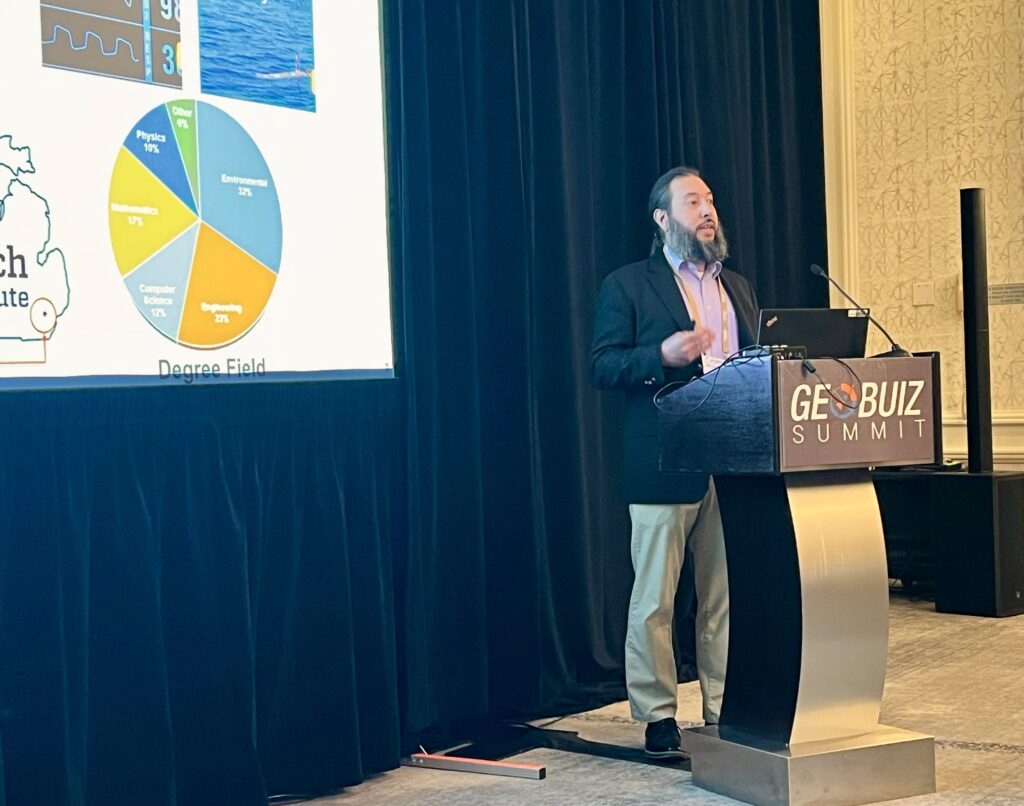
In FAA‑sponsored work on airport pavement inspections, MTRI replaced the traditional “two people in a van” method with drone‑enabled remote sensing. Entire runways and ramps were captured as 3D models at resolutions down to one millimeter, resolving hairline cracks as fine as one‑eighth to one‑sixteenth of an inch. Automated analytics then scanned these models to identify cracking and spalling, flagging precise locations for maintenance teams.
The same approach extended to bridges in a multi‑year Michigan DOT program. MTRI created full 3D models of bridge decks, piers and interiors using RGB photogrammetry, then fused thermal imaging to detect delaminations, air gaps forming on rebar that signal future potholes and structural failures. Collecting thermal data during known heating and cooling cycles allowed the team to spot subtle temperature differentials, which turned invisible defects into mapped, actionable features.
Digital twins also power simulation. At the American Center for Mobility in Michigan, MTRI built a high‑fidelity 3D model of an entire test track and used it to run autonomous driving simulations, populating virtual roads with simulated vehicles so autonomy stacks can be tested against realistic scenarios without putting human drivers at risk.
Across these use cases, Dobson emphasized that the hard work begins after the data is collected: aligning coordinate systems, harmonizing scales, integrating with other real‑time feeds and, most importantly, getting the right information to decision‑makers in usable forms.
Ports, People and the Politics of Data

Many of the same digital patterns playing out at airports are emerging in ports. Logistics operators have mastered the art of moving cooperative cargo, containers that behave predictably, but cruise terminals and passenger ferries add the unpredictability of human movement. Spatial intelligence becomes essential to modeling and managing those flows, whether on a crowded terminal curb or a congested harbor channel.
At DEN, lidar‑enabled cameras and sensors are used to understand how crowds actually move. This reveals where construction walls create bottlenecks and where better signage or rerouting might minimize friction. On the curb and approach roads, traffic sensors distinguish airport‑bound vehicles from local traffic that “uses Peña and then gets off on an exit,” shaping infrastructure investment decisions.
Zoldi’s response, “That sounds dystopian,” captured a tension that runs through nearly every smart airport and smart port initiative. That tension is intensifying as powerful “enterprise AI” concepts emerge. Zoldi described a CES keynote in which a personal pendant and device ecosystem captured everything a user sees and hears, aggregating data from phones, wearables and PCs into what the vendor called a “super AI.” For airports and ports already swimming in camera, sensor and drone feeds, questions about who owns the data, how long it is stored and where else it may be going are important issues that must be addressed.
National security overlays compound this data complexity. Recent U.S. policy moves, from Coast Guard notices about foreign‑made port equipment to Federal Communications Commission actions limiting approvals for foreign drones and components, continue to reshape procurement choices for airports, ports and law enforcement agencies. At the same time, very few domestic platforms are entirely free of foreign components, which creates tension between policy intent and operational reality.
Earning Trust in a Sensor‑Saturated World
Against this backdrop, the panelists converged on the fact that spatial intelligence can only scale if the public trusts how it is used. “We’re the product now,” Dobson observed, citing commercial real estate operators who track shoppers in stores and the broader sense that “we’re just being monitored.”
For front‑line practitioners, the most effective path has often been radical transparency. Dobson recounted early days flying drones in 2011, when the word “drone” evoked armed Predators, not inspection tools. When confronted by skeptical residents, sometimes even threatened, he would explain, in concrete terms, that he was working with the state DOT to inspect a specific bridge and that the resulting data would go directly into planning and budgeting to fix infrastructure they used every day. Once framed as a public‑good project, conversations shifted from suspicion to curiosity.
Zoldi argued that the industry must also “cross the Rubicon” into mainstream storytelling. Her Dawn of Autonomy podcast and reporting work often reaches professionals already immersed in autonomy. The general public rarely sees the positive side of drones, ports and geospatial systems outside occasional stories about pandemic‑era deliveries or novelty demonstrations. She envisions a more accessible, narrative‑driven mainstream approach that brings real‑world use cases to wider audiences and demystifies the technology.
Airports and ports racing to digitize with spatial intelligence, digital twins and drone‑enabled sensing must deploy these tools with equal attention to governance, transparency and communication if they are to deliver not just smarter infrastructure, but also more confident communities.
Real-World Use Cases: From Runways to Bridges
- Airport operations: GIS has moved from as a back-office viewer to an operational system integrated with camera platforms, asset management, and inspection tools. High-precision maps of runways, taxiways, and airspace surfaces are now available to internal and external stakeholders, guiding everything from building siting to maintenance planning.
- Drone-enabled inspections: Researchers shared work on drone-based pavement inspection, generating 3D models of entire runways at resolutions down to a millimeter to detect hairline cracks and spalling. Automated analytics then scan these dense point clouds to flag defects that feed directly into budgeting and repair workflows.
- Bridge health and transportation assets: Similar techniques are being applied to bridges, where optical, thermal, and elevation data are combined to detect delamination, spalling and other failure indicators before they become safety hazards. In transportation-heavy states with notoriously rough roads, this story resonates with the public once framed in terms of “fixing this bridge for you.