
By: Dawn Zoldi
At GBEF EDGE 2026 in Las Vegas, in a powerful keynote, retired Maj. Gen. John “JO/Sprocket” Olson (USAF Ret.) issued a national technology launch sequence. To win across the various contested domains, from AI and autonomous systems to cislunar space and beyond, demands that the United States decide, now, whether it intends to lead.

From “Midnight Hammer” To Moonshots
Olson framed the stakes through the kind of mission that never makes the highlight reels: a nearly 40‑hour global sortie, supported by aerial refueling and thousands of airmen and guardians, flown to ensure nonproliferation of weapons of mass destruction. It was, he argued, the product of a deeply integrated industry‑government team that practiced, tested and validated a complex kill chain until it worked “flawlessly.” That operation, codenamed “Operation Midnight Hammer,” served as both a metaphor and warning. Freedom, Olson reminded the Vegas audience, “is not free.” Neither is technological leadership in an era when innovation cycles have compressed from years to weeks on the modern battlefield.
The New High Ground: Space, AI And Autonomy
Olson sees 2026 as an inflection point when leadership in aerospace, AI, data, quantum, advanced energy, materials and synthetic biology will set global trajectories for centuries, not decades. Every one of those domains increasingly relies on autonomous systems and intelligent, networked platforms at scale.
He pointed to a near‑term calendar that looks more like a mission manifest than a news cycle:
- The first time any nation returns humans back around the Moon in the Artemis II timeframe of February 2026.
- Blue Origin’s planned Mark-1 lunar lander mission, Dream Chaser’s first orbital mission as a lifting‑body cargo vehicle, and large‑scale on‑orbit Starship refueling series of mission demonstrations – all in 2026.
These milestones, Olson argued, are not isolated space “events” but the early stages of an operational cislunar architecture that will depend on autonomous proximity operations, AI‑driven traffic management, in‑space logistics, and resilient, software‑defined communications.
War, Autonomy And The Speed Of Need

If space is the high ground, Ukraine is the live‑fire laboratory. Olson underscored that almost four years of conflict have revolutionized how quickly militaries learn, iterate and scale new technologies, especially drones and first‑person view (FPV) systems. Innovation cycles that once ran on roughly two‑year increments have collapsed to two months or even two weeks, with affordable, attritable systems and mass “proving that quantity has a quality all its own.”
Those dynamics translate directly into an autonomy imperative:
- Multi‑domain, AI‑enabled systems must be responsive, ready, reliable, repairable, relocatable, reconfigurable, and resilient by design, not as an afterthought.
- “Good enough today” beats a perfect solution that never gets to the field. Winning now depends on operationalizing autonomy at the “speed of need and relevance.”
Olson warned that U.S. strategists cannot afford to build for the last war while adversaries race to the future operate under total‑war paradigms, with industrial bases mobilized for conflict and few ethical constraints on how emerging technologies are applied.
Quad Security And The Architecture Of Trust
For Olson, technology leadership is not just a defense narrative. He described a “quad security” model – economic, health, environmental, and national security – that is interdependent, synergistic and symbiotic. Covid‑19, he noted, humbled both global economies and militaries, just as cheap CRISPR tools and synthetic biology now introduce new bio‑threat vectors even as they promise breakthroughs in personal and population health.
In that context, autonomy and AI must be embedded inside a broader architecture of truth, trust, transparency, and timeliness if they are to deliver a durable advantage. Olson flagged:
- Strategic AI trends from multi‑agent systems and “AI legions of agents” to low‑level inference performance and hallucination rates acceptable for critical mission systems.
- The convergence of physical AI – robotics and humanoid systems – with cyber capabilities, producing predictive and preventative cybersecurity, maintenance, and systems integration that spans both digital and physical platforms.
Autonomous systems, in Olson’s view, sit at the junction of these trends, acting as both sensor and effector across space, air, land, sea and cyber, with AI providing the cognitive layer that fuses data and orchestrates action.
Space Preeminence, People Power
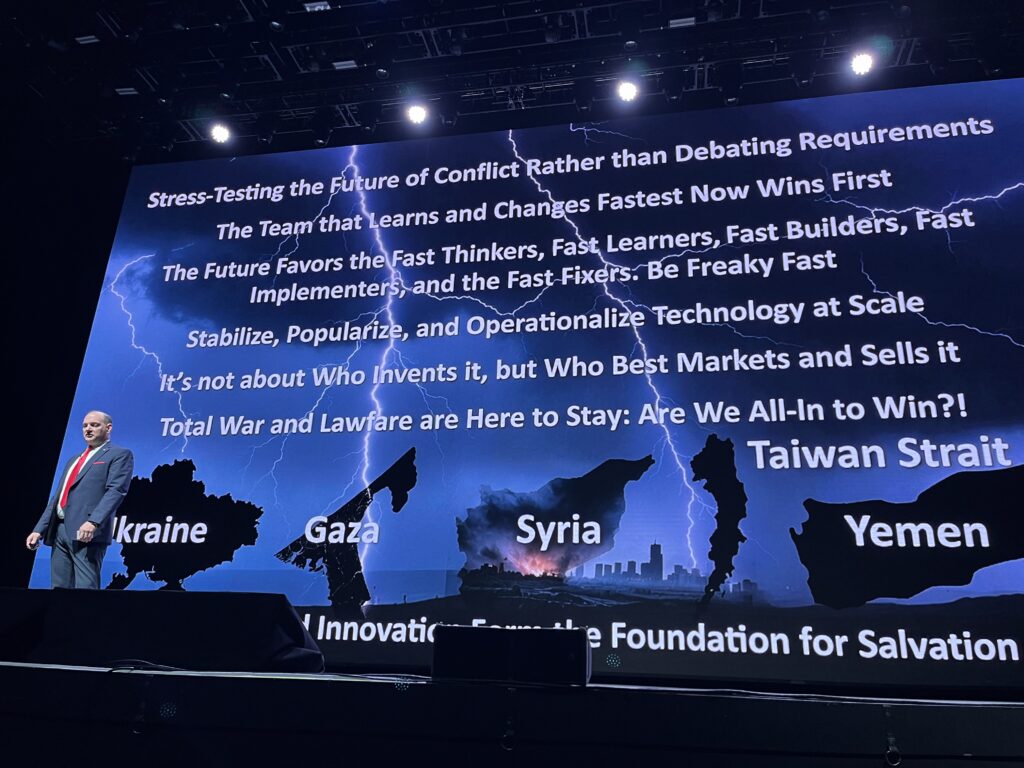
Olson’s space credentials are not abstract; as Mobilization Assistant to the Chief of Space Operations, he helped stand up the U.S. Space Force, the nation’s smallest service, but the one with the largest area of responsibility. He was also the first Department of the Air Force Chief Data and AI Officer with a mission to operationalize AI for the Air Force and Space Force, so these are important operational realities for him. He outlined that space missions require smart human-machine integration, deft technology application as a force multiplier, and responsive use of AI and automation to meet mission demands. He also highlighted the civil space applications and highlighted the International Space Station’s 25 years of continuous human presence in orbit as a foundation for what comes next, not a capstone for the past.
Looking ahead, he argued that U.S. grand strategy must shift from an Earth‑centric to a Moon‑inclusive focus, treating lunar and cislunar operations as an imperative, not a luxury. That includes:
- Building sustainable, scalable architectures from low Earth orbit (~250 miles) to geosynchronous orbit (~22,300 miles) and out to the Moon (~234,000 miles) and Mars (~34 million miles).
- Pursuing “preeminence, not dominance” in space through partnerships, prosperity, and shared benefit, even as competitors move aggressively to secure strategic positions.
Yet Olson was emphatic that even in an age of AI, robotics, quantum sensing and next‑generation energy systems, the future remains “people-powered and purpose-driven.” Space, AI and autonomy may define the technical battlespace, but it is the integrated community of industry, government, academia and students – “the right people, at the right place, at the right time, with the right skills and experience” – that will decide whether America wins tomorrow.
For Autonomy Global’s ecosystem of builders, operators, and policymakers, Olson’s message lands as both challenge and invitation. 2026 is not just another year on the conference circuit. It is the opening phase of a multi‑domain race where autonomy, space and AI will determine who sets the rules for the next century.